
TX HHS Form 8577. Questionnaire for LTSS Waiver Program Interest Lists
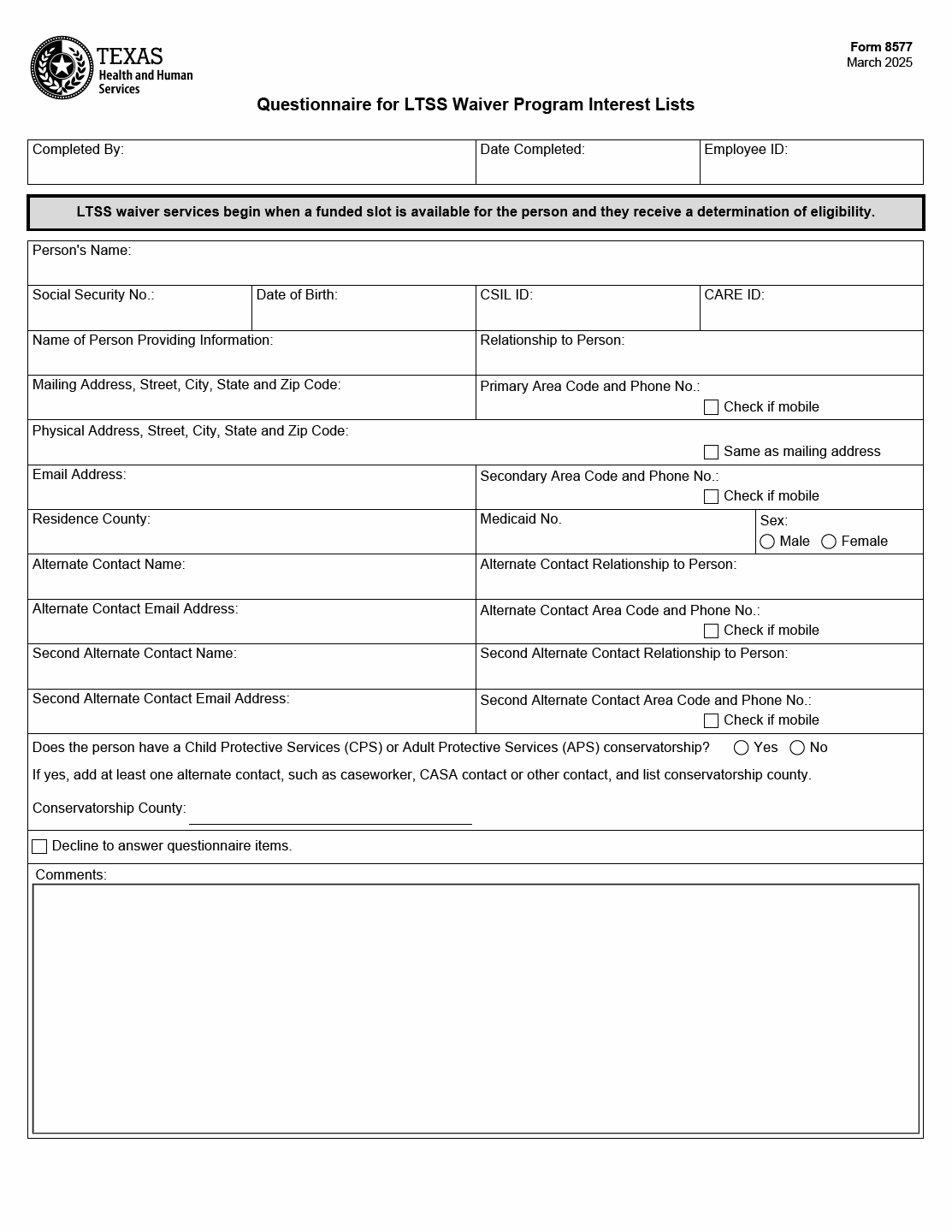
Form 8577 is a questionnaire designed to gather information about individuals interested in Long-Term Services and Supports (LTSS) waiver programs. It helps assess eligibility, needs, and placement on interest lists for services that support people with disabilities or chronic conditions in community settings rather than institutions.
Purpose of the Form
The primary purpose of Form 8577 is to collect detailed personal, medical, and support-related information from individuals or their representatives to determine interest and potential eligibility for LTSS waiver programs. These programs provide home and community-based services to help people with intellectual, developmental, or physical disabilities live independently or with support, avoiding institutionalization. The form is used to build interest lists, where services begin once a funded slot becomes available and eligibility is confirmed. It ensures that resources are allocated based on need, health conditions, and living situations.
Who Uses the Form
This form is typically completed by individuals seeking LTSS waiver services, their family members, guardians, caseworkers, or representatives from organizations like the Texas Health and Human Services Commission (HHSC) or Local Intellectual and Developmental Disability Authorities (LIDDA). It is also used by staff from agencies such as Aging and Disability Resource Centers (ADRC), Area Agencies on Aging (AAA), or Department of Family and Protective Services (DFPS). Professionals in healthcare, social services, or protective services may fill it out on behalf of the person, especially if the individual has conservatorship through Child Protective Services (CPS) or Adult Protective Services (APS).
When and Why the Form is Applied
Form 8577 is applied when someone expresses interest in LTSS waiver programs, such as Home and Community-based Services (HCS), Texas Home Living (TxHmL), Community Living Assistance and Support Services (CLASS), or Medically Dependent Children Program (MDCP). It is needed in situations where an individual requires long-term support due to disabilities, chronic illnesses, or aging-related needs. Common scenarios include transitioning from institutional care (e.g., nursing facilities or state hospitals) to community living, losing current caregiver support, or needing assistance with daily activities. The form helps prioritize individuals on waitlists based on urgency, ensuring services promote health, welfare, and independence.
Sections and Data Requested
The form is divided into an introductory section for basic information, followed by 20 numbered questions covering diagnoses, living arrangements, needs, and barriers. It requests comprehensive data to paint a full picture of the person's situation.
Introductory Section
This section captures administrative and contact details:
- Completed By: Name of the person filling out the form.
- Date Completed: Date the questionnaire is filled.
- Employee ID: Identifier for staff completing the form.
- Person's Name: Full name of the individual interested in services.
- Social Security No.: Social Security number for identification.
- Date of Birth: Birth date to determine age-related eligibility.
- CSIL ID and CARE ID: Specific identifiers for tracking in state systems.
- Name of Person Providing Information and Relationship to Person: Details on who is supplying the info (e.g., self, parent, guardian).
- Mailing Address and Physical Address: Street, city, state, zip code; option to mark if same as mailing.
- Primary and Secondary Phone Numbers: Area code and number, with checkboxes for mobile.
- Email Address: For communication.
- Residence County: County where the person lives.
- Medicaid No.: Medicaid number for eligibility checks.
- Sex: Male or Female.
- Alternate Contacts: Up to two alternate contacts, including name, relationship, email, phone (with mobile checkbox).
- Conservatorship: Question on CPS or APS conservatorship (Yes/No/Decline); if yes, requires at least one alternate contact (e.g., caseworker) and conservatorship county.
- Comments: Space for additional notes.
Questions 1-5: Diagnoses and Health Conditions
These questions focus on intellectual, developmental, sensory, medical, and behavioral health issues:
- Question 1: Diagnosis of intellectual or developmental disability before age 18 (Yes/No/Unknown); list diagnoses.
- Question 2: Developmental disability before age 22 (Yes/No); checkboxes for conditions like Autism Spectrum Disorder, Cerebral Palsy, Down Syndrome, Traumatic Brain Injury, or Other/Unsure (with explanation).
- Question 3: Vision or Hearing Impairment (separate Yes/No for each).
- Question 4: Chronic medical condition (Yes/No); checkboxes for Seizures, Diabetes, Heart Disease, etc., or Other; hospitalizations over five in past 12 months (Explain).
- Question 5: Mental or behavioral health diagnosis (Yes/No); checkboxes for ADHD, Anxiety, Bipolar, Schizophrenia, etc., or Other/Unsure (with explanation).
Questions 6-10: Living Arrangements and Support Stability
These assess current living situation and potential risks:
- Question 6: Current living arrangements; options like living alone with/without caregivers, with family, in facilities (e.g., ICF/IID, nursing facility), or Other; age range of main caregiver if applicable.
- Question 7: Risk of losing caregiver supports (Yes/No; Explain).
- Question 8: Desire to live independently (Yes/No).
- Question 9: Backup plan if caregiver/living arrangement is lost within next year (Yes/No; Explain).
- Question 10: Need for assistance with current living arrangement (Yes/No); checkboxes for minor home modifications, new arrangement, or Other.
Questions 11-17: Assistance Needs
These detail specific support requirements:
- Question 11: Help with personal care tasks (Yes/No); checkboxes for Hygiene, Toileting, Dressing, Meal Preparation, Feeding, or Other.
- Question 12: Help with communicating (Yes/No); checkboxes for Assistive technology, Communicating with others; methods like Braille, Sign Language, or Other; sub-areas like Comprehending, Listening, Speaking.
- Question 13: Help with walking/mobility (Yes/No); checkboxes for Total physical assistance, Mobility device, Supported guidance, or Other.
- Question 14: Barriers to accessing services (Yes/No); sub-A: checkboxes for Transportation, No services in area, Financial limitations, Rural area, or Other; sub-B: access to transportation options like Family, Public, Personal vehicle, or Other.
- Question 15: Community integration assistance (Yes/No); checkboxes for Shopping, Socialization, Skills training (Explain type), or Other.
- Question 16: Life skills training (Yes/No; Explain type, e.g., time management, budgeting).
- Question 17: Employment/vocational services (Yes/No); checkboxes for Basic job skills, Finding a job, On-the-job training, Skills training (Explain).
Questions 18-20: Current Services and Urgency
These cover existing supports and timing:
- Question 18: Current community services; checkboxes for None, Emergency Response Services, Home-Delivered Meals, LIDDA, Unpaid caregivers, or Other/Unknown.
- Question 19: Opinion on when waiver services should begin (e.g., within 3 months, 6 months, year, or Other).
- Question 20: Additional comments.
Referral Section
At the end, it lists referrals made to programs or agencies like ADRC, AAA, LIDDA, CLASS, HCS, MDCP, etc.; section completed by HHSC or LIDDA staff.
Requirements for Completing the Form
The form must be completed accurately and thoroughly, as incomplete information may delay placement on interest lists or eligibility determination. If conservatorship is involved, at least one alternate contact must be provided. Responses should be based on known facts; "Unknown" or "Unsure" options allow for uncertainty, with explanations required. The form emphasizes checking all applicable boxes and providing details in explanation fields to ensure a comprehensive assessment. It is typically submitted to HHSC or related authorities in Texas.
Situations Where the Form is Needed
This form is essential in scenarios involving potential loss of independence, such as aging caregivers, worsening health conditions, or transitions from institutional care. It is used for planning community-based supports for children with disabilities (e.g., via MDCP or ECI), adults with intellectual disabilities (e.g., HCS or TxHmL), or those with multiple needs (e.g., DBMD for deaf-blind individuals). It applies during initial interest expressions, annual reviews, or changes in circumstances that heighten urgency for services.
Key Form Details
Name: Questionnaire for LTSS Waiver Program Interest Lists
Number: Form 8577
Region/Organization: Texas Health and Human Services Commission (HHSC)
Edition Date: March 2025