
TX HHS Form 8002. Transportation Log
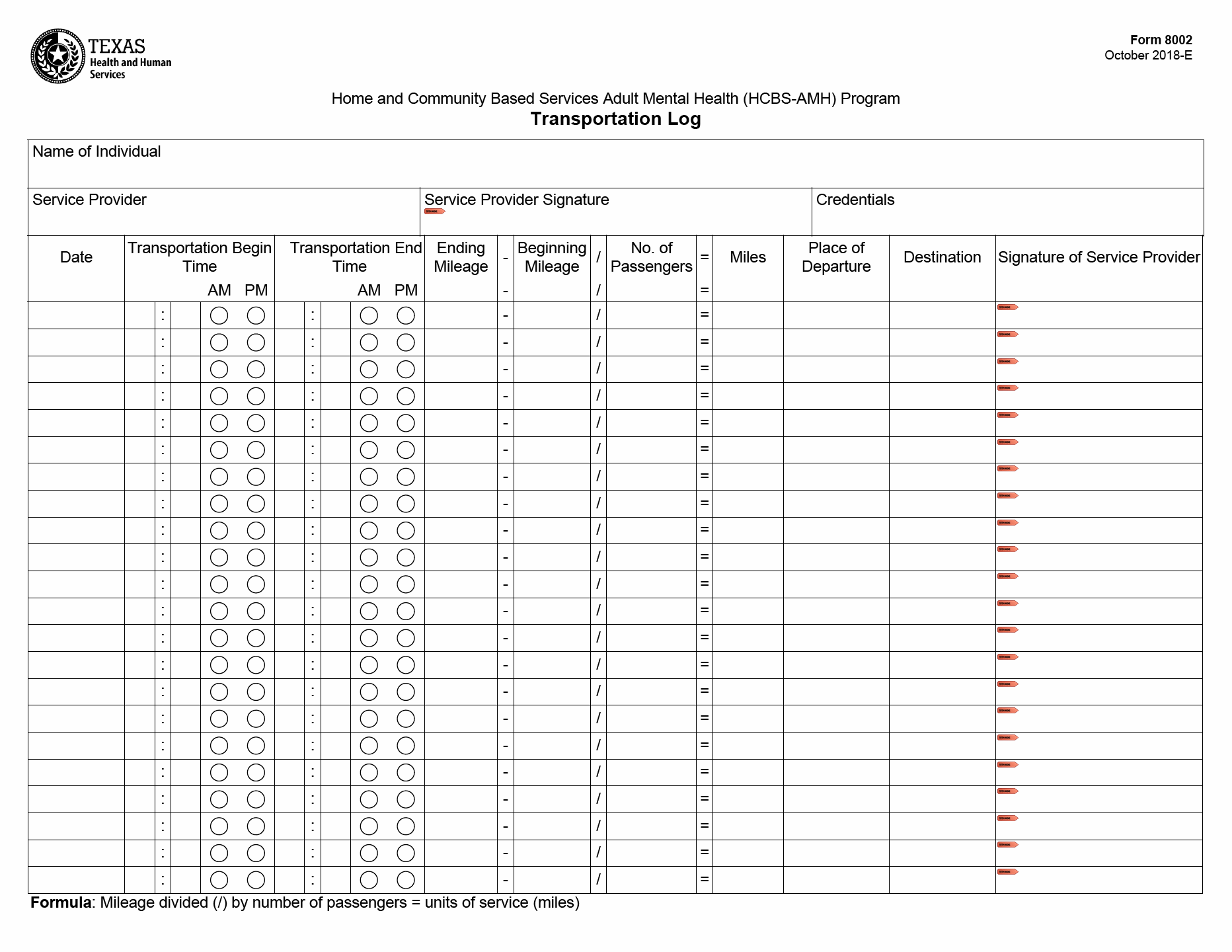
Form 8002 is a transportation log used within the Home and Community-Based Services – Adult Mental Health (HCBS-AMH) Program. Service providers use this document to record each trip completed for an enrolled individual, ensuring accurate reporting, proper billing, and accountability in state-funded mental health support services. Although the form looks simple at first glance, it carries significant administrative and regulatory weight. A correctly completed log protects both the client and the provider by documenting mileage, time, and service delivery details.
Purpose and Function of the Transportation Log
The HCBS-AMH Program offers intensive community-based services to adults transitioning from institutional or crisis care to independent living. Transportation is often a critical part of this support—helping individuals attend medical appointments, counseling, employment programs, or essential community activities.
Form 8002 ensures that every ride is properly documented. State health agencies require this information to verify that transportation services were actually provided, to calculate service units, and to prevent billing inconsistencies. In many cases, an incomplete or inaccurate transportation log can result in denied claims or compliance issues during audits.
Explanation of Key Sections
Name of Individual
This is the HCBS-AMH participant receiving transportation. The name must match the client’s official record exactly—misspellings here commonly result in rejected documentation.
Service Provider and Credentials
This identifies the person who provided the transportation. “Credentials” typically refers to the provider’s job title, certification, or role within the contracted agency—such as “Peer Specialist,” “Recovery Manager,” or “Transportation Aide.” Providers must use their legally recognized credentials to ensure the trip meets program requirements.
Date
The date the transportation took place. Each trip must be logged on the correct service day—filling logs retrospectively is one of the most common compliance errors.
Transportation Begin Time / End Time
Record the exact start and end times. Accurate time entries help verify the reasonableness of the mileage and ensure that providers are actually transporting the client rather than reporting estimated intervals.
Beginning Mileage / Ending Mileage
These odometer readings must be taken directly from the vehicle before and after the trip. Mileage cannot be estimated. Providers must use the same vehicle from start to finish of the trip.
No. of Passengers
This number directly affects billing, since total mileage is divided by the number of passengers to calculate billable units.
Miles (Ending Mileage – Beginning Mileage)
This is the raw distance traveled for the trip. Errors here are frequent—double-check your math before submitting.
Formula for Billable Units
Mileage ÷ Number of Passengers = Units of Service. Accurate passenger count is essential. Providers must include all HCBS-AMH eligible passengers transported on the same trip.
Place of Departure / Destination
Record specific locations, such as “Client’s residence,” “Outpatient Clinic,” or “Pharmacy.” Vague entries like “around town” or “errands” may be rejected during review.
Signature of Service Provider
The form is not valid without the provider’s signature. Electronic signatures are accepted only if the agency’s internal policies allow them; otherwise, a handwritten signature is required.
Common Mistakes to Avoid
- Using estimated times instead of actual times.
- Rounding mileage instead of using exact odometer readings.
- Leaving destination fields too vague.
- Forgetting to record passengers, resulting in incorrect billing units.
- Submitting logs without signatures.
When This Form Must Be Completed
- Every time transportation is provided to an HCBS-AMH individual.
- Whenever mileage is claimed for reimbursement.
- When a provider transports more than one eligible individual on the same trip.
The form is not required if transportation was not provided or if travel was strictly administrative (such as staff commuting).
Who Is Allowed to Complete This Form?
- Authorized HCBS-AMH service providers
- Staff operating under a contracted HCBS-AMH provider agency
- Individuals with approved credentials for delivering transportation services
Required Supporting Documents
- Vehicle logs (if required by agency policy)
- Appointment records or service notes supporting the transportation purpose
- Internal route documentation when transporting multiple clients
Legal and Program Context
The Texas Health and Human Services Commission (HHSC) requires transportation logs as part of program integrity and financial accountability for community-based mental health services. Providers must maintain accurate logs to comply with state audits, Medicaid billing rules, and contract requirements. Incorrect logs may lead to recoupment, corrective action plans, or loss of provider eligibility.
Practical Tips for Filling Out Form 8002
- Keep the form in the vehicle so entries can be made immediately.
- Use exact odometer readings—never estimate mileage.
- Write specific destinations to reduce audit questions.
- Double-check passenger counts before calculating mileage units.
- Sign the form before the end of your shift to avoid missing signatures.
Examples of Real-Life Use
- A client needs transportation from a group home to a psychiatric appointment—provider records start and end mileage, location, and time.
- A peer specialist transports two HCBS-AMH participants to a supported employment orientation; mileage is divided by two passengers for billing.
- A recovery manager drives a client to pick up essential medications; the trip is logged to document service delivery and reimbursement.
- A provider helps a participant attend a mandatory housing meeting—this is logged because it supports the individual’s community integration plan.
FAQ
- Do I need to complete the form for short trips?
Yes. All transportation trips, regardless of distance, must be logged. - Can I combine multiple trips on one line?
No. Each trip must be entered separately to ensure audit compliance. - What if the client cancels mid-trip?
Record actual mileage and note the cancellation in your internal service notes. - Are electronic logs acceptable?
Only if approved by your agency and compliant with HHSC documentation rules. - What happens if I forget to log a trip?
Unlogged trips generally cannot be billed and may create inconsistencies in audit reviews. - Can volunteers fill out this form?
No. Only authorized HCBS-AMH service providers may complete the transportation log. - Do I need to attach GPS printouts?
Only if required by your agency or if requested during an audit.
Micro-FAQ (Short Answers)
- Purpose: To document transportation services for HCBS-AMH clients.
- Who files: Authorized service providers.
- Deadline: Same day as the trip; do not delay entries.
- Attachments: Usually none; depends on agency policy.
- Submitted to: Provider agency for billing and compliance records.
- Units of service: Mileage ÷ number of passengers.
- Required for audits: Yes, logs are reviewed regularly.
- Multiple passengers allowed: Yes, but document each participant.
- Non-client transport: Not billable.
- Signatures required: Always.
Related Forms
- HCBS-AMH Program Enrollment Forms
- HCBS-AMH Service Delivery Log
- Transportation Reimbursement Request Forms
- Community Supports Documentation Sheets
Form Details
- Form Name: HCBS-AMH Program Transportation Log
- Form Number: Form 8002
- Region: Texas
- Edition Date: October 2018