
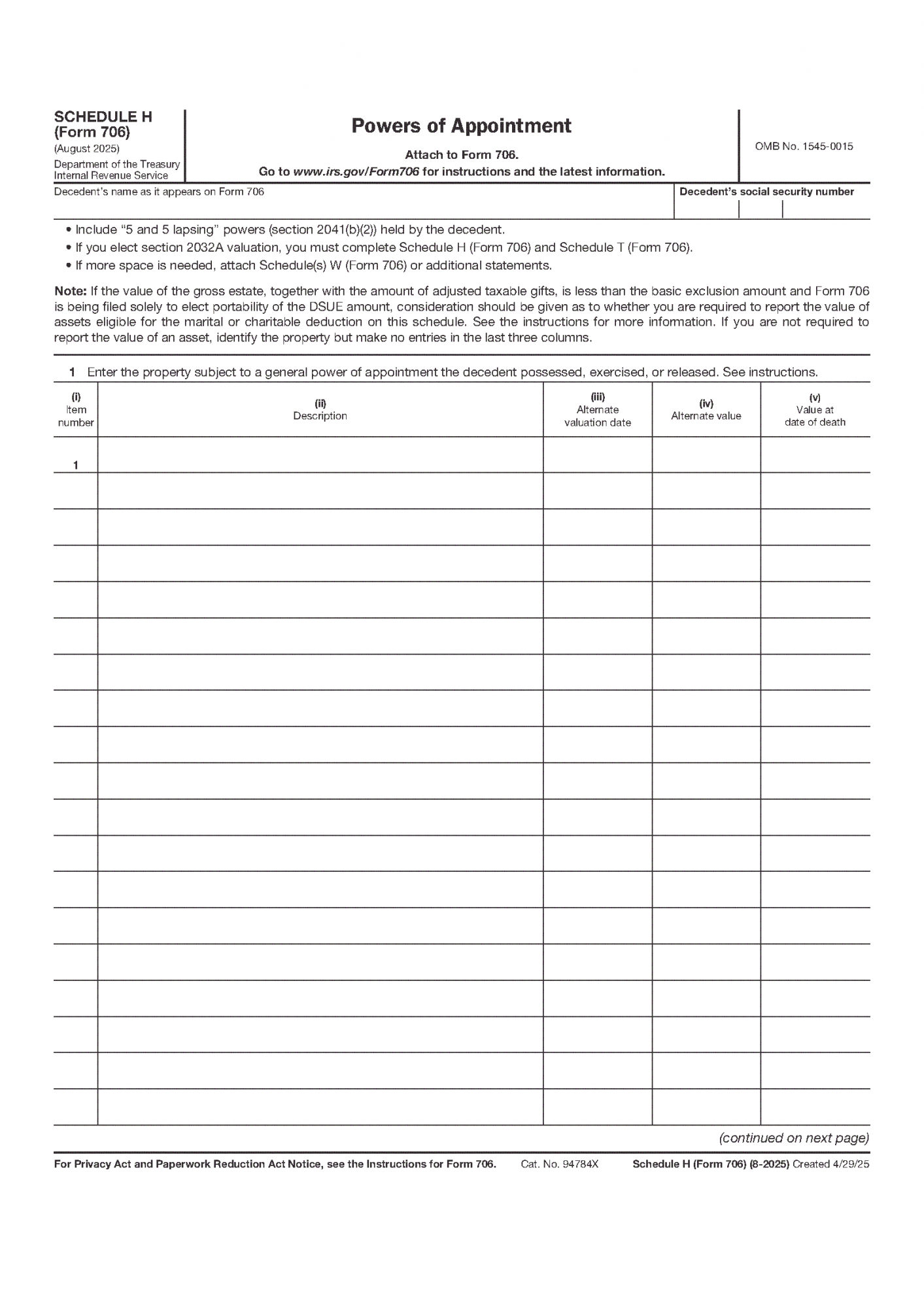
Powers of appointment are included in the Form 706 process when the decedent held legal authority to designate who would receive certain property interests. Within the estate tax system, these powers are treated as a form of control rather than ownership, and their existence at death can cause property to be included in the gross estate even if the decedent never held title to the assets.
Why powers of appointment are evaluated separately
The estate tax system distinguishes powers of appointment because they represent the ability to control the disposition of property. When the decedent held a general power of appointment, the system treats that authority as equivalent to ownership for estate tax purposes, requiring inclusion of the affected property.
The official structure of Form 706 and the placement of each schedule within the return are defined on the IRS Form 706 document page.
When a power of appointment causes inclusion in the estate
Property is included in the gross estate when the decedent held a general power of appointment at the time of death. This includes powers exercisable in favor of the decedent, the decedent’s estate, creditors, or creditors of the estate. Limited or special powers of appointment are evaluated differently and may not result in inclusion.
The determination focuses on the scope of authority held at death rather than whether the power was exercised.
Valuation of property subject to a power of appointment
For estate tax purposes, property subject to an includible power of appointment is valued based on its fair market value as of the date of death or an alternate valuation date when applicable. This value is included in the gross estate as if the decedent owned the property outright.
The inclusion of such property can significantly affect the estate’s overall tax position.
Interaction with deductions and later stages
Property included through powers of appointment may be affected by deductions or exclusions applied later in the Form 706 process, such as marital or charitable deductions, depending on how the property ultimately passes.
The application of these deductions within the system is explained in how the Form 706 filing process works.
How this schedule fits into the overall Form 706 process
The reporting of powers of appointment represents one step in the broader Form 706 filing sequence. Once these powers are identified and evaluated, the estate proceeds through remaining stages of asset integration and tax calculation.
The central overview for all Form 706-related scenarios is available in the Form 706 overview.