
TX HHS Form H1155. Request for Domicile Verification
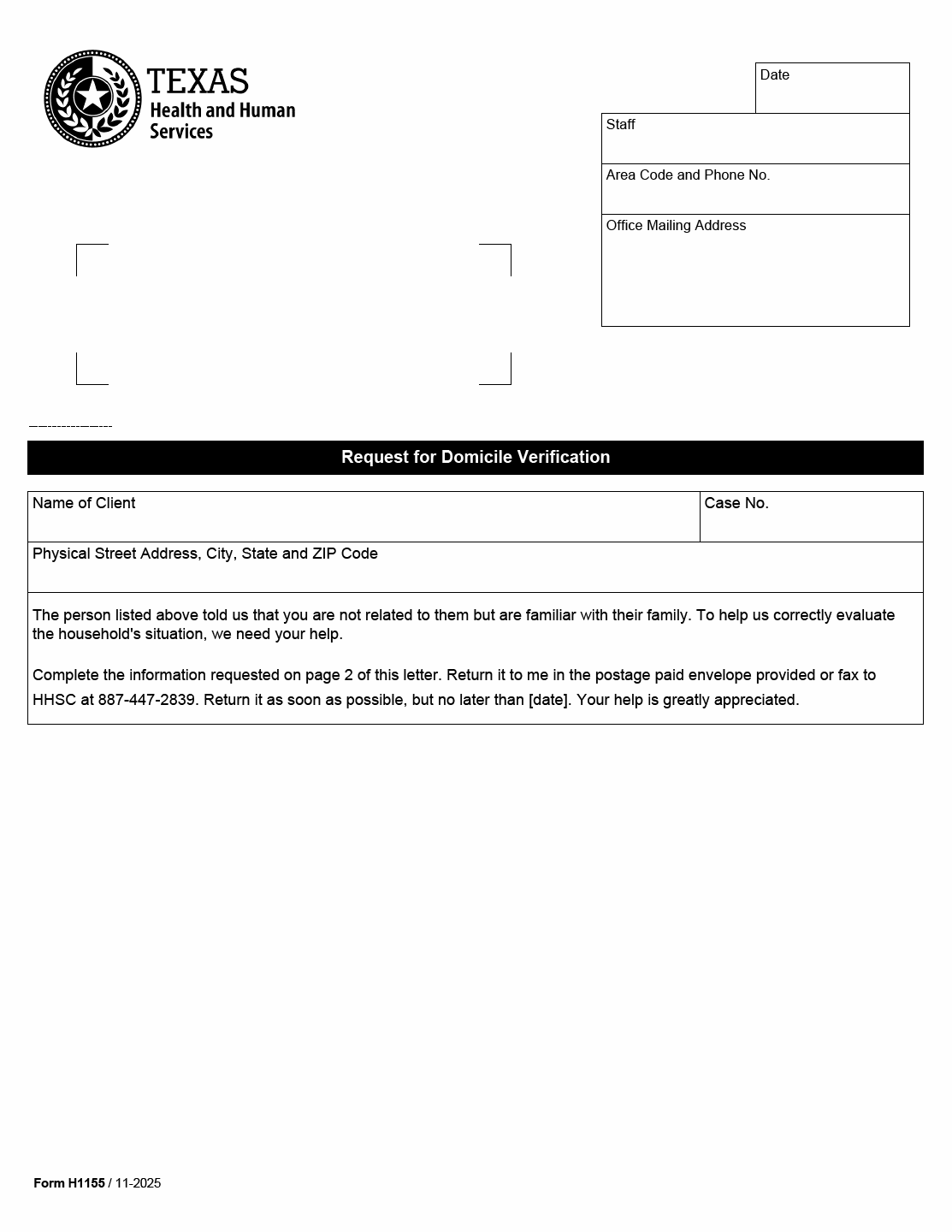
Form H1155, also known as the Request for Domicile Verification, is a document used by the Texas Health and Human Services Commission (HHSC) to verify where a client actually lives and who resides with them. Although the form is brief, it plays a significant role in determining eligibility for various public assistance programs. HHSC cannot rely solely on a client’s statement when housing details are unclear, inconsistent, or require third-party confirmation — especially when the household composition affects benefits.
This description explains what the form does, who must complete it, how HHSC uses the information, and how to avoid common mistakes that may delay case processing.
Purpose of the Form
The form is designed for one purpose: to confirm a client’s place of residence and the people living with them. In many assistance programs (such as SNAP, TANF, Medicaid), household composition directly affects eligibility. If an applicant’s living situation is uncertain, HHSC may ask someone who knows the family — but is not related to them — to verify the information.
Only a non-relative who does not live with the client may complete the form. The state uses third-party verification to ensure objectivity.
When This Form Is Required
HHSC typically requests Form H1155 in situations where:
- The client recently moved and has not yet established stable documentation.
- There is a discrepancy between what the client reported and what HHSC has on file.
- The client’s living arrangement seems temporary, informal, or unclear.
- Household members have changed and verification is needed.
- Mail has been returned to HHSC from the client’s listed address.
Who Can Complete the Form
The person completing Form H1155 must:
- not be related to the client,
- not live in the same household,
- have reasonable knowledge of the client’s family and living situation.
Typical individuals who complete the form include:
- neighbors,
- landlords,
- employers,
- clergy members,
- school officials,
- child care providers,
- long-term family friends.
Explanation of Each Section
1. Client Identification
This section lists the client’s name, case number, address, and the HHSC staff contact. It ensures that the verification is linked to the correct household. The reviewer should check that the information matches what they know about the family.
2. Household Members
The verifier must list all individuals living in the home, including the client. This information helps HHSC confirm household size for benefit eligibility.
Typical mistake: listing only adults or only people the verifier personally knows. If uncertain, the verifier should state that the list reflects their best knowledge.
3. Relationship to the Client
This confirms the verifier is a non-relative. If the relationship does not fall into one of the predefined options, “Other” can be used with explanation.
4. How Long the Verifier Has Known the Family
HHSC uses this to evaluate the credibility of the verification. Long-term acquaintances tend to provide more reliable information, but even short-term knowledge can be acceptable if accurate.
5. Verifier’s Signature and Contact Information
A signature is legally required because the verifier attests that the information is true to the best of their knowledge. Providing an address and phone number allows HHSC to contact them if clarification is needed.
Practical Advice for Completing the Form
- Write clearly to avoid misinterpretation.
- List all household members you reasonably know live there — partial information is better than none.
- Be honest about how long you’ve known the family; estimates are acceptable.
- Sign and date the form; HHSC cannot accept unsigned documents.
- If unsure about details, briefly note the uncertainty (e.g., “I believe two children live in the home, but I am not certain”).
Examples of Real-Life Situations
- Recently divorced parent: A mother moves into a new apartment after separation. HHSC requests verification because she has no lease yet.
- New job and relocation: A worker relocates for employment and lives temporarily with a friend. A neighbor verifies residence while the client awaits rental paperwork.
- College student returning home: HHSC needs clarification on whether the student resides at the home full-time for benefit purposes.
- Shared housing: Two unrelated adults share an apartment. A landlord verifies who is listed as residing at the property.
Documents Commonly Attached
While Form H1155 itself is a third-party verification, HHSC may also accept supporting documents when available:
- lease agreements,
- utility bills,
- mail showing the client’s name and address,
- letter from a landlord or property manager,
- school or employer address records.
Related Forms
- Form H1020 — Request for Information
- Form H1010 — Application for Benefits
- Form H1028 — Employment Verification
- Form H1852 — Proof of Residency Statement
FAQ
Who is allowed to fill out Form H1155?
A non-relative who does not live with the client and knows the family’s living situation.
Why does HHSC request domicile verification?
To confirm household composition and determine eligibility for public assistance programs.
Does the verifier need to provide documents?
No, but supporting evidence may help if the situation is unclear.
What happens if the form is not returned?
HHSC may delay or deny benefits until residency is confirmed.
Can a coworker complete the form?
Yes, if they are not related and do not live with the client.
Does the verifier face legal consequences for false information?
Providing knowingly false information may carry legal implications.
Micro-FAQ
- Purpose? To verify where the client lives and who lives with them.
- Who files? A non-relative who knows the family.
- Deadline? As soon as possible or by the date stated in the HHSC letter.
- Attachments? Optional — lease, bills, or other proof.
- Submitted to? HHSC, via mail or fax.
- Is signature required? Yes.
- Do relatives qualify? No.
- Can neighbor complete? Yes.
Form Reference
- Form Name: Request for Domicile Verification
- Form Number: H1155
- Agency: Texas Health and Human Services Commission (HHSC)
- Region: Texas
- Revision Date: 11-2025