
TX HHS Form H1073. Personal Responsibility Agreement
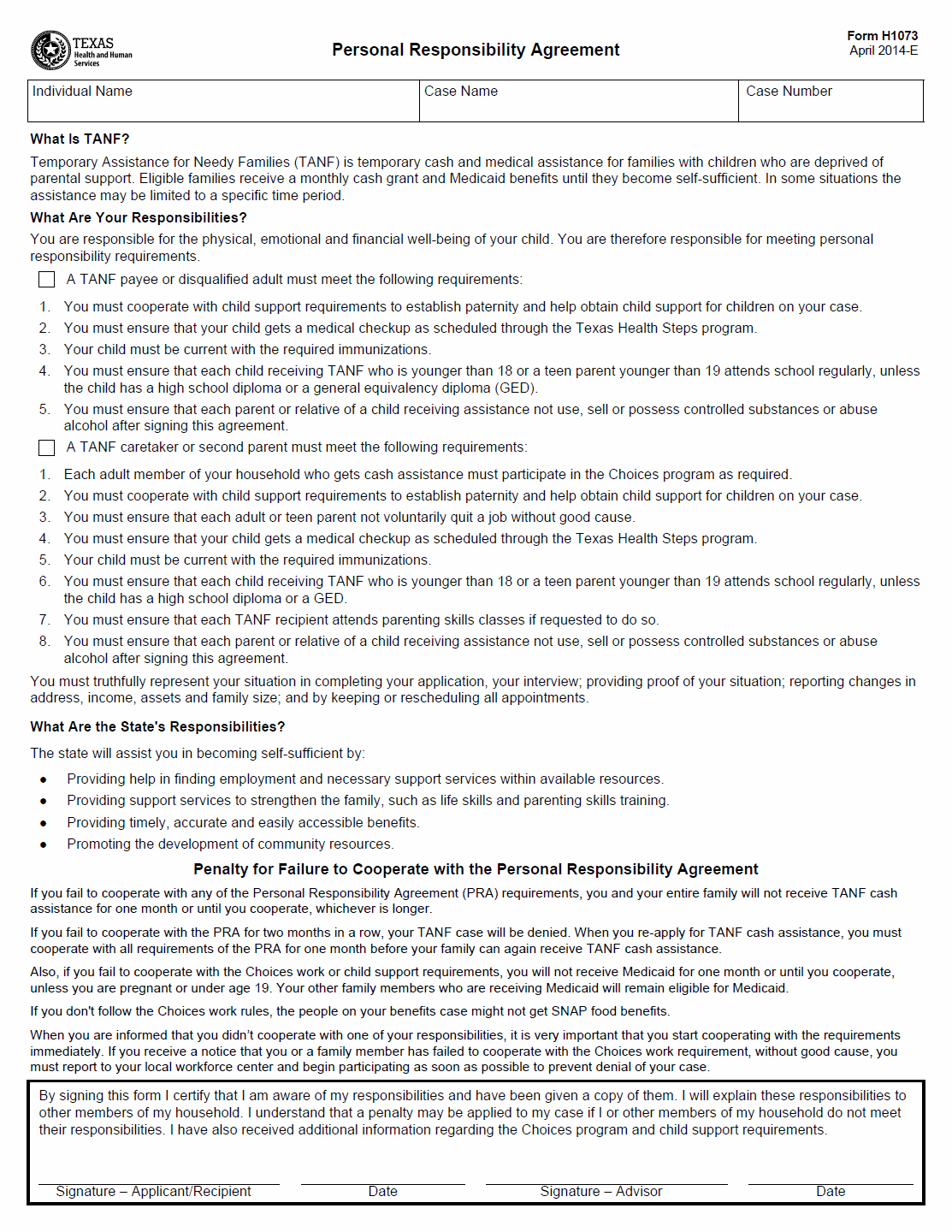
The Personal Responsibility Agreement (PRA), documented through Form H1073, is a core requirement for Texans applying for or receiving Temporary Assistance for Needy Families (TANF). Although the form itself is short, it carries significant legal and practical consequences for every adult in a TANF household. This guide explains the real meaning of each section, why the state requires these commitments, and how families can meet the expectations without running into preventable penalties.
Purpose of Form H1073
Form H1073 outlines the responsibilities that each TANF applicant or recipient must meet to continue receiving cash assistance and certain related benefits. The form serves two functions:
- It confirms that the applicant understands the behavioral, legal, and reporting rules associated with TANF.
- It establishes a written agreement between the household and the State of Texas, ensuring cooperation with employment, health, child support, and school attendance requirements.
Although it appears procedural, the PRA can directly affect whether a family continues receiving benefits, how long a case remains open, and whether sanctions or denials might occur.
Why This Form Is Required by Texas Law
The PRA is mandated under Texas Human Resources Code and federal TANF program rules. These regulations require that adults receiving TANF cash assistance take active steps toward self-sufficiency, maintain household stability, and ensure the well-being of children in the home. The state must document compliance — and Form H1073 is the written proof of that commitment.
Signing the PRA is not optional. Without it, TANF assistance cannot be granted or continued.
Key Sections of the Personal Responsibility Agreement
1. Responsibilities for TANF Payees and Disqualified Adults
These rules apply to adults who manage the TANF case, including adults who are ineligible for TANF but who care for children in the household.
- Cooperation with child support. Adults must work with the Office of the Attorney General (OAG) to establish paternity and pursue child support. Failure to cooperate is a common cause of sanctions.
- Medical checkups (Texas Health Steps). Parents must ensure children attend scheduled screenings, which the state uses to track wellness and developmental milestones.
- Required immunizations. Children must be up to date with vaccinations unless medically exempt.
- School attendance. Children under 18 and teen parents under 19 must attend school unless they hold a high school diploma or GED.
- No use or possession of controlled substances. Adults and relatives receiving assistance must not use, sell, or possess illegal drugs or abuse alcohol.
2. Responsibilities for TANF Caretakers and Second Parents
These requirements apply when two adults share responsibility for children on the TANF case.
- Participation in the Choices program. Each adult receiving cash assistance must take part in work-related activities, such as job search, training, or employment.
- Cooperation with child support. Both adults must assist in establishing paternity and seeking support for the children.
- No voluntary job quitting. Adults cannot quit employment without good cause, such as unsafe conditions or medical necessity.
- Medical checkups and immunizations. Same health requirements as above apply.
- Parenting classes. If requested, adults must attend state-approved parenting training.
- No use or possession of controlled substances. Strictly prohibited for all adults involved in care.
3. Accuracy of Information
Applicants must provide truthful and up-to-date information about income, employment, household members, assets, and address changes. Misreporting or failing to report changes is one of the most common triggers for penalties.
Penalties for Non-Cooperation
The PRA includes clearly defined consequences:
- First violation: TANF cash payments stop for at least one month or until cooperation.
- Two consecutive months of non-cooperation: TANF case is closed entirely.
- Reapplying after closure: Household must meet all PRA requirements for one full month before payments restart.
- Medicaid consequences: Non-cooperation with work or child support rules may suspend Medicaid for the adult but not for children.
- SNAP consequences: Some work-rule violations may affect food benefits for household members.
The state emphasizes that immediate cooperation after receiving a notice can prevent case denial.
Practical Tips for Completing Form H1073
- Read each requirement carefully and make sure you understand what you are agreeing to.
- When unsure about paternity cooperation or child support rules, ask your case advisor before leaving the appointment.
- Keep records of child immunizations and Texas Health Steps appointments.
- Set alerts for job appointments and Choices program meetings — missed meetings often trigger penalties.
- Report changes (address, employment, income) immediately through Your Texas Benefits.
Examples of Real-Life Situations
- A parent needs to establish paternity. A mother applying for TANF must participate in DNA testing to confirm paternity so child support can be established.
- Teen parent attending school. A 17-year-old parent receiving TANF must attend classes regularly or risk losing their household’s benefits.
- Caregiver skipping a Texas Health Steps appointment. Missing a child’s scheduled screening may result in temporary loss of TANF cash assistance.
- An adult quits a job without cause. If a second parent leaves their job voluntarily, the household may face sanctions unless they show good cause.
Documents Commonly Needed Alongside Form H1073
- Identification for all adults
- Birth certificates for children
- Proof of school attendance
- Immunization records
- Texas Health Steps appointment confirmations
- Employment or income records
FAQ
- Do I have to sign the PRA to receive TANF? Yes. TANF cannot be approved without agreeing to the PRA requirements.
- What happens if I miss a Choices appointment? You may lose TANF or adult Medicaid for at least one month until you resume participation.
- Is child support cooperation mandatory? Yes, unless you have a documented good-cause exemption, such as safety concerns.
- Do children lose benefits if a parent does not cooperate? Usually no — children remain eligible for Medicaid even if an adult loses coverage.
- Can I get TANF back after my case is denied? Yes, but you must cooperate for one month before payments restart.
- What counts as “good cause” for quitting a job? Unsafe conditions, harassment, medical issues, or significant reduction in hours may qualify.
Micro-FAQ (Short Answers)
- Purpose? To ensure TANF recipients meet required responsibilities.
- Who signs? TANF applicants, payees, caretakers, and second parents.
- Deadline? Must be signed during TANF application or recertification.
- Attachments? Usually none, but supporting documents may be requested.
- Submitted to? Texas Health and Human Services (HHS).
- Penalties? Loss of TANF cash for at least one month or case closure.
- Medical impact? Adult Medicaid may be suspended for non-cooperation.
- Child support rules mandatory? Yes.
- School attendance required? Yes for minors and teen parents.
- Drug use allowed? No — possession or use violates the PRA.
Related Forms
- Texas Form H1010 — Application for Benefits
- Texas Form H1836 — Medical Release / Verification
- Texas Form H1020 — Request for Information
- Texas Form H1106 — Child Support Good Cause Claim
Form Details
- Form Name: Personal Responsibility Agreement
- Form Number: H1073
- Region: State of Texas
- Latest Revision: April 2014-E