
LDSS-4438. Emergency Plan Child Day Care Centers, School Age Child Care Programs, and Legally Exempt Group Child Care Programs
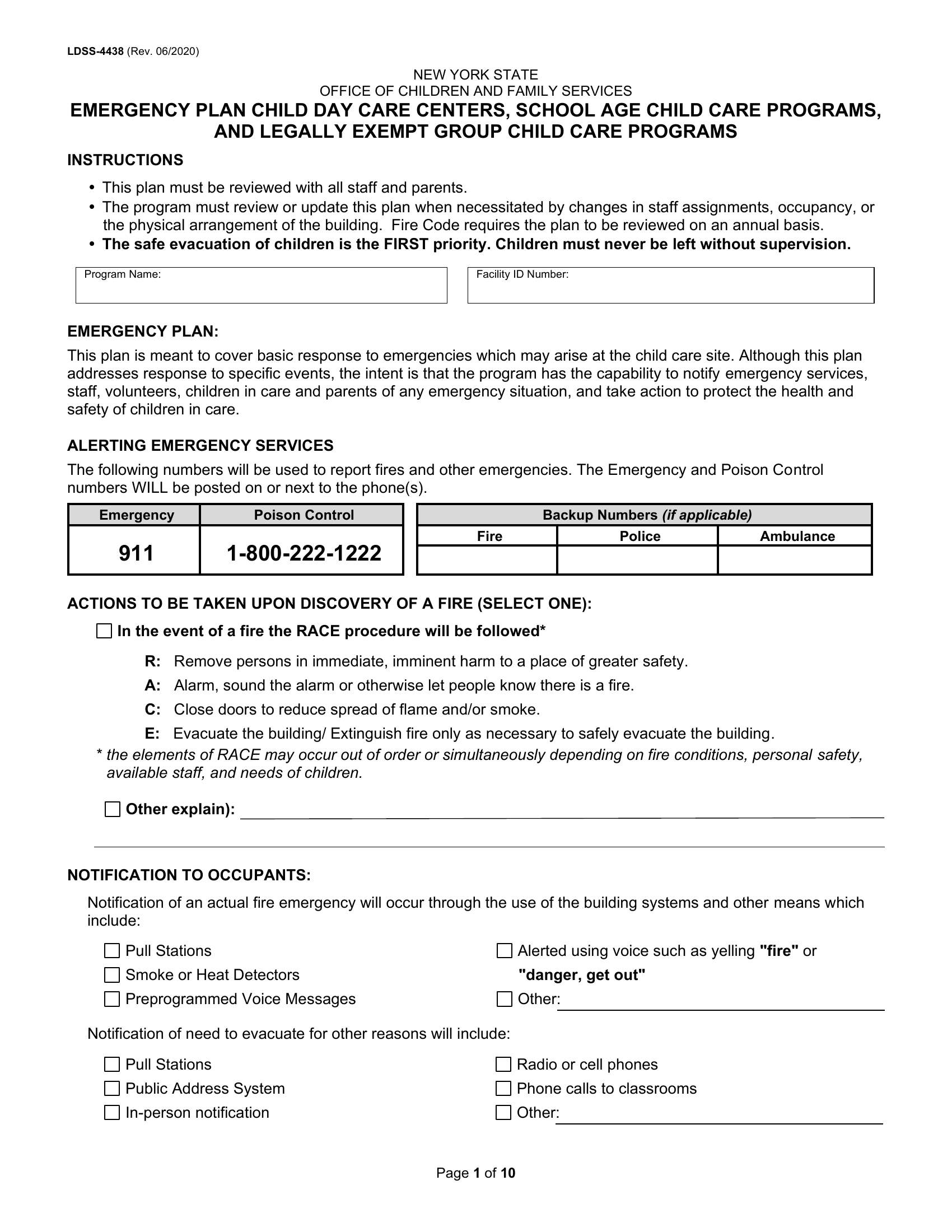
This document is an expert, practical guide to the New York State Emergency Plan (LDSS-4438, Rev. 06/2020) used by child day care centers, school-age child care programs, and legally exempt group child care programs. The Emergency Plan is a required program-level written plan that describes how staff will respond to fires, evacuations, shelter-in-place, relocation, reunification, drills, and related communication and safety tasks. This guide explains what each section of the form means, common pitfalls, when the plan is required, who completes it, what supporting documents you may need, and concrete tips to make your plan clear, compliant, and usable in an emergency.
Purpose and When This Form Is Required
The Emergency Plan documents a program’s procedures to protect children, staff, and visitors during an emergency. New York State requires programs to prepare, review, and maintain a current plan:
- when the program initially opens;
- whenever there are changes to staff, occupancy, building layout, or evacuation procedures;
- and at least annually (fire code and OCFS guidance require annual review and updates).
Programs licensed, registered or enrolled with the Office of Children and Family Services (OCFS) must keep this plan on file and submit an updated copy to OCFS when changes occur or upon request.
Quick Legal and Regulatory Context
The Emergency Plan aligns with the Uniform Fire Prevention and Building Code requirements, local fire code, and OCFS guidance. It is part of the program’s overall health and safety obligations and is tied to licensor, registrar, or enrollment agency oversight. While this guide explains regulatory context, it does not replace official code language or legal counsel.
Section-by-Section Explanation
Program Identification and Instructions
This opening area captures the program name and facility ID and outlines the plan’s purpose and review timing. Make sure the program name and facility ID match OCFS records to avoid confusion during inspections or after an incident.
Alerting Emergency Services
This section lists the phone numbers and procedures for contacting 911, Poison Control, fire, police, and ambulance services. Ensure emergency phone numbers are posted near every phone and staff know where to find them.
Actions Upon Discovery of a Fire
The form references RACE (Remove, Alarm, Close, Evacuate/Extinguish). Describe how your staff will put those steps into practice given your building layout, staff levels, and age groups in care.
Notification to Occupants
Describe how occupants are alerted—alarm systems, voice announcements, pull stations, classroom phone calls, or in-person notification. Be precise: list methods that are actually available at your site.
Evacuation Procedures and Accountability
This critical section defines staff roles for escorting children, taking attendance, closing doors, and identifying primary/secondary exits and assembly areas. The plan must name who carries attendance records, emergency contact cards, and supplies. Identify alternatives for children needing mobility assistance.
Relocation Sites
List primary and secondary relocation sites with addresses and contact names; confirm written permission from each site. Indicate transport method (walking, bus, car) and any logistical details (meeting points, accessibility).
Shelter in Place
Describe when shelter-in-place will be used (e.g., hazardous materials release, severe weather), the selected interior spaces, how to minimize window exposure, and how utilities/HVAC will be handled. Include a list of shelter supplies and storage locations.
Meeting Emotional Needs of Children
Outline calming activities such as quiet play, reading, or songs. This shows regulators and parents that the program accounts for children’s emotional welfare during an emergency.
Communication
Document how and when OCFS or the enrollment agency will be notified, and list the program’s licensor/registrar contact information. Explain parent notification procedures for evacuation, relocation, and sheltering.
Reunification Procedures
Detail how children will be released to authorized persons, where reunification occurs, documentation required for pickup, and contingency plans if parents cannot pick up children promptly.
Drills
Specify drill frequency (monthly evacuation drills per shift, twice-annual shelter in place), methods for initiating drills, and how records of drills will be maintained. Include procedures for notifying parents about drills when required.
Additional Components and Evacuation Diagram
Confirm fire department access routes, major fire hazard controls, and maintenance responsibilities. The evacuation diagram must be room-specific, posted conspicuously, and oriented for easy use during emergencies.
Common Mistakes and How to Avoid Them
- Incomplete or inconsistent contact information: Keep phone numbers and addresses current and cross-checked with OCFS records.
- Vague staff responsibilities: Assign and document specific evacuation and accountability duties for each staff member per shift.
- Unapproved relocation sites: Obtain written permission from relocation sites and keep copies on file.
- Missing evacuation diagrams or outdated maps: Update diagrams after any layout change and ensure “You Are Here” markers are correct.
- Insufficient supplies listed or not inspected: Inventory shelter supplies regularly and record inspections.
- Failure to document drills: Maintain drill logs showing date, time, type of drill, participants, and any follow-up actions.
Who Should Complete and Review the Plan
The plan is typically prepared by the program director or an assigned safety coordinator and reviewed with all staff and parents. The director is responsible for ensuring the plan is implemented, reviewed annually, and updated after significant changes. The program should involve building management, maintenance staff, and local code officials as appropriate.
Practical Tips for Filling Out the Form
- Use clear, specific language—avoid generic phrases like “staff will notify parents.” Specify methods and responsible persons.
- Attach evidence of written permissions for relocation sites and contact names/phone numbers.
- Map primary and secondary exits for every room; use consistent room names that match posted signage.
- Keep a master copy of the plan on site and provide a redacted copy for parents if privacy is a concern.
- Schedule and log regular checks of emergency supplies and include expiration dates where applicable.
- Practice drills with realistic variables (e.g., simulated blocked exit) to test alternate procedures.
Real-Life Examples (Mini Case Studies)
- Small center, downtown storefront: A fire in a neighboring tenant triggers an evacuation. Staff use prearranged primary assembly at a nearby municipal plaza and account for infants using evacuation cribs and assigned carriers.
- School-age program in a school building: During severe weather, the program shelters in an interior corridor with no windows, secures HVAC, and uses preapproved school gym as a temporary relocation site.
- Rural child care program: Flooding requires relocation by car to a partnering church; written permission and driving routes were confirmed beforehand to speed the response.
Required and Recommended Attachments
- Evacuation diagram(s) for each room with “You Are Here” markers.
- Written permission letters from relocation sites.
- Staff assignment roster showing evacuation/accountability duties.
- Inventory and inspection logs for shelter supplies, medications, and infant equipment.
- Drill log records showing dates, participants, and corrective actions.
- Documentation of any specialized equipment or accessibility accommodations.
Detailed Frequently Asked Questions (FAQ)
When must we update and resubmit the Emergency Plan?
Update the plan whenever staff assignments, occupancy, building layout, or evacuation routes change. Submit a new copy to OCFS if your program is required to do so or if a licensor requests it; maintain annual reviews as required by fire code.
Do parents need to see the full plan?
Programs must review the plan with parents; this can be done through summaries, brochures, or parent meetings. Maintain the complete plan on-site for inspection while providing parents with the relevant procedures for notification and reunification.
How detailed must evacuation diagrams be?
Diagrams should show all exits, primary and secondary routes, assembly points, fire extinguishers, and any special symbols cited in the form. They must be room-specific and posted conspicuously.
What if a relocation site refuses to be listed later?
If a relocation site withdraws permission, update the plan immediately and identify an alternate approved location. Notify staff and parents of the change and document the withdrawal and replacement.
Are drills required when children are not present?
No—evacuation drills must be conducted during each shift of care so staff can practice with the children they supervise. Shelter-in-place drills occur at least twice a year and should include staff and, when appropriate, children.
Who inspects the Emergency Plan?
OCFS licensors or registrars, local fire marshals, and building code officials may review the plan. Keep documentation of all reviews and any requested corrections.
How should we handle children with mobility or medical needs?
Document specific evacuation/relocation procedures, assign staff to assist, include evacuation equipment (cribs, wheelchairs), and list medications/supplies to be taken during relocation. Coordinate with parents and medical providers in advance.
Micro-FAQ — Ultra-short Answers (Snippet-ready)
- Purpose: Records procedures to protect children and staff during emergencies.
- Who fills it out: Program director or designated safety coordinator.
- When to update: After staff, occupancy, or layout changes and at least annually.
- Attachments: Evacuation diagrams, relocation permissions, drill logs.
- Submitted to: Kept on site and provided to OCFS/licensor on request.
- Drill frequency: Monthly evacuation drills per shift; shelter-in-place twice yearly.
- Reunification: Children are released only to authorized adults with proper ID.
- Shelter supplies: First aid, food/water, flashlights, infant needs, medications (if applicable).
- Notification methods: Phone, text, email, social media, website, or posted notices.
- Evacuation diagram required: Yes, posted in every approved room.
Related Forms and Resources
- OCFS drill and emergency reporting guidance
- Local fire marshal contact and building fire safety plan
- Child pickup authorization and emergency contact forms
- Medication administration and special needs documentation
- Enrollment agency notification forms
Final Notes and Practical Checklist
Before finalizing your Emergency Plan, confirm these items:
- All contact numbers and relocation permissions are current and documented.
- Evacuation diagrams are room-specific, posted, and accurate.
- Staff assignments for accountability are listed by shift and reviewed with personnel.
- Emergency supplies are inventoried and inspected per schedule.
- Drills are logged and corrective actions are implemented.
- Parents have been informed of notification and reunification procedures.
Form Details
Form Name: Emergency Plan — Child Day Care Centers, School Age Child Care Programs, and Legally Exempt Group Child Care Programs
Form Number: LDSS-4438
Issuing Authority / Region: New York State Office of Children and Family Services (OCFS)
Revision Date: Rev. 06/2020