
TX HHS Form H3038-P. CHIP Perinatal - Emergency Medical Services Certification
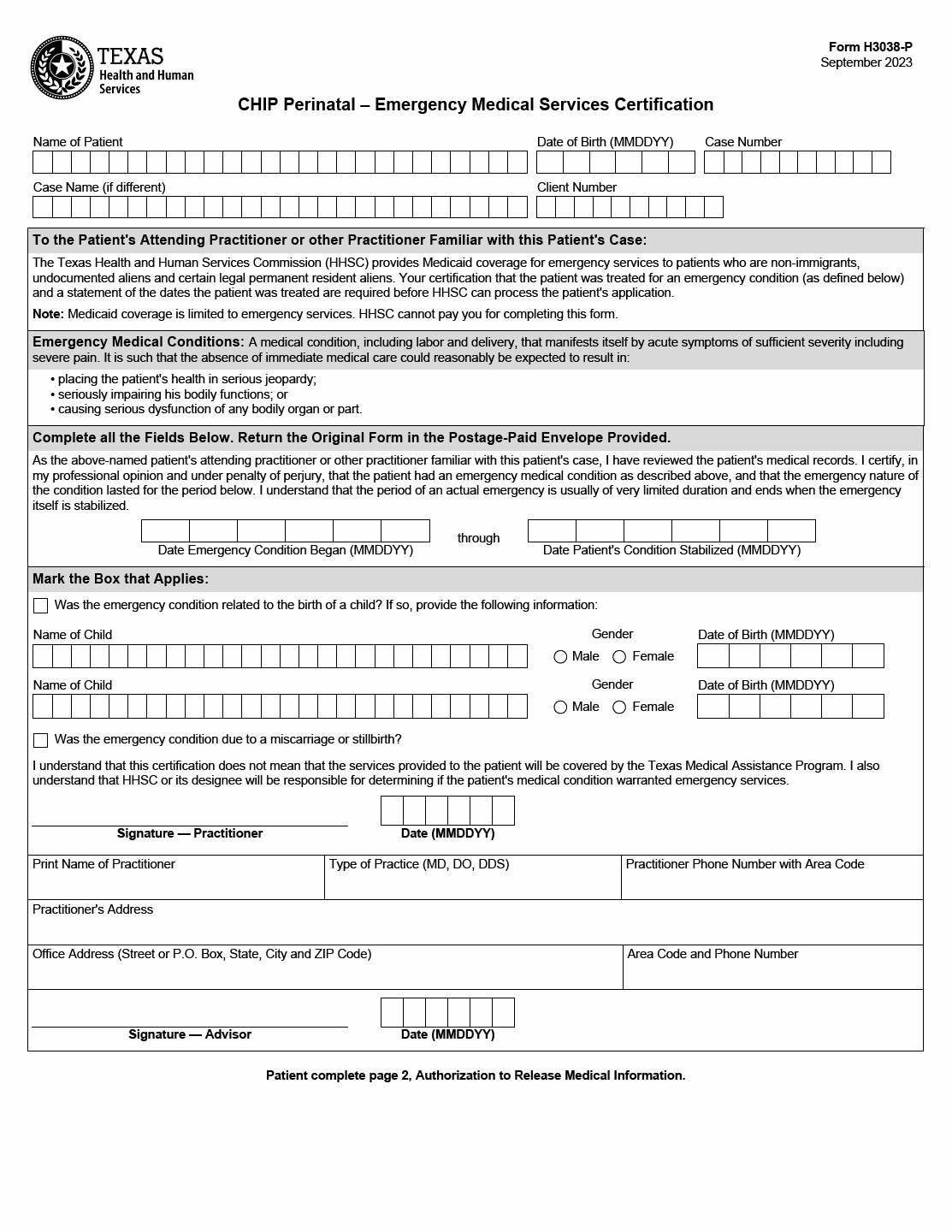
Form H3038-P is used in Texas to document that a non-citizen patient received treatment for a true medical emergency. This certification is required so the Texas Health and Human Services Commission (HHSC) can determine whether the patient qualifies for Emergency Medicaid or CHIP Perinatal emergency services. The form must be completed by the attending practitioner who personally evaluated the patient or reviewed their medical records.
Although the form looks simple, it plays a crucial legal role: it links specific medical events to federal and state definitions of an “emergency medical condition.” Because Emergency Medicaid only pays for the stabilization period—not routine care—accurate completion of this document is essential.
Purpose and Scope of Form H3038-P
Emergency Medicaid in Texas is available only when a patient’s condition meets strict criteria: the situation must involve acute symptoms so severe that without immediate treatment, the patient’s health would be seriously jeopardized. Practitioners use Form H3038-P to certify whether that threshold was met and to indicate the exact dates when the emergency existed.
The form is also used in perinatal cases, including labor, delivery, miscarriage, or stillbirth, where emergency medical care may be required even if the patient does not qualify for regular Medicaid.
Explanation of Key Sections
Patient Information
This section identifies the individual who received care—name, date of birth, case number, and other identifiers used by HHSC. Errors in this area commonly delay processing, so it must exactly match medical and clinic records.
Emergency Medical Conditions Definition
The form restates the official legal definition. Practitioners should ensure the condition involved:
- acute symptoms of sufficient severity,
- risk of serious impairment or dysfunction without treatment,
- a medical necessity for immediate intervention.
This definition excludes chronic or scheduled care even if the patient is generally unwell.
Certification of Emergency Nature
The provider must certify:
- the date the emergency began,
- the date the patient became stabilized,
- whether the emergency involved childbirth, miscarriage, or stillbirth.
A frequent mistake is extending the “emergency period” beyond stabilization. Emergency Medicaid does not pay for care after the patient is stable, even if inpatient hospitalization continues.
Childbirth-Related Information
If the emergency involved labor or delivery, the practitioner records the child’s name, gender, and date of birth. This helps HHSC verify that services occurred during a qualifying emergency window.
Practitioner Identification and Signature
The provider signs under penalty of perjury. HHSC uses this certification to decide whether services are reimbursable. The signature must match the provider’s credential file, and the office address and phone number must be current.
Authorization to Release Medical Information (Page 2)
The patient signs this portion to allow HHSC to obtain medical records. Without this signature, the application cannot move forward. A personal representative may sign with an explanation of their authority. If the signer cannot write, two witnesses must sign next to the mark.
When This Form Must Be Filed
- When a non-citizen receives emergency treatment and seeks Emergency Medicaid coverage.
- When a CHIP Perinatal patient requires emergency care or delivers a child.
- When emergency treatment occurred during miscarriage or stillbirth.
The form is not needed for routine prenatal visits, follow-up appointments, scheduled procedures, or chronic conditions.
Who Can Complete the Form
- Attending physicians (MD, DO)
- Dentists when treating qualifying dental emergencies (DDS)
- Other practitioners who directly evaluated or treated the patient and can certify based on medical records
Administrative staff, caseworkers, or billing departments cannot complete the emergency certification.
Documents Commonly Attached
- Emergency room records
- Admission and discharge summaries
- Labor and delivery notes
- Diagnostic test results confirming acute conditions
- Stabilization notes
Legal and Administrative Consequences
The certification forms the basis for an HHSC decision about payment. Incorrect dates or inaccurate claims can result in denial of reimbursement or further investigation. Providers must be precise, as the signature is made under penalty of perjury.
Practical Tips for Completion
- Use exact dates from medical records—do not estimate.
- Do not list stabilization dates later than clinically justified.
- If childbirth is involved, double-check the newborn’s information for accuracy.
- Ensure the practitioner’s contact details match clinic records to avoid verification delays.
- Have the patient sign the authorization section before they leave the facility.
Real-Life Examples of When Form H3038-P Is Used
- A pregnant woman in active labor arrives without insurance or legal status. Emergency Medicaid may pay for labor and delivery once the practitioner certifies the emergency period.
- A patient experiences severe abdominal pain requiring immediate surgery. The surgeon completes the form to confirm that delaying care would have jeopardized the patient’s health.
- A miscarriage requiring emergency intervention qualifies when the attending provider documents the acute nature of the condition.
- A non-citizen with a traumatic injury from an accident receives stabilization; the form certifies the exact period during which life-saving treatment occurred.
Related Forms
- Form H3038 — Emergency Medical Services Certification (traditional Medicaid)
- CHIP Perinatal Program forms
- Texas Medicaid Application – Form H1205
FAQ
- What is considered an emergency for Medicaid purposes? An emergency involves acute symptoms where the absence of immediate medical care could cause serious health risks or impair bodily functions.
- Does completing this form guarantee Medicaid payment? No. HHSC reviews the certification and decides whether the services meet emergency criteria.
- Can a nurse or staff member sign the form? No. Only the attending practitioner or someone directly responsible for medical care may certify the emergency.
- Is the form required for routine prenatal care? No. It is only required for emergency labor, delivery, or other acute conditions.
- Does the form cover treatment after stabilization? No. Emergency Medicaid covers only the period until the patient is stabilized.
- What if the patient cannot sign the authorization page? A representative may sign, or the patient may make a mark with two witnesses.
- Where is the form sent? The provider returns it in the supplied envelope to HHSC.
Micro-FAQ (Short Answers for Quick Reference)
- Purpose? To certify that the patient had a qualifying emergency condition.
- Who completes it? The attending practitioner who treated the patient.
- Patient signature needed? Yes, on the authorization page.
- Is childbirth covered? Yes, when labor or delivery is an emergency.
- Is miscarriage covered? Yes, if emergency treatment was required.
- What dates are needed? Emergency start date and stabilization date.
- Attachments? Medical records supporting the emergency.
- Submitted to? Texas Health and Human Services Commission.
- Does it ensure payment? No, HHSC makes the final determination.
Form Details
- Name: Emergency Medical Services Certification
- Form Number: H3038-P
- Region: State of Texas
- Program: CHIP Perinatal / Emergency Medicaid
- Edition Date: September 2023