
TX HHS Form 8647. Service Coordination Assessment Intellectual Disability Services
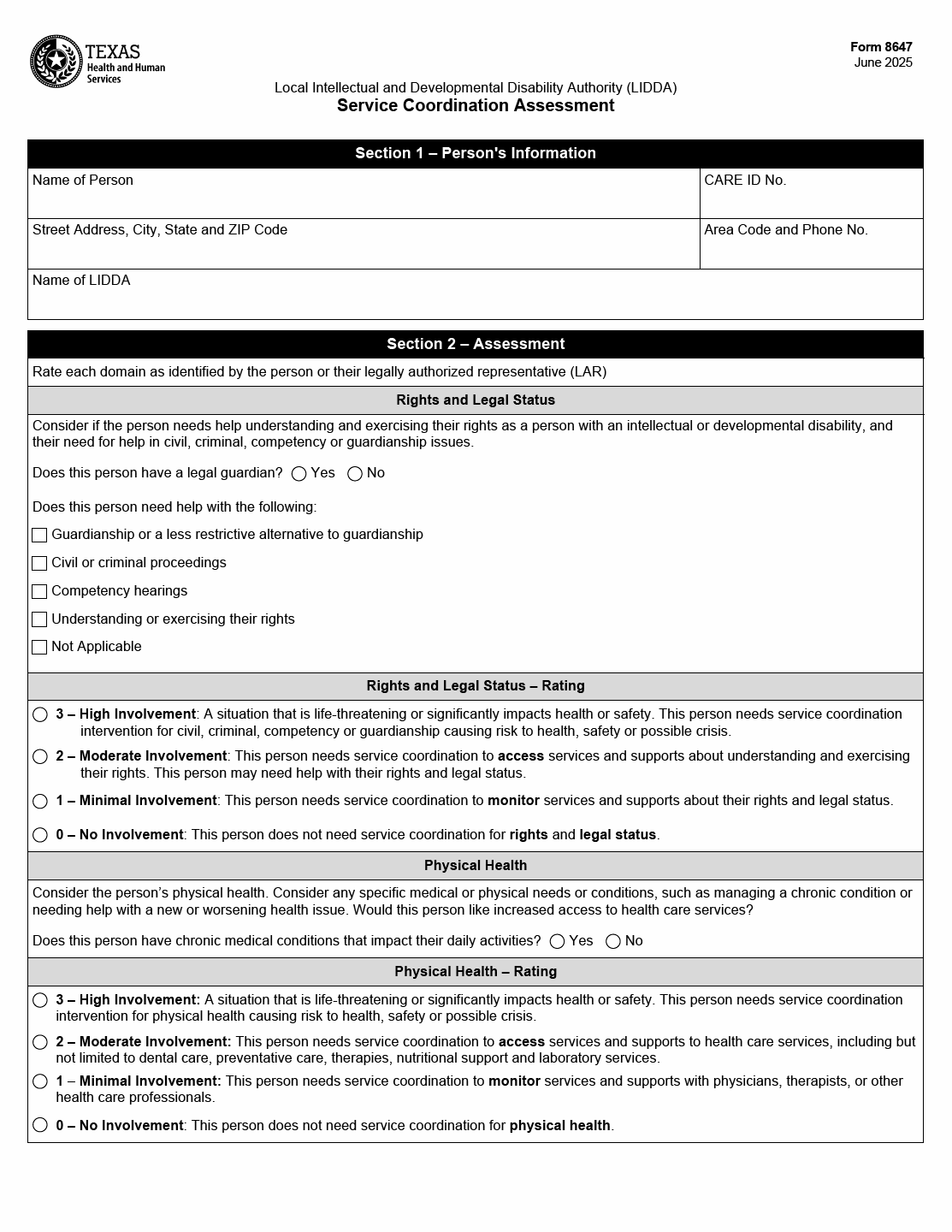
Form 8647 (June 2025) is a structured assessment tool used by Local Intellectual and Developmental Disability Authorities (LIDDAs) in Texas. Its purpose is to evaluate the level of service coordination a person needs across several key life domains: rights and legal status, physical health, emotional and behavioral health, and independent living skills. While the form looks straightforward, it plays a critical role in determining the type and intensity of support a person receives — which means accurate, thoughtful completion is essential.
Purpose of Form 8647
LIDDAs use this assessment to understand not only what challenges a person is experiencing, but also how urgently service coordination must respond. Each domain is rated from 0 (no involvement needed) to 3 (high involvement), creating a clear snapshot of needs that helps guide service planning, prioritization, and referrals.
This form is typically completed during intake, annual reassessments, or when a person’s circumstances change significantly (for example, a major health decline or new behavioral risk).
Breakdown of Key Sections
Section 1 – Person’s Information
This section records the basic identifying information: name, CARE ID, address, phone number, and the name of the LIDDA completing the assessment. While simple, accuracy matters — incorrect identification data can delay service coordination or cause mismatches in state systems.
Typical mistakes:
- Incorrect CARE ID, causing mismatches with existing records.
- Using a mailing address instead of the person’s physical location when services depend on residence.
- Listing a guardian’s phone number without specifying it’s not the person’s own number.
Section 2 – Assessment
This is the core of the form. Each domain must be rated according to what the person (or their legally authorized representative) identifies as their needs.
Rights and Legal Status
This domain assesses whether a person understands their rights, whether they need support in exercising them, and whether there are active or potential legal issues. Examples include guardianship, criminal matters, competency hearings, and challenges in understanding personal rights.
What reviewers look for:
- Whether the person currently has a legal guardian.
- Whether civil or criminal issues impact their safety or decision-making.
- Whether the person struggles to understand or exercise their rights independently.
Why this section matters: A high rating often triggers immediate service coordination, especially when legal issues present safety or compliance risks.
Physical Health
This assesses health-related needs: chronic conditions, new or worsening symptoms, problems accessing health care, and need for coordination with medical professionals.
- Chronic conditions affecting daily life (e.g., diabetes, epilepsy, respiratory problems).
- Requests for increased access to health services.
- Need for oversight in managing medications or treatments.
Common errors: Underreporting chronic conditions because the person “is used to them,” or overlooking mild symptoms that may worsen later.
Emotional and Behavioral Health
This domain evaluates whether emotional or behavioral challenges interfere with daily functioning. This includes diagnosed mental health conditions, substance use, risk behaviors (self-harm, aggression, running away), or the need for a behavior support plan.
- Existing mental health diagnoses affecting daily life.
- Current involvement with mental or behavioral health providers.
- Risky behaviors requiring monitoring or intervention.
High ratings usually indicate immediate safety risks and require urgent coordination with mental health services.
Independent Living
This assesses a person's functional skills and support needs for daily tasks, such as cooking, hygiene, home safety, communication, finances, transportation, community access, and their current living environment.
Typical reasons for higher involvement ratings:
- Difficulty performing activities of daily living without support.
- Communication challenges interfering with safety or independence.
- Limited mobility or ability to navigate their environment.
- Inability to manage finances safely.
Practical Guidance for Completing the Form
- Base ratings on present needs, not historical challenges.
- Avoid minimizing issues—coordination levels depend heavily on accuracy.
- When unsure between two ratings, choose the higher one and document supporting detail.
- Engage the person or LAR directly; avoid filling out based solely on previous records.
- Document major changes (recent hospitalizations, legal events, behavioral crises).
Examples of Real-Life Situations
- Declining physical health: A person with diabetes begins missing appointments and shows symptoms of poor glucose control. They may need a higher physical health rating.
- Behavioral crisis: A normally stable individual begins engaging in self-harm after a major life change, requiring urgent behavioral coordination.
- Transition to independent living: A young adult leaving the family home may need temporary increased support to learn daily living skills.
- Legal complications: A person facing a competency hearing may require intensive coordination for guardianship-related decisions.
Documents Commonly Attached
- Medical summaries or recent hospital discharge notes
- Behavioral health evaluations or psychiatric reports
- Guardianship papers or legal notices
- Service plans from other agencies
- Medication lists or treatment plans
FAQ (Detailed)
- Who completes Form 8647? Usually a LIDDA service coordinator, based on interviews with the person and their legally authorized representative.
- Does the person need to sign the form? Signature requirements vary by agency, but participation in the assessment is required.
- When is the form used? During intake, annual reassessments, or major life/health changes.
- Can ratings be changed later? Yes. Ratings are updated when the person's needs change.
- Does a high rating guarantee services? It indicates urgency, but eligibility depends on program rules and capacity.
- Is medical documentation required? Not always, but it strengthens accuracy and improves coordination.
Micro-FAQ (Short Answers)
- What is the form for? To assess service coordination needs in four life domains.
- Who files it? LIDDA service coordinators.
- When is it required? At intake, annually, or when needs change.
- Is a guardian involved? Yes, if the person has one.
- What attachments are common? Medical, behavioral, and legal documents.
- Who processes it? The local LIDDA.
- Is it legally binding? It informs required state service coordination decisions.
- How long does it take? Usually 30–60 minutes.
- Can it be updated? Yes, at any time.
- Does it determine eligibility? It influences but does not solely determine services.
Related Forms
- Form 1049 – LIDDA Diagnostic Assessment
- Form 2067 – Case Information
- Form 8578 – Intellectual Disability/Related Condition Assessment
- Person-Directed Plan (PDP) Templates
Form Details
- Name: Service Coordination Assessment
- Form Number: 8647
- Edition: June 2025
- Issued by: Local Intellectual and Developmental Disability Authority (LIDDA), Texas
- Pages: 2+