
TX HHS Form 8616. In-Home Individualized Skills and Socialization Service Delivery Log
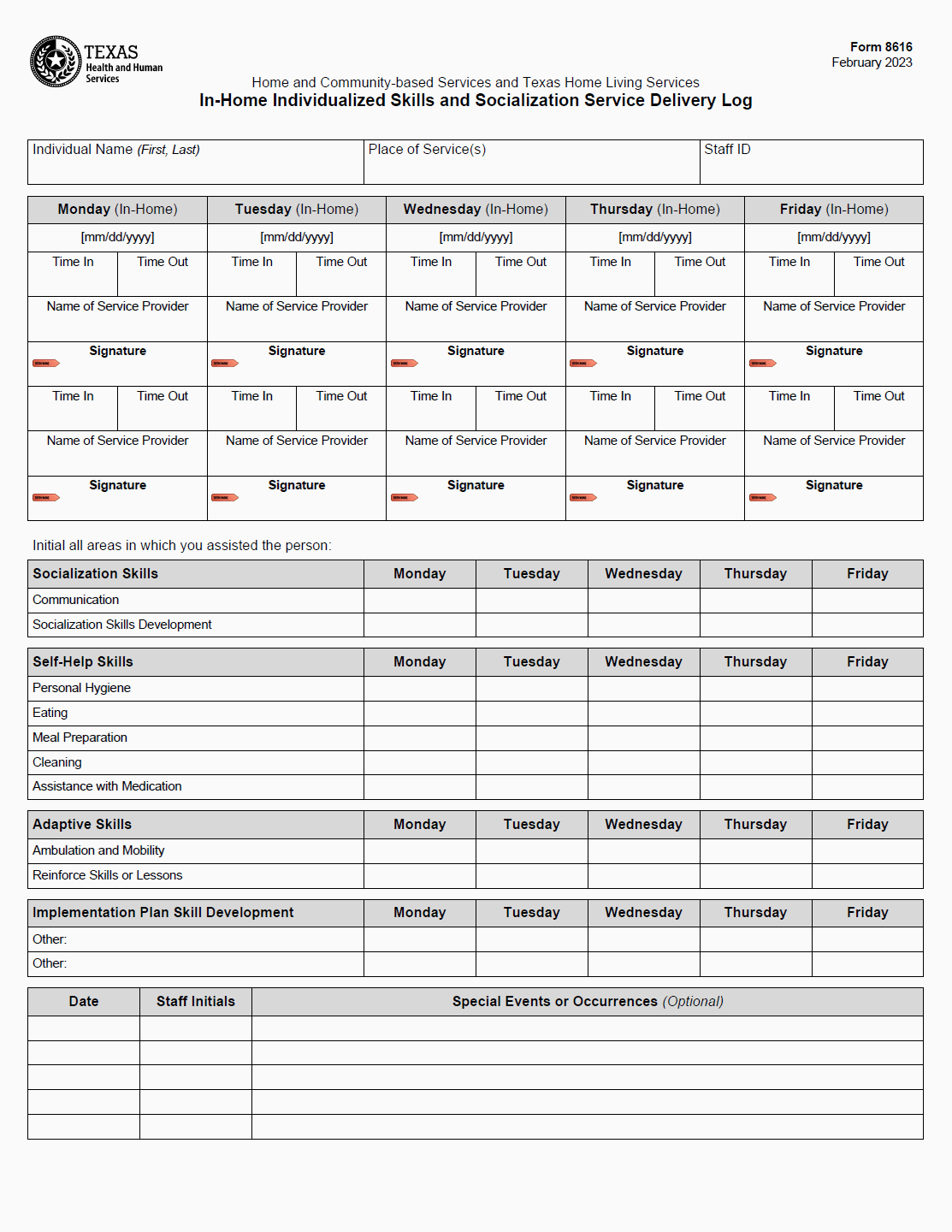
Form 8616, updated in February 2023, is a weekly service delivery log used in the Texas Home and Community-Based Services (HCS) and Texas Home Living (TxHmL) programs. It documents every instance of in-home Individualized Skills and Socialization services provided to a person enrolled in these Medicaid waiver programs. Although the form appears straightforward, it plays an essential regulatory role: it verifies that services were delivered as authorized, supports Medicaid billing, and helps ensure that individuals receive the assistance outlined in their Individual Plan of Care (IPC) and Implementation Plan (IP).
This document is typically completed by direct support professionals (DSPs) or service providers who work with individuals in their homes throughout the week.
Purpose and Function of the Form
Form 8616 serves as a time and activity record. It captures not only when services were provided but also what kind of support was delivered. Medicaid audits rely heavily on these logs, and incomplete entries can lead to denied claims or compliance issues for providers. The form formalizes the link between daily hands-on support and the regulatory requirements of the HCS and TxHmL programs.
In other words, this is not just a timesheet—it's a legal and clinical record that must accurately reflect the individual’s progress, needs, and services received.
Explanation of Each Section
Individual Information
- Individual Name: Identifies the person receiving services. Must match the name used in the service authorization.
- Place of Service(s): Typically the person’s home, but may include other approved settings.
- Staff ID: The unique identifier for the staff member providing services. Many providers assign numeric IDs.
Daily In-Home Service Logs (Monday–Friday)
Each weekday includes two sets of “Time In / Time Out” fields. This accommodates providers who deliver services at two separate times during the same day.
- Time In / Time Out: Must reflect the exact start and end times of service. Rounding (e.g., to the nearest 15 minutes) is a common error and should be avoided.
- Name of Service Provider: The full legal name of the staff member delivering the service.
- Signature: A handwritten or approved electronic signature verifying accuracy.
Skill Areas Checklist
The form includes four support domains. For each weekday, the DSP must initial all areas in which assistance was provided.
1. Socialization Skills
- Communication: Support with conversation, expressing needs, or social engagement.
- Socialization Skills Development: Assistance practicing interaction, boundaries, teamwork, or community participation.
2. Self-Help Skills
- Personal Hygiene: Bathing, grooming, dental care.
- Eating: Meal setup, prompting, or feeding support.
- Meal Preparation: Teaching or assisting with cooking tasks.
- Cleaning: Household chores and daily upkeep.
- Assistance with Medication: Non-clinical support allowed under program rules (e.g., reminders).
3. Adaptive Skills
- Ambulation and Mobility: Assistance with walking, transfers, and safe movement.
- Reinforce Skills or Lessons: Supporting carry-over from therapy or prior teaching.
4. Implementation Plan Skill Development
This section links daily support to the individual's active goals in their Implementation Plan. Providers should initial here only when the task directly aligns with documented objectives.
Other / Special Notes
- Other: Use this for supports that do not fall into any predefined category.
- Date / Staff Initials: Verifies responsibility for optional notes or updates.
- Special Events or Occurrences (Optional): Useful for documenting unusual progress, crises, medical issues, or family requests.
When This Form Must Be Completed
- Every time in-home Individualized Skills and Socialization services are provided.
- For every day services are delivered—logs cannot be merged or generalized.
- Before billing the service to Medicaid; claims require matching service documentation.
You do not need this form if the individual received only out-of-home services that day or if the shift was cancelled.
Typical Mistakes to Avoid
- Leaving blank fields (auditors treat blanks as “service not delivered”).
- Using unreadable handwriting or inconsistent time formats.
- Failing to initial skill areas even when time is recorded.
- Writing vague notes such as “helped with tasks.”
- Entering time ranges that conflict with electronic visit verification (EVV) data.
Practical Tips for Completing the Form
- Use exact start and end times—Medicaid requires accuracy.
- Initial only the skills actually performed that day.
- If two providers serve the individual on the same day, each must complete their own service block.
- Write short but specific notes for unusual events (e.g., “family requested early departure due to appointment”).
- Review the Implementation Plan weekly to ensure consistency with recorded skill development.
Examples of Real-Life Situations
- A DSP helps an individual prepare lunch, then returns later to assist with communication exercises—requiring two daily time entries.
- An individual practices meal preparation as part of an Implementation Plan goal; the provider initials both “Meal Preparation” and “Implementation Plan Skill Development.”
- A staff member documents a late arrival because the individual’s family requested schedule changes.
- The provider reinforces skills learned in occupational therapy earlier that week, marking the “Reinforce Skills or Lessons” category.
Documents Commonly Attached
- Copy of the individual’s Implementation Plan (IP)
- Service authorization (IPC)
- Provider's timesheets or EVV verification
- Incident reports if special events recorded involve safety concerns
FAQ
- Do I need to complete the log if the individual refuses services?
Yes. You must document the refusal and record the attempted service time. - Can I fill out all my logs at the end of the week?
No. Medicaid requires contemporaneous documentation—complete entries on the same day. - What if two staff members work with the individual on the same day?
Each provider must record their own times and sign separately. - Can I leave a skill category blank?
Only if no assistance was provided in that category; otherwise, the auditor may flag the entry. - Does this form replace EVV?
No. EVV captures visit verification; Form 8616 documents the type of support delivered. - Is electronic signature allowed?
Yes, if your agency uses an approved documentation system. - Who reviews this form?
Program supervisors, compliance staff, and Medicaid auditors.
Micro-FAQ (Short Answers)
- Purpose? To document weekly in-home skills and socialization services.
- Who fills it out? Direct support providers.
- Submitted to? The provider agency for billing and compliance.
- Deadline? Same day as service delivery.
- Attachments? IP, authorization, and EVV records if required.
- Legal basis? Texas HCS and TxHmL Medicaid waiver requirements.
- Is signature required? Yes, for each service entry.
- Two visits per day? Yes, the form includes two time blocks.
- Partial visits? Document exact times, even if shortened.
Related Forms
- HCS Implementation Plan Template
- TxHmL Service Delivery Log (Out-of-Home)
- IPC Revision Request Form
- Incident Report Form (HHSC)
Form Details
- Form Name: In-Home Individualized Skills and Socialization Service Delivery Log
- Form Number: 8616
- Program: Home and Community-Based Services (HCS) / Texas Home Living (TxHmL)
- Region: Texas
- Revision Date: February 2023