
TX HHS Form 6104. Freestanding Emergency Medical Care Facility Incident Report
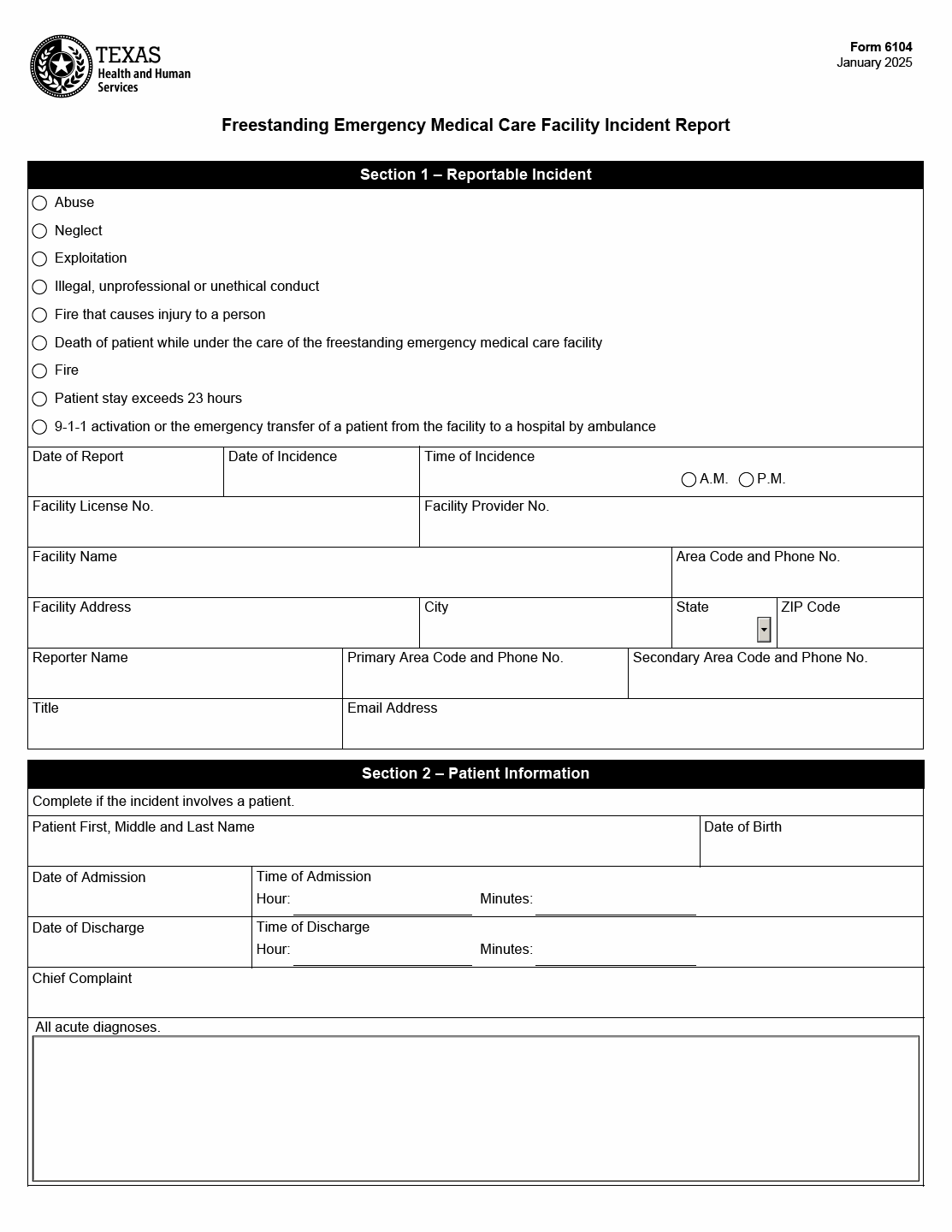
Form 6104 is the official incident reporting document used by freestanding emergency medical care facilities in Texas to report serious, reportable events to state regulators. The form captures detailed information about incidents involving patient harm, safety risks, professional misconduct, emergency transfers, fires, deaths, or other events that require regulatory review and follow-up.
Purpose of Form 6104
The primary purpose of Form 6104 is to ensure that significant incidents occurring at a Freestanding Emergency Medical Care (FEMC) facility are promptly documented, reviewed, and addressed. The form creates an official record for oversight authorities and supports investigations, corrective actions, and system-wide quality improvement.
Submission of this form helps regulators assess compliance with licensing standards and evaluate whether additional enforcement, monitoring, or referrals are required.
When This Form Must Be Filed
Form 6104 must be completed when a reportable incident occurs at a licensed FEMC. Examples of reportable incidents include:
- Abuse, neglect, or exploitation involving a patient
- Illegal, unethical, or unprofessional conduct by staff
- Patient death while under facility care
- Fires causing injury or requiring emergency response
- Patient stays exceeding 23 hours
- 9-1-1 activation or emergency ambulance transfer to a hospital
The form is not required for minor operational issues that do not meet reporting thresholds or pose no risk to patient safety.
Who Is Authorized to Complete the Form
Form 6104 is typically completed by facility administrators, compliance officers, risk managers, or other designated leadership staff. While multiple staff members may contribute information, the facility is responsible for ensuring the report is complete, accurate, and submitted on time.
Explanation of Each Key Section
Section 1 – Reportable Incident
This section identifies the type of incident being reported and captures facility details, timing of the event, and reporter contact information. Selecting the correct incident category is critical, as it determines how the report is reviewed.
Section 2 – Patient Information
Completed when a patient is involved, this section documents identifying details, admission and discharge times, chief complaints, diagnoses, procedures performed, and discharge disposition.
Section 3 – Medical Provider Information
If a medical provider was involved, this section records the provider’s name, title, and license number to support professional accountability and potential board review.
Section 4 – Witness Information
This section identifies staff members who witnessed the incident and may be contacted during an investigation.
Section 6 – Alleged Perpetrator Information
When staff misconduct is alleged, this section documents identifying and licensing information for the individual involved.
Section 7 – Incident Summary and Investigation
This is the narrative core of the report. It explains what happened, how the facility responded, patient outcomes, investigative steps taken, and measures planned to prevent recurrence.
Section 8 – Referrals
This section records reports made to external agencies such as law enforcement, protective services, licensing boards, or federal regulators.
Office Use Only – Corrective Actions
This area documents corrective actions such as staff education, policy revisions, disciplinary measures, or quality assurance initiatives.
Practical Tips for Completing Form 6104
- Complete the form as soon as possible after the incident.
- Use clear, factual language in narrative sections.
- Ensure dates, times, and names are consistent throughout the report.
- Attach additional documentation when space is insufficient.
- Coordinate with legal and compliance teams when necessary.
Common Mistakes to Avoid
- Failing to report incidents that meet reporting criteria
- Submitting incomplete patient or provider information
- Using vague or speculative language in narratives
- Omitting referral information when reports were made
- Missing follow-up actions or corrective plans
Legal and Regulatory Context
Form 6104 is required under Texas laws and administrative rules governing freestanding emergency medical care facilities. These regulations mandate prompt reporting of serious incidents to protect patients, ensure transparency, and maintain facility licensure.
Failure to report required incidents may result in enforcement actions, penalties, increased oversight, or licensing consequences.
Real-Life Situations Where This Form Is Used
- A patient is transferred by ambulance to a hospital after emergency stabilization.
- A fire alarm event results in patient injury or evacuation.
- A patient dies while receiving care at the facility.
- Allegations of staff misconduct trigger an internal investigation.
Documents Commonly Attached to This Form
- Incident investigation reports
- Medical records and treatment notes
- Witness statements
- Corrective action plans
- External agency reports or reference numbers
Frequently Asked Questions
Is Form 6104 required for every incident?
No, only incidents that meet reportable criteria.
Who reviews the submitted form?
State regulatory authorities overseeing FEMC facilities.
Can additional pages be attached?
Yes, attachments are allowed and often necessary.
Does submitting the form admit fault?
No, it documents facts and corrective actions.
Are external reports required in all cases?
Only when mandated by law or regulation.
What happens after submission?
The report may be reviewed, investigated, or used to initiate follow-up actions.
Related Forms
- FEMC Corrective Action Plan Forms
- Patient Grievance Reports
- Medical Board or Nursing Board Complaint Forms
- OSHA Incident Reporting Forms
Form Details
- Form Name: Freestanding Emergency Medical Care Facility Incident Report
- Form Number: 6104
- Issued By: Texas Health and Human Services Commission
- State: Texas
- Revision Date: January 2025