
TX HHS Form 4807-D. Action Taken on Hearing Decision
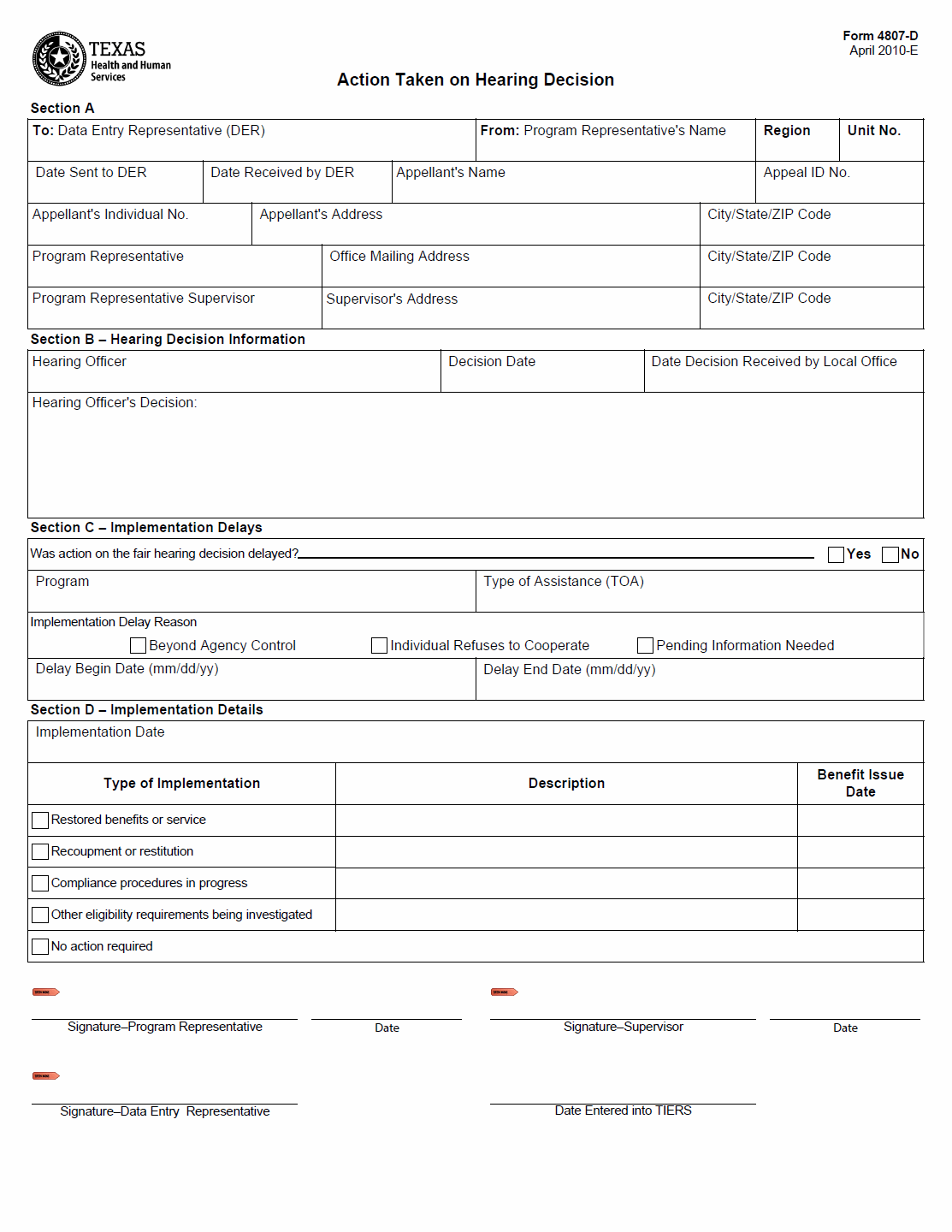
Form 4807-D is used by Texas Health and Human Services (HHS) staff to document how a local office handled a fair hearing decision. Although the form looks administrative, it plays an important legal role: it confirms when a hearing decision was received, what action the agency took, whether benefits were restored, and whether delays occurred. For anyone involved in appeals within public assistance programs, this form is the official record that shows the agency followed the Hearing Officer’s ruling.
Purpose of Form 4807-D
The form tracks what happens after a fair hearing decision is issued. When an appellant challenges an eligibility or benefit decision, a Hearing Officer reviews the case and issues a ruling. Local staff must then implement that ruling correctly and within strict deadlines. Form 4807-D captures:
- who received the decision and when;
- whether the ruling was implemented on time;
- what actions were taken (restored benefits, recoupment, no action needed);
- whether delays occurred and why;
- signatures confirming official compliance.
In short, it is the compliance audit trail for fair hearings inside HHS programs.
Who Uses This Form
Only agency staff fill out Form 4807-D. It is not completed by the public. Participants in a hearing may receive decisions and letters, but this internal document ensures the agency complies with state and federal rules governing public assistance programs.
When the Form Is Required
The form is used each time a fair hearing decision requires action by the local office—for example, restoring benefits or adjusting eligibility. It is not needed when a case is dismissed before a decision or when a Hearing Officer concludes that no action is required.
Overview of Key Sections
Section A — Basic Case and Staff Information
This section identifies the appellant and the staff responsible for implementing the hearing decision. It includes dates when the decision was sent to and received by the Data Entry Representative (DER). A common mistake is entering inconsistent dates, which can suggest a processing delay that did not actually happen.
Section B — Hearing Decision Information
Here the Program Representative records the Hearing Officer’s decision, along with the dates it was issued and received. These dates are crucial because implementation deadlines are calculated from them. If the decision date is missing or incorrect, it can lead to compliance issues during audits.
Section C — Implementation Delays
This section documents whether the local office experienced delays in carrying out the decision. Acceptable delay reasons include situations beyond the agency’s control or cases where the appellant fails to cooperate. Listing an incorrect delay category or leaving the “Delay Begin Date” blank is a common processing error.
Section D — Implementation Details
This is the most important part of the form. Staff document exactly what action was taken—restoring benefits, initiating recoupment, confirming compliance, or noting that no action was needed. The Implementation Date must match the recorded action. Missing signatures in this section are one of the most frequent compliance findings.
Practical Recommendations for Completing the Form
- Verify all dates before submission—incorrect date chains trigger compliance reviews.
- Ensure the “Type of Implementation” matches the Hearing Officer’s written conclusion.
- Attach or reference any internal notes explaining unusual delays.
- Confirm all required signatures are collected on the same day the form is finalized.
Common Errors and How to Avoid Them
- Mismatched dates: Always confirm receipt dates with TIERS logs.
- Incorrect delay category: Choose “Beyond Agency Control” only when documentation supports it.
- Missing implementation description: Provide a short but clear explanation of what action was taken.
- Unsigned forms: Submit only after all three signatures are collected.
Examples of Real-World Situations
- Example 1: An appellant wins a hearing because their SNAP income was calculated incorrectly. The local office uses Form 4807-D to document the restoration of benefits.
- Example 2: A Medicaid case is denied, but the Hearing Officer upholds the denial. Staff complete the form to record that no further action is required.
- Example 3: A delay occurs because the appellant refuses to provide updated residency documentation. Section C captures the delay period and reason.
Documents Commonly Attached
- copy of the Hearing Officer’s decision;
- internal case notes explaining actions taken;
- benefit recalculation documentation when benefits are restored or recouped;
- delay justification documentation, if applicable.
FAQ
What is the purpose of Form 4807-D?
It documents how a local office implemented a fair hearing decision and verifies that required actions were completed.
Who fills out this form?
Only Texas HHS staff, including Program Representatives, Supervisors, and Data Entry Representatives.
Is the form required for every fair hearing?
No. It is used only when the Hearing Officer’s decision requires action by the local office.
What happens if an implementation delay occurs?
The delay must be documented with an appropriate reason and exact start and end dates.
Does the appellant see this form?
No. This is an internal compliance document used by HHS.
What if no action is required?
Section D is used to document that no further steps are needed based on the hearing decision.
Where is the form submitted?
After completion, it is entered into TIERS by the Data Entry Representative.
Micro-FAQ
- Purpose: To document implementation of a fair hearing decision.
- Who completes it: Texas HHS staff only.
- Deadline: Shortly after receiving the Hearing Officer’s decision.
- Attachments: Usually the hearing decision and implementation notes.
- Submitted to: Entered into TIERS.
- Used when: A hearing decision requires action.
- Delay allowed: Yes, if properly documented.
- Legal impact: Confirms agency compliance with hearing rulings.
- Action types: Benefit restoration, recoupment, or no action.
- Signatures required: Program Representative, Supervisor, DER.
Related Forms
- Form H4800 – Fair Hearing Request
- Form H4803 – Notice of Hearing
- Form H4805 – Summary for Fair Hearing
- Form H4806 – Hearing Decision Cover Letter
Form Details
- Form Name: Action Taken on Hearing Decision
- Form Number: 4807-D
- Region: Texas Health and Human Services
- Edition: April 2010-E