
TX HHS Form 3713. Nursing Facility Consent for Antipsychotic or Neuroleptic Medication Treatment
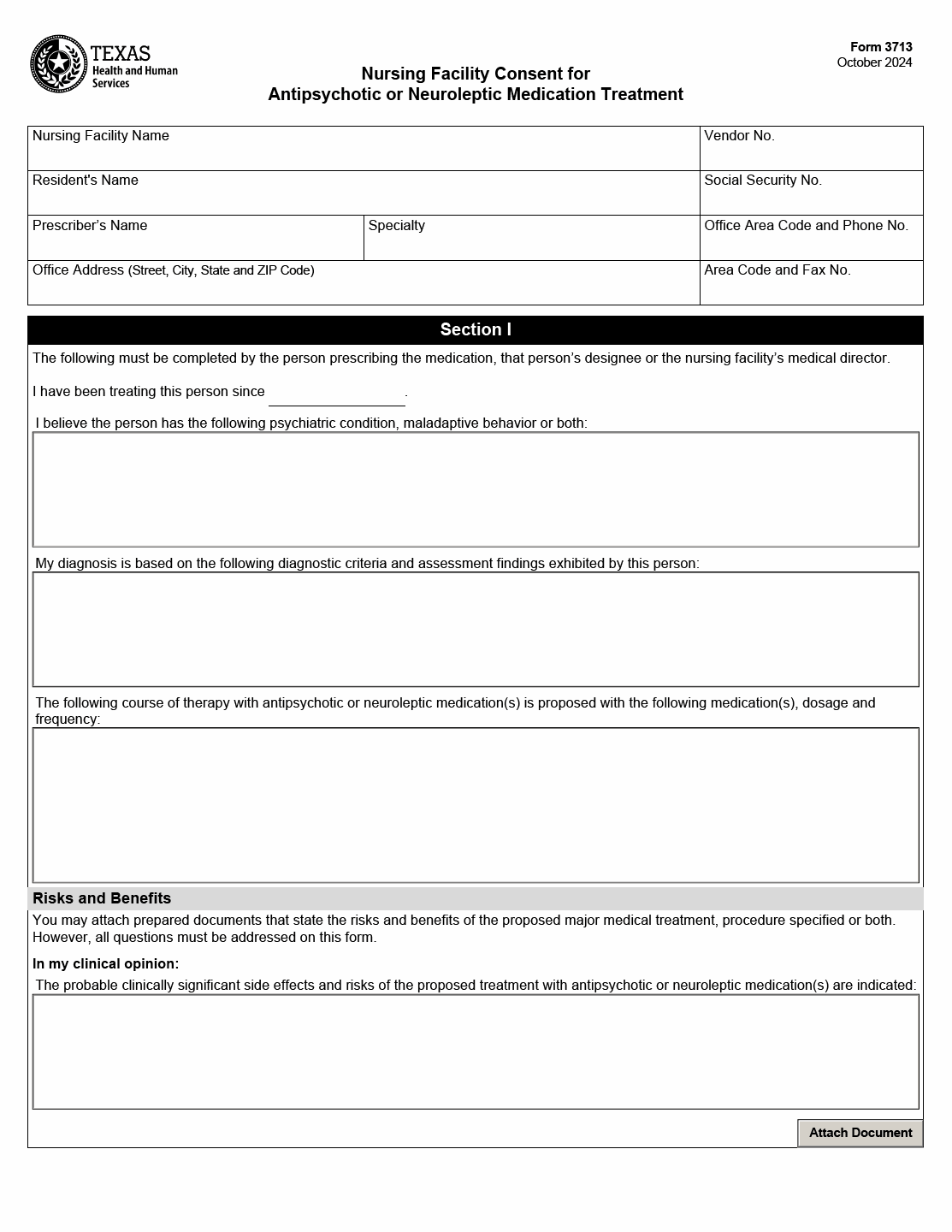
Form 3713, titled “Nursing Facility Consent for Antipsychotic or Neuroleptic Medication Treatment”, is an official Texas Health and Human Services form used in nursing facilities when antipsychotic or neuroleptic medications are prescribed to a resident. The form documents the medical justification for treatment and confirms that informed consent has been properly obtained and recorded.
This document is a mandatory part of the resident’s clinical record and is designed to protect residents’ rights while ensuring that prescribing clinicians and facilities comply with state regulatory requirements.
Purpose of the Form
The primary purpose of Form 3713 is to ensure that antipsychotic or neuroleptic medications are prescribed only when clinically appropriate and that residents, or their legally authorized representatives, fully understand and consent to the treatment.
The form creates a clear record that:
- The prescribing professional has assessed the resident and documented a valid clinical rationale.
- The risks, side effects, and benefits of the medication have been considered and disclosed.
- Consent was given voluntarily and can be withdrawn at any time.
Who Must Complete and Use This Form
Form 3713 is used in Texas nursing facilities and involves multiple parties:
- Physicians or other authorized prescribers
- Prescriber designees or the facility’s medical director
- Nursing facility residents
- Legally authorized representatives acting on behalf of a resident
The form is required only when antipsychotic or neuroleptic medication treatment is proposed or continued.
Explanation of Each Section
Facility and Resident Information
This section identifies the nursing facility, vendor number, resident’s name, Social Security number, and the prescribing clinician’s contact information. Accurate identification ensures the consent is properly matched to the correct resident and facility records.
Section I — Prescriber’s Clinical Statement
This section must be completed by the prescribing clinician, their authorized designee, or the nursing facility’s medical director. It documents:
- How long the resident has been under the prescriber’s care
- The psychiatric condition, maladaptive behavior, or both that justify treatment
- The diagnostic criteria and assessment findings supporting the diagnosis
- The proposed medication regimen, including dosage and frequency
The prescriber must also clearly explain the anticipated benefits and the clinically significant risks or side effects. Supporting documents may be attached, but all required questions must still be addressed on the form.
Section II — Resident or Representative Consent
This section confirms informed consent. The resident or their legally authorized representative acknowledges that:
- The form was received with Section I fully completed
- They consent to the proposed medication treatment
- The decision was made voluntarily, without pressure or coercion
- Consent may be revoked at any time
The section must be signed and dated to be valid.
When This Form Is Required — and When It Is Not
Form 3713 must be completed whenever a nursing facility resident is prescribed antipsychotic or neuroleptic medication. It is not required for medications outside this category or for treatments that do not involve these drug classes.
Failure to include this form in the resident’s clinical record may result in compliance issues during audits or inspections.
Legal and Regulatory Context
The use of Form 3713 is governed by 26 Texas Administrative Code §554.1207. Texas regulations require nursing facilities to document informed consent for certain major medical treatments, including antipsychotic and neuroleptic medications.
This form serves as proof that the facility has met its legal obligation to protect resident rights and follow state healthcare standards.
Common Mistakes to Avoid
- Leaving diagnostic criteria or assessment findings vague or incomplete
- Failing to clearly describe risks and side effects
- Missing signatures or dates
- Using outdated versions of the form
- Not placing the form in the resident’s clinical record
Practical Tips for Completing the Form
- Ensure all clinical explanations are specific and individualized
- Attach supporting documentation if detailed risk–benefit explanations are lengthy
- Review the form with the resident or representative before signing
- Keep a copy readily accessible in the clinical file
Real-Life Situations Where This Form Is Used
- A resident with severe behavioral symptoms related to dementia requires antipsychotic medication.
- A psychiatric condition worsens and medication adjustments are necessary.
- A new resident arrives with an existing antipsychotic prescription that must be formally consented to.
Documents Commonly Attached
- Detailed risk and benefit explanations prepared by the prescriber
- Clinical assessments or psychiatric evaluations
- Supporting treatment plans
Frequently Asked Questions
Who is allowed to sign this form?
The resident or a legally authorized representative may sign the consent section.
Can consent be withdrawn later?
Yes. Consent may be revoked at any time.
Is this form required for every medication?
No. It applies specifically to antipsychotic and neuroleptic medications.
Must the prescriber complete the form personally?
It may be completed by the prescriber, an authorized designee, or the facility’s medical director.
Where must the form be stored?
The original or a copy must be included in the resident’s clinical record.
Micro-FAQ
- Purpose: To document informed consent for antipsychotic or neuroleptic medication.
- Who files: Nursing facility prescribers and residents or their representatives.
- When required: Before or during treatment with these medications.
- Attachments: Risk and benefit explanations, if applicable.
- Submitted to: Maintained in the resident’s clinical record.
Related Forms
- Nursing Facility Admission Agreements
- Resident Rights Acknowledgment Forms
- Medical Treatment Consent Forms
Form Details
- Form Name: Nursing Facility Consent for Antipsychotic or Neuroleptic Medication Treatment
- Form Number: 3713
- Region: Texas
- Regulatory Authority: Texas Health and Human Services
- Revision Date: October 2024