
TX HHS Form 3302. Standard Application for Residential Treatment Services
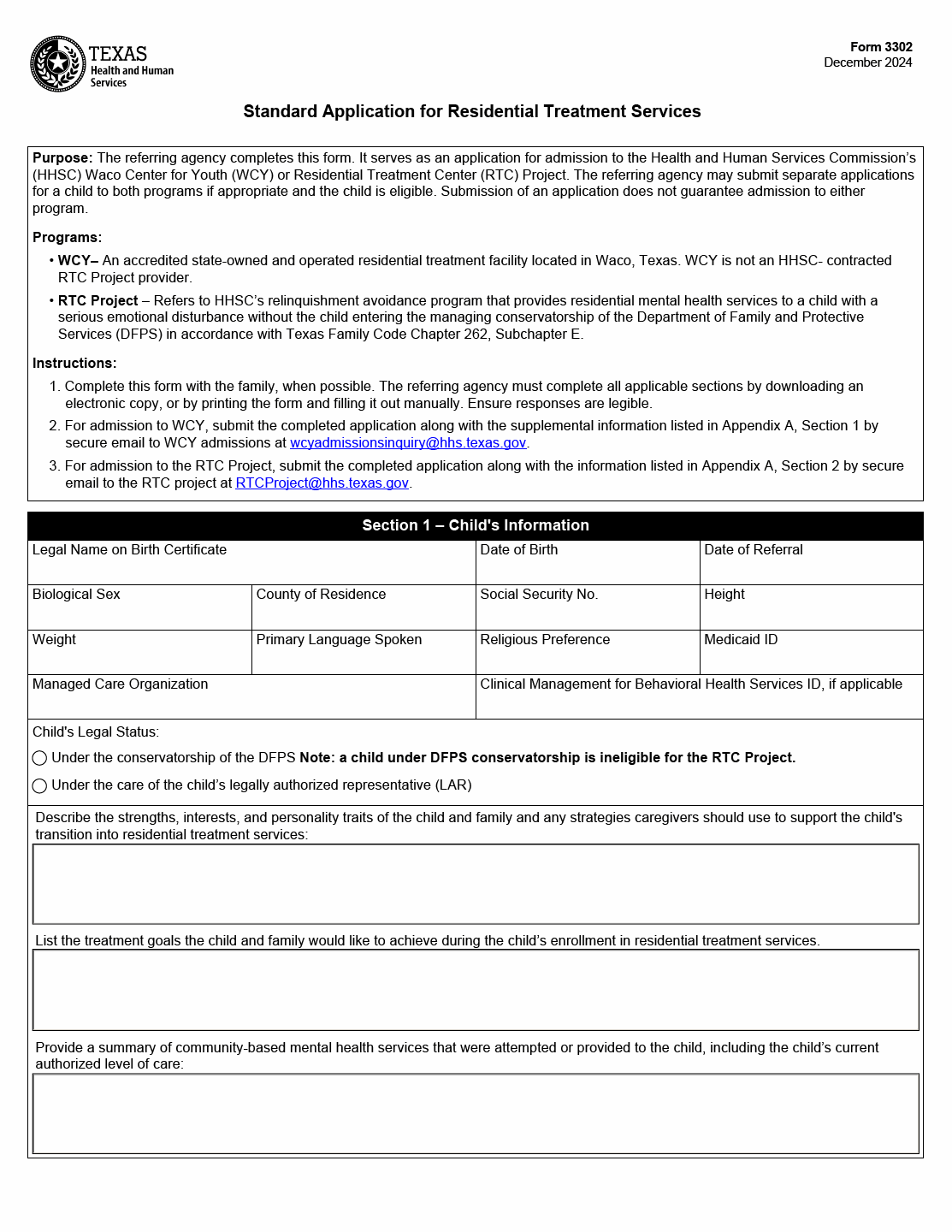
Form 3302 is the standard application used by referring agencies in Texas to request admission for a child into state-supported residential mental health programs, including the Waco Center for Youth (WCY) and the Residential Treatment Center (RTC) Project. The form gathers detailed clinical, family, educational, legal, and social information to help Health and Human Services Commission (HHSC) determine eligibility, appropriateness, and placement options for residential treatment services.
Purpose of Form 3302
The main purpose of Form 3302 is to provide HHSC with a comprehensive, structured picture of a child’s needs, history, and current circumstances when residential treatment is being considered. It allows decision-makers to assess whether a child meets program criteria, whether less restrictive services have been attempted, and which program may best support the child’s safety and mental health needs.
Submission of this form is required for consideration but does not guarantee admission to WCY or the RTC Project.
When This Form Must Be Used
Form 3302 must be completed when a referring agency seeks placement for a child in residential treatment through HHSC programs. Typical situations include:
- A child with serious emotional disturbance who has not stabilized with community-based services
- A youth at risk of residential placement entering state conservatorship without intervention
- A referral to the Waco Center for Youth for intensive residential care
- An application to the RTC Project to avoid relinquishment of custody to DFPS
The form should not be used if the child is already under DFPS conservatorship and applying to the RTC Project, as such children are ineligible for that program.
Who Is Authorized to Complete the Form
Form 3302 is completed by the referring agency, such as a Local Mental Health Authority (LMHA), Local Behavioral Health Authority (LBHA), DFPS, or other authorized coordination entities. The form should be completed with the family whenever possible.
Parents or Legally Authorized Representatives (LARs) provide information but do not independently submit the application.
Explanation of Key Sections
Section 1 – Child’s Information
This section captures identifying details, Medicaid and managed care information, legal status, and a narrative overview of the child’s strengths, personality, and treatment goals. It also documents prior community-based services and current levels of care, which are critical for demonstrating medical necessity.
Section 2 – Referral Source
Here, the referring agency identifies itself and provides contact information for case managers, liaisons, or coordination staff. This ensures HHSC can request clarifications and coordinate next steps.
Section 3 – Household Information
This section outlines the child’s living situation, family composition, and caregiver relationships. It helps reviewers understand family dynamics, stability, and available supports.
Section 4 – Trauma History and Risk Behavior
This detailed section documents abuse history, traumatic experiences, behavioral risks, substance use, and safety concerns. Accuracy is essential, as this information directly affects placement decisions and treatment planning.
Section 5 – Health Care Summary
This section covers psychiatric history, medical conditions, medications, developmental history, and family medical background. It helps assess clinical complexity and treatment readiness.
Section 6 – Legal History
Legal involvement, probation conditions, gang affiliation, and court requirements are documented here. These details inform supervision needs and program compatibility.
Section 7 – Educational History
This section describes academic performance, special education services, disciplinary history, and current enrollment. Educational needs are a core component of residential treatment planning.
Appendix A – Required Supplemental Information
The appendix lists mandatory supporting documents, which differ depending on whether the application is for WCY or the RTC Project. Missing items may delay or prevent review.
Practical Tips for Completing Form 3302
- Complete the form collaboratively with the family whenever possible.
- Ensure narratives are specific, factual, and consistent across sections.
- Double-check legal status to confirm program eligibility.
- Attach all required supplemental documents listed in Appendix A.
- Use secure email and the correct submission address for each program.
Common Mistakes to Avoid
- Submitting incomplete appendices or outdated evaluations
- Providing vague or inconsistent trauma or service histories
- Applying to the RTC Project for a child under DFPS conservatorship
- Omitting recent psychiatric or psychological assessments
- Illegible handwritten responses
Legal and Regulatory Context
Form 3302 is required under Texas Health and Human Services policies governing residential mental health services for children. The RTC Project operates under Texas Family Code Chapter 262, Subchapter E, which focuses on preventing unnecessary relinquishment of parental rights. WCY admissions are governed by HHSC program standards and eligibility criteria.
Providing accurate information is essential, as the form becomes part of the child’s official placement and treatment record.
Real-Life Examples of Use
- An LMHA applies for RTC Project placement to stabilize a child and avoid DFPS conservatorship.
- A referring agency submits an application to WCY after repeated inpatient hospitalizations.
- A child with escalating safety risks is referred for residential treatment following failed outpatient services.
Documents Commonly Required with This Form
- Psychological and psychiatric evaluations
- Progress notes and discharge summaries
- Birth certificate and Social Security card
- Immunization and Medicaid records
- Custody or court orders, if applicable
- CANS assessment and Family Agreement (for RTC Project)
Frequently Asked Questions
Does submitting Form 3302 guarantee admission?
No, it is an application only and does not guarantee placement.
Can a child apply to both WCY and the RTC Project?
Yes, separate applications may be submitted if the child is eligible.
Who sends the completed form?
The referring agency submits the application by secure email.
Is parental participation required?
Family involvement is strongly encouraged but the agency submits the form.
What happens if documents are missing?
The review may be delayed or the application may be deemed incomplete.
Can the form be updated after submission?
Updates may be requested by HHSC during the review process.
Related Forms
- Form 3301 – Family Agreement
- Form 2037 – Referral for Placement in DSHS-Funded RTC
- Form 2823 – LMHA or LBHA Referral
- CANS Assessment Documentation
Form Details
- Form Name: Standard Application for Residential Treatment Services
- Form Number: 3302
- Issued By: Texas Health and Human Services Commission
- State: Texas
- Revision Date: December 2024