
TX HHS Form 3236. Licensed Chemical Dependency Counselor Licensure by Reciprocity Application
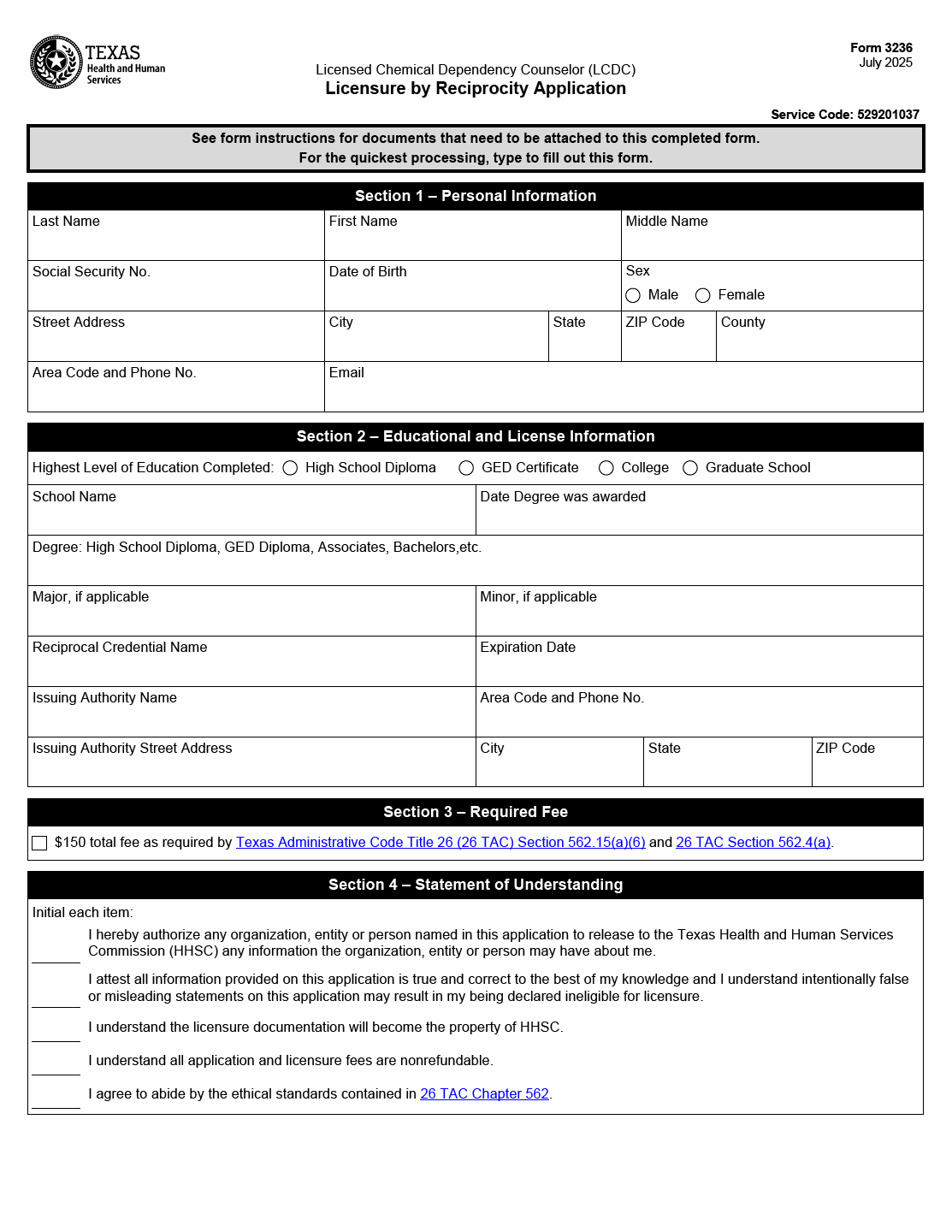
Form 3236 is the official application used to request a Texas Licensed Chemical Dependency Counselor (LCDC) license through reciprocity. It allows counselors who already hold a qualifying credential in another jurisdiction to apply for Texas licensure through the Health and Human Services Commission (HHSC), provided they meet education, credential, and regulatory requirements.
Purpose of Form 3236
The purpose of Form 3236 is to evaluate whether an out-of-state chemical dependency counseling credential meets Texas standards for LCDC licensure. Rather than completing the full Texas licensure pathway from the beginning, eligible applicants may use this form to demonstrate equivalency through education, existing licensure, and professional standing.
The form also serves as a legal attestation that the applicant understands and agrees to comply with Texas licensure laws, ethical standards, and ongoing regulatory obligations.
When This Form Must Be Submitted
Form 3236 must be submitted when an individual seeks LCDC licensure in Texas based on an existing credential issued by another state or jurisdiction. Common situations include:
- Relocating to Texas while holding an active out-of-state chemical dependency counseling license
- Accepting employment in Texas that requires LCDC licensure
- Transitioning from military or federal service licensure to Texas credentials
- Seeking faster licensure through reciprocity rather than standard application routes
This form should not be used by applicants who do not already hold a qualifying reciprocal credential or who are applying for initial LCDC licensure in Texas.
Who Is Authorized to Complete the Form
Form 3236 must be completed by the individual applying for licensure. All information, signatures, and attestations must come directly from the applicant. Third parties may assist with preparation, but responsibility for accuracy rests entirely with the applicant.
Explanation of Each Key Section
Section 1 – Personal Information
This section identifies the applicant and includes legal name, date of birth, Social Security number, contact information, and residence details. Accuracy is essential, as this information is used for identity verification and official correspondence.
Section 2 – Educational and License Information
Applicants disclose their highest level of education, degree details, and the reciprocal credential they are relying on. Information about the issuing authority allows HHSC to verify the license’s standing, scope, and expiration.
Section 3 – Required Fee
This section confirms the nonrefundable $150 application fee required under Texas Administrative Code. Applications submitted without the correct fee are not processed.
Section 4 – Statement of Understanding
Applicants initial each statement to acknowledge consent for background verification, ownership of submitted documents by HHSC, nonrefundability of fees, and agreement to follow ethical standards under 26 TAC Chapter 562.
Section 5 – Signature and Notarization
The applicant must sign the form in the presence of a notary public. This notarized attestation confirms that the applicant has reviewed Texas licensure laws and accepts responsibility for ongoing compliance.
Section 6 – GovDelivery Updates
This optional section allows applicants to receive official updates regarding rule changes, licensing requirements, and program notices related to chemical dependency counselor licensure.
Practical Tips for Completing Form 3236
- Type responses whenever possible to avoid legibility issues.
- Confirm that your reciprocal license is active and unexpired.
- Attach all required documentation listed in the form instructions.
- Ensure notarization is completed correctly before mailing.
- Include the full application fee to prevent processing delays.
Common Mistakes to Avoid
- Submitting expired or inactive reciprocal credentials
- Failing to notarize the signature section
- Providing inconsistent education or license dates
- Omitting required supporting documents
- Assuming fees are refundable if the application is denied
Legal and Regulatory Context
Form 3236 is governed by Texas Administrative Code Title 26, Chapter 562, which establishes licensing, ethical, and disciplinary standards for chemical dependency counselors. Texas law requires HHSC to verify that reciprocal credentials meet or exceed state requirements to protect public health and ensure professional competence.
False statements or omissions may result in denial of licensure or future disciplinary action.
Real-Life Situations Where This Form Is Used
- A licensed counselor moves from another state to Texas for employment.
- A military spouse applies for Texas licensure using an existing out-of-state credential.
- A counselor expands practice to Texas-based treatment facilities.
Documents Commonly Required with This Form
- Proof of reciprocal licensure
- Educational transcripts or diplomas
- Verification from issuing licensing authority
- Payment of required application fee
- Any additional documents listed in the form instructions
Frequently Asked Questions
Does reciprocity guarantee Texas licensure?
No, HHSC must determine equivalency before approval.
Is the application fee refundable?
No, all fees are nonrefundable.
Must the form be notarized?
Yes, notarization is required for the application to be valid.
Can I work while the application is pending?
Licensure is required before practicing as an LCDC in Texas.
How long does processing take?
Processing time varies depending on documentation completeness.
What happens if information is false or incomplete?
The application may be denied or disciplinary action may follow.
Related Forms
- LCDC Initial Licensure Application
- LCDC License Renewal Form
- LCDC Supervisor Designation Form
- HHSC Credential Verification Requests
Form Details
- Form Name: LCDC Licensure by Reciprocity Application
- Form Number: 3236
- Issued By: Texas Health and Human Services Commission
- State: Texas
- Revision Date: July 2025