
TX HHS Form 2993. General Residential Operations Medication Log
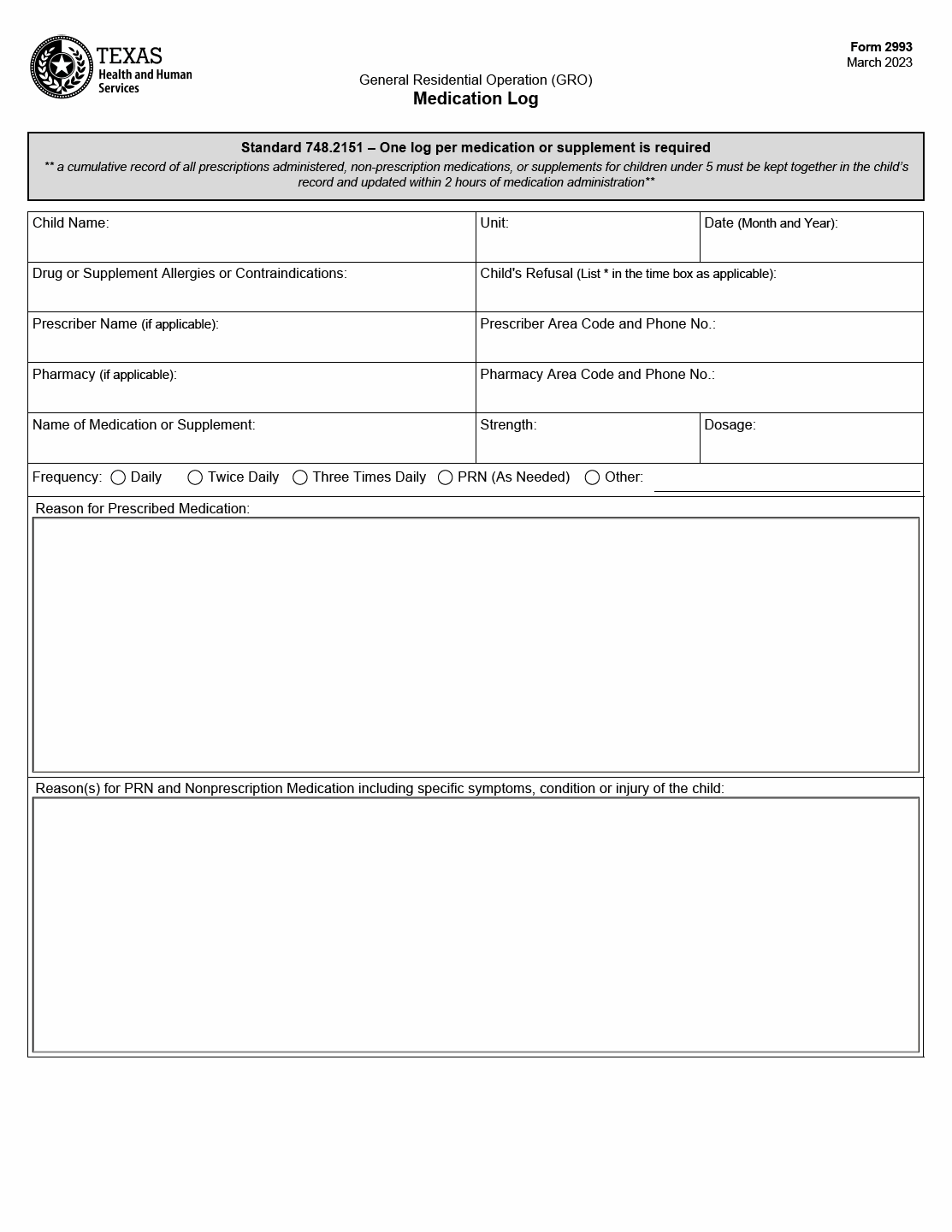
The GRO Medication Log (Form 2993) is a mandatory record used in Texas residential childcare operations to track every prescription, nonprescription medication, and supplement administered to a child. This form helps ensure accurate documentation, consistency of care, and compliance with state childcare regulations. It also protects both the child and the caregivers by creating a clear, time-stamped history of medication activity.
Purpose of Form 2993
Texas Minimum Standards (§748.2151) require licensed General Residential Operations to maintain a separate log for each medication or supplement. For children under five years old, all medications must be documented together as a cumulative record and updated within two hours of administration. This form supports safe medication practices, prevents dosing errors, and provides a transparent trail for inspections, audits, and medical reviews.
Overview of the Main Sections
Child and Record Information
This section identifies the child, the unit or cottage where they reside, and the month and year the log covers. Accuracy here ensures the log cannot be confused with another child’s records.
- Child Name – Full legal name of the child.
- Unit – The child’s assigned living unit or program area.
- Date – Month and year for which this log is used.
Allergies and Contraindications
Caregivers must list any drug allergies or known contraindications. This is crucial for preventing harmful interactions and ensuring all staff are aware of restrictions.
Child’s Refusal
If a child refuses medication, caregivers note an asterisk (*) in the time box. Documenting refusals protects the operation legally and clinically, showing that medication was offered but not forced.
Prescriber and Pharmacy Information
- Prescriber Name & Phone – The healthcare professional responsible for the medication order.
- Pharmacy & Phone – Where the medication was dispensed.
These details allow quick contact if clarification or refill information is needed.
Medication Details
- Name, Strength, Dosage – Full pharmaceutical details must match the prescription label.
- Frequency – Daily, twice daily, three times daily, PRN, or other schedules.
- Reason for Medication – The condition or symptoms requiring treatment.
- Reason for PRN/Nonprescription Use – Specific symptoms that justify giving the medication.
Daily Administration Log
The calendar-style grid allows staff to record each administration:
- Time – When the dose was given.
- Initials – Initials of the caregiver providing the medication.
- Amount Remaining – Helps track inventory and detect discrepancies.
Caregiver Verification
At the bottom of the form, caregivers print their names, include the date, and add initials to verify entries. These signatures authenticate the log for regulatory reviews and protect both staff and children.
Common Mistakes and How to Avoid Them
- Missing time entries – Every dose, refusal, or PRN administration must be recorded immediately.
- Incorrect dosage documentation – Always match the prescription label exactly.
- Not updating within 2 hours – Required for children under five.
- Unclear initials – Staff should use consistent, identifiable initials.
- Skipping the “amount remaining” field – This can create compliance issues during audits.
When Form 2993 Is Required
- Any time a GRO administers a prescription medication.
- When a child takes nonprescription medicine (e.g., fever reducer, allergy relief).
- When supplements (vitamins, herbal products) are provided under approval.
- For PRN medications, regardless of how rarely they are used.
You do not need this form for staff medication or for children living with a foster family outside the facility environment.
Real-Life Examples of When This Form Is Used
- Example 1: A child with ADHD receives a morning and lunchtime prescription. Staff document each dose and remaining pill count daily.
- Example 2: A child has seasonal allergies. The log records occasional PRN antihistamine use when symptoms flare.
- Example 3: A toddler with a chronic condition requires multiple supplements. For children under 5, all entries are kept together in a combined log.
- Example 4: After an injury, a child receives short-term pain medication. Staff update the log each time medication is given or refused.
Documents Commonly Required Alongside Form 2993
- Prescription label or physician’s order
- Treatment or care plan from the healthcare provider
- Incident report (if the medication is related to injury)
- Parental or guardian consent for nonprescription medications
- Allergy or medical alert documentation
Practical Tips for Accurate Completion
- Record entries immediately to avoid mistakes.
- Keep medications in original containers with visible labels.
- Double-check time and dosage if multiple staff are on shift.
- Use the same initials consistently across all logs.
- Review the log at the end of each shift to catch missing entries.
FAQ
- Who is allowed to complete this log? Any authorized caregiver trained in medication administration at a licensed GRO.
- Is a separate form required for each medication? Yes, except for children under 5, where all medications must be combined in one cumulative log.
- What happens if a child refuses medication? Place an asterisk (*) in the time box and document the refusal according to facility policy.
- Do supplements count as medications? Yes. Vitamins and herbal products must be logged.
- How quickly must the log be updated? Immediately, and within 2 hours for children under 5.
- What if a mistake is made on the log? Follow the facility’s correction policy—usually a single line strike-through with initials.
- Is this form reviewed by inspectors? Yes, during regulatory visits and audits.
Micro-FAQ
- Purpose? Track all medications and supplements administered to a child.
- Who fills it out? Authorized caregivers in a licensed GRO.
- Deadline? Entries must be made immediately.
- Attachments? Prescription labels, medical orders, consent forms.
- Submitted to? Kept on file at the GRO for inspection.
- One form per medication? Yes, with exceptions for children under five.
- Are PRN meds included? Always.
- Are refusals logged? Yes, using an asterisk.
- Legal requirement? Required by Texas Minimum Standards §748.2151.
Related Forms
- Texas Form 2994 – Medication Incident Report
- Texas Form 2901 – Health Care Professional’s Assessment
- Texas Form 3019 – Emergency Care Plan
- General Residential Operation Daily Care Logs
Form Details
- Form Name: General Residential Operation Medication Log
- Form Number: 2993
- Region: Texas
- Last Revision: March 2023