
TX HHS Form 0066. Request for Authorized Electronic Monitoring
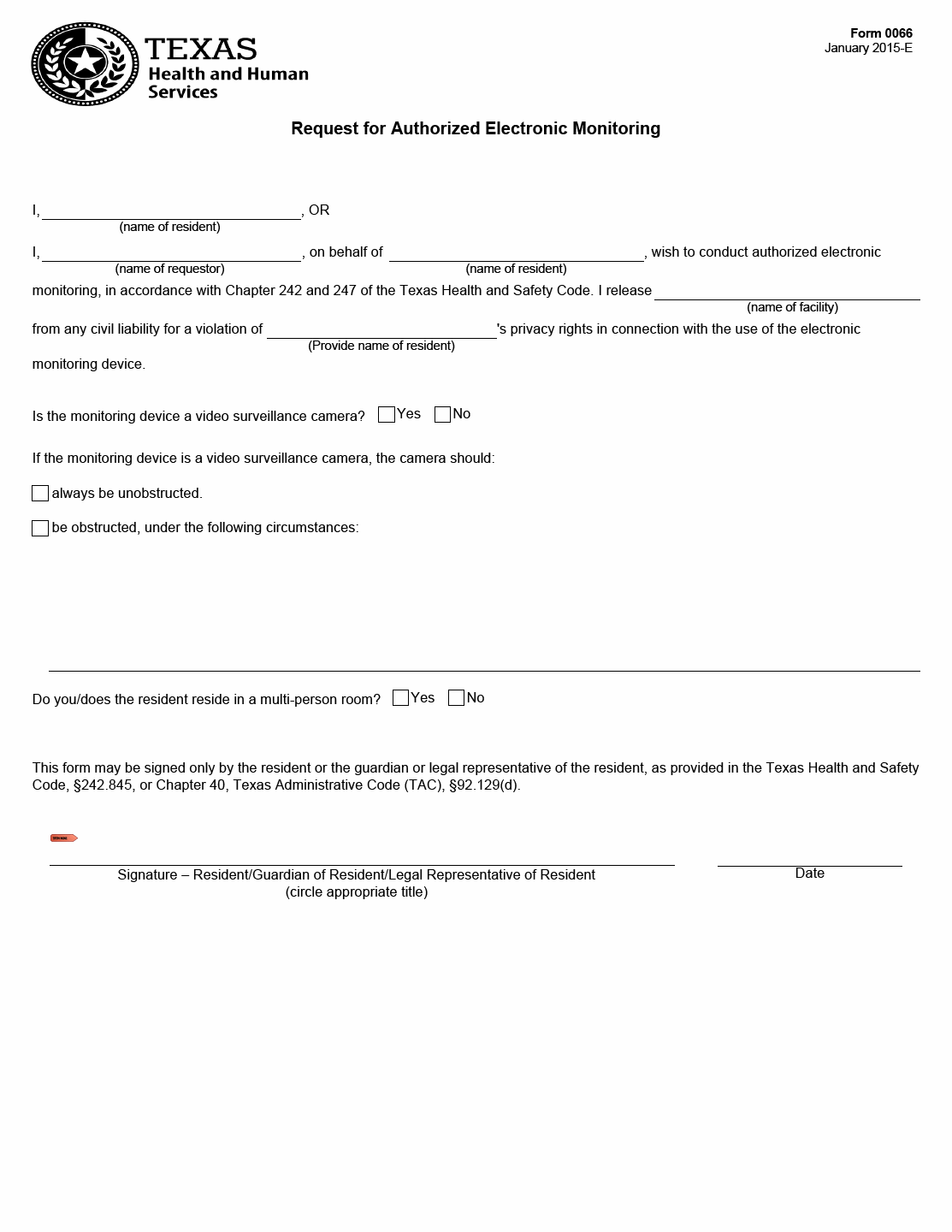
The “Request for Authorized Electronic Monitoring” form is a short but legally significant document used in Texas long-term care facilities. It allows a resident—or a legal representative acting on their behalf—to formally authorize the use of an electronic monitoring device, such as a video camera, inside the resident’s room. Although the form looks simple, it triggers specific rights and obligations under Texas Health and Safety Code Chapters 242 and 247. Understanding how to complete it correctly is essential, as improperly submitted requests may lead to delays or disputes around privacy and compliance.
Purpose of the Form
This form is designed to document a resident’s informed consent to electronic monitoring. Texas law grants residents the right to install monitoring equipment in their rooms, usually for safety, oversight of care, or peace of mind for family members. However, the facility must receive a written request before monitoring can begin. The form ensures:
- that the resident (or guardian/legal representative) authorizes recording,
- that the facility is released from civil liability related to the resident’s privacy,
- that any roommates or shared-room conditions are properly disclosed,
- that video equipment placement and possible obstructions are clarified.
Explanation of Key Sections
Resident and Requestor Identification
The form begins by identifying the resident who will be monitored and the individual submitting the request. This may be the resident themselves or a legal guardian, agent under a medical power of attorney, or another authorized representative. Accuracy here is important, as the facility will rely on these names when documenting consent.
Statement of Authorization
This portion states that the request is made in compliance with Texas Health and Safety Code requirements. It confirms that the resident understands and agrees to electronic monitoring. The legal reference helps clarify why the facility must collect this documentation before allowing equipment in a resident’s room.
Release of Liability
The requestor must name the facility and explicitly release it from civil liability connected to the resident’s loss of privacy due to the installation of the monitoring device. This does not remove the facility’s responsibility for care, but it shields them from claims that arise solely from the resident’s choice to install monitoring equipment.
Type of Monitoring Device
The form asks whether the device is a video surveillance camera. Texas law treats audio and video differently, especially due to wiretap regulations, so clarifying the device type helps ensure compliance. If it is video, the requestor must indicate whether the camera will remain unobstructed or whether there are situations where it might be covered or turned away.
Shared Room Disclosure
If the resident lives in a multi-person room, additional consent from roommates may be required under state law. Failing to disclose that the resident shares a room is one of the most common mistakes and can delay installation until all required permissions are collected.
Signature Section
This form can only be signed by the resident or their authorized legal representative as defined in Texas Health and Safety Code §242.845 and Texas Administrative Code §92.129(d). The date is also required, as the facility must maintain accurate records of when electronic monitoring was authorized.
Practical Recommendations
- Use full legal names for all individuals listed to avoid confusion.
- If the resident shares a room, notify the facility in advance so they can obtain roommate consent.
- Clarify where the camera will be positioned; facilities may reject installations that violate fire safety or obstruct staff access.
- Keep a copy of the signed form for your own records.
Common Real-World Scenarios
- A daughter wants to monitor her mother’s nighttime safety after repeated falls. She submits this form to install a camera facing the bed.
- A resident with dementia lives in a shared room. His son completes the form but must also coordinate with the facility to collect the roommate’s consent.
- A family suspects inconsistent care and uses this form to authorize a camera for transparency and reassurance.
- A resident wants a camera only when caregivers are not present. They specify that the camera may be obstructed during personal care activities.
Required Supporting Documents
- Proof of legal authority (guardianship order, power of attorney), if the resident is not signing personally.
- Facility-specific installation guidelines, if required.
- Roommate consent form, if applicable.
FAQ
Who is allowed to sign this form?
The resident may sign, or an authorized legal representative such as a guardian or agent under a medical power of attorney.
Do I need consent from a roommate?
Yes. Texas law requires additional consent if the resident lives in a multi-person room.
Can I install audio recording equipment?
Audio devices may trigger additional state and federal privacy laws. Facilities often allow video more readily than audio.
Can the facility refuse electronic monitoring?
The facility cannot refuse a lawful request but may impose reasonable safety and installation rules.
What happens if the camera records staff?
Staff may be recorded during normal duties. This is generally permissible when the resident authorizes monitoring in their own room.
Is the facility responsible for maintaining the equipment?
No. The resident or representative is responsible for installation, maintenance, and costs.
Can the camera be turned off during personal care?
Yes. The form allows requestors to indicate when the camera may be obstructed.
Micro-FAQ (Short Answers)
- Purpose: Authorize electronic monitoring in a resident’s room.
- Who signs: Resident or legal representative.
- Device type: Video must be disclosed.
- Deadline: Before installing any monitoring device.
- Attachments: Legal authority documents and roommate consent.
- Submitted to: The long-term care facility’s administration.
- Legal basis: Texas Health & Safety Code Chapters 242 and 247.
Related Forms
- Roommate Consent for Electronic Monitoring (Texas)
- Notice of Electronic Monitoring Installation
- Resident Rights and Responsibilities Form
Form Details
- Form Name: Request for Authorized Electronic Monitoring
- Form Number: 0066
- Region: State of Texas
- Last Revision: January 2015