
Form MCSA-5871. Vision Evaluation Report
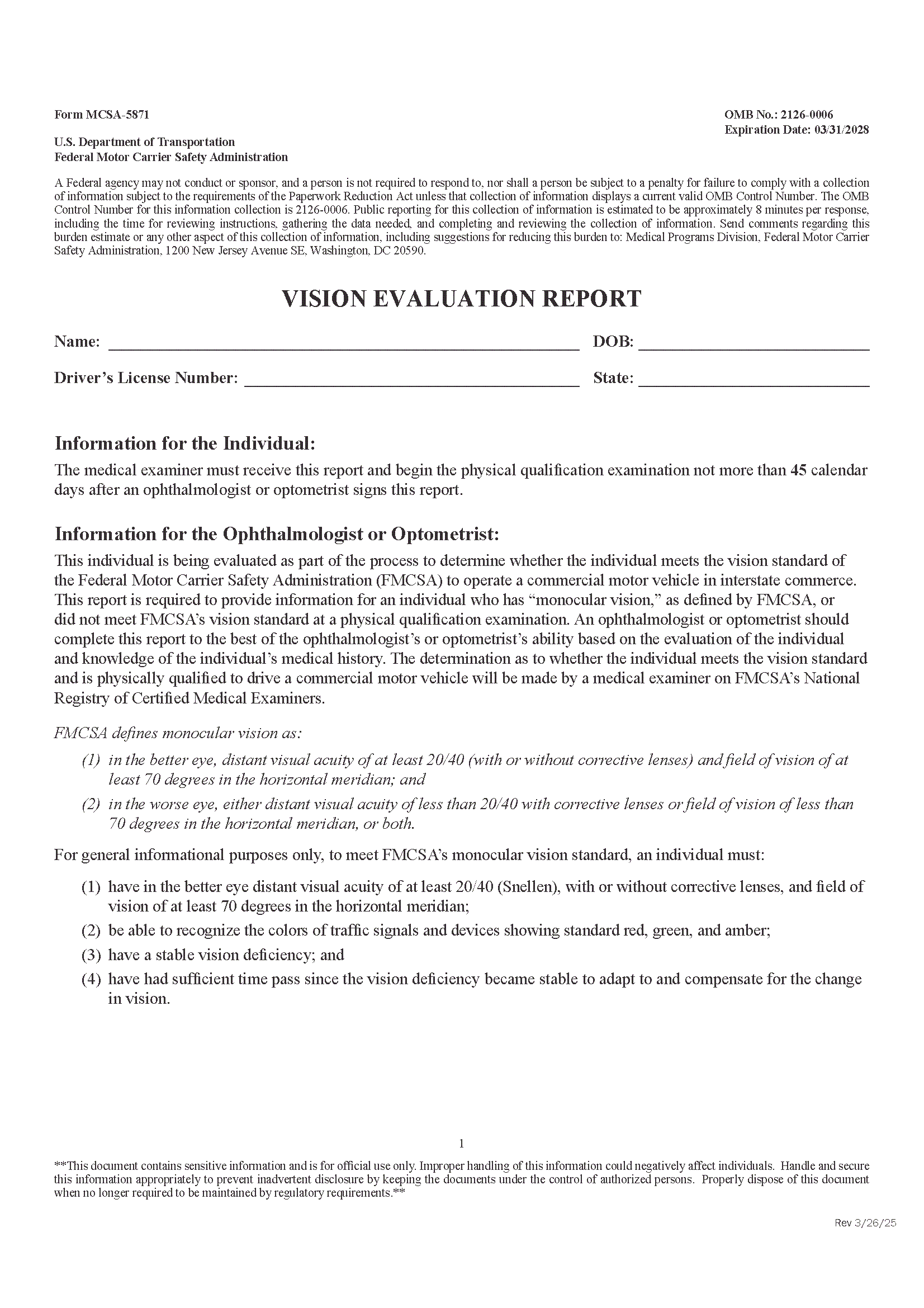
The MCSA-5871 Vision Evaluation Report is a mandatory form used by the Federal Motor Carrier Safety Administration (FMCSA) to assess whether individuals meet the vision standards required to operate commercial motor vehicles in interstate commerce. This report is essential for drivers with monocular vision or those who have not met FMCSA vision requirements during a physical qualification exam. It ensures safety on the road while complying with federal regulations.
Purpose and Overview of the Form
The form collects detailed ophthalmologic or optometric information to determine if the driver can safely operate a commercial motor vehicle. It is designed to provide medical examiners with sufficient information to certify or deny a driver’s qualification based on visual acuity, field of vision, color recognition, and stability of vision deficiencies.
Sections of the Form and Expert Explanations
Section 1: Individual Information
This section captures the driver’s personal details, including name, date of birth, and driver’s license number. Accurate information is crucial as errors may delay processing or affect medical certification.
Section 2: Evaluation Timing
The form must be received by the medical examiner within 45 days of being signed by an ophthalmologist or optometrist. Late submissions may invalidate the evaluation and delay certification.
Section 3: Ophthalmologist or Optometrist Details
The evaluating professional must indicate their credentials and provide contact information. This ensures accountability and allows the FMCSA to verify the evaluation if needed.
Section 4: Vision Testing Results
- Distant Visual Acuity – Right and Left eye, both corrected and uncorrected. Use of standard notation (Snellen) is required. Avoid vague terms like "normal" or "full".
- Field of Vision – Must be tested to at least 120 degrees horizontally. Formal perimetry results must be attached for both eyes.
- Color Recognition – Driver must recognize standard red, green, and amber traffic signals.
- Monocular Vision Confirmation – Ophthalmologist or optometrist confirms whether the individual meets FMCSA monocular vision standards.
Common mistakes include incomplete measurements, missing attachments, or unclear notation of correction type (glasses/contacts).
Section 5: Medical History and Conditions
- Document any progressive eye conditions, their diagnosis date, severity, and current treatment.
- Confirm stability of vision deficiencies, as unstable conditions may disqualify a driver.
- Provide additional notes on adaptation and compensation for monocular vision.
Section 6: Examiner Opinions
The medical professional must state whether the individual’s vision is stable, whether enough time has passed to adapt, and whether more frequent evaluations are required. Clear documentation here prevents future certification disputes.
Section 7: Attestation and Signature
The examiner attests that the information provided is accurate. Missing signatures or incomplete credentials can result in rejection of the form.
Practical Tips for Completion
- Attach formal perimetry tests for each eye.
- Double-check all dates and measurements; incorrect entries may invalidate the evaluation.
- Ensure professional credentials and contact information are complete.
- Include comments on vision stability to clarify adaptation for monocular vision.
Real-Life Scenarios
- A commercial truck driver with monocular vision seeking renewal of FMCSA certification.
- An interstate bus driver who failed the standard vision exam and requires additional documentation.
- A new applicant with a recent diagnosis of cataracts, requiring evaluation for stability before certification.
- An individual adapting to vision changes after an eye injury, needing assessment to confirm safe driving ability.
Required Documents
- Formal perimetry test results for both eyes
- Medical history notes relevant to vision conditions
- Proof of credentials of evaluating ophthalmologist or optometrist
- Any previous FMCSA vision evaluation forms
Frequently Asked Questions
Who must complete this form?
Individuals with monocular vision or those who did not meet FMCSA vision standards during a physical exam must complete this form.
Can the form be submitted electronically?
Submission methods vary; check with the FMCSA-certified medical examiner. Typically, paper submission is required.
What happens if the form is late?
Medical examiners may reject evaluations submitted after the 45-day window, delaying certification.
Do I need supporting documents?
Yes, attach formal perimetry tests and relevant medical history for verification.
Who is authorized to complete the form?
Only licensed ophthalmologists or optometrists can legally complete and sign this evaluation.
What are the consequences of inaccurate information?
Providing incorrect data can lead to denial of certification and potential safety risks.
How often must vision be evaluated?
Evaluation frequency depends on stability of the vision condition; medical examiners may require annual or more frequent assessments.
Micro-FAQ (Quick Answers)
- Purpose: To verify FMCSA vision standards for commercial drivers.
- Who files: Drivers with monocular vision or failed vision exams.
- Deadline: Submit to examiner within 45 days of signing.
- Attachments: Formal perimetry results and medical history.
- Submitted to: FMCSA-certified medical examiner.
- Stable vision required: Yes, must allow adaptation.
- Color recognition needed: Red, green, amber signals.
Related Forms and Navigation
- FMCSA Medical Examination Report (MCSA-5875)
- Driver Medical History Questionnaire (MCSA-5876)
- Commercial Driver Physical Examination Form
- Other FMCSA vision-related forms
Form Details
Name: Vision Evaluation Report
Form Number: MCSA-5871
Region: United States – Federal Motor Carrier Safety Administration
Revision Date: 03/26/2025
OMB Control Number: 2126-0006
Expiration Date: 03/31/2028
Purpose: Evaluate monocular vision compliance for commercial vehicle operation.