
Form DSS-8227. Important Information You Need to Know
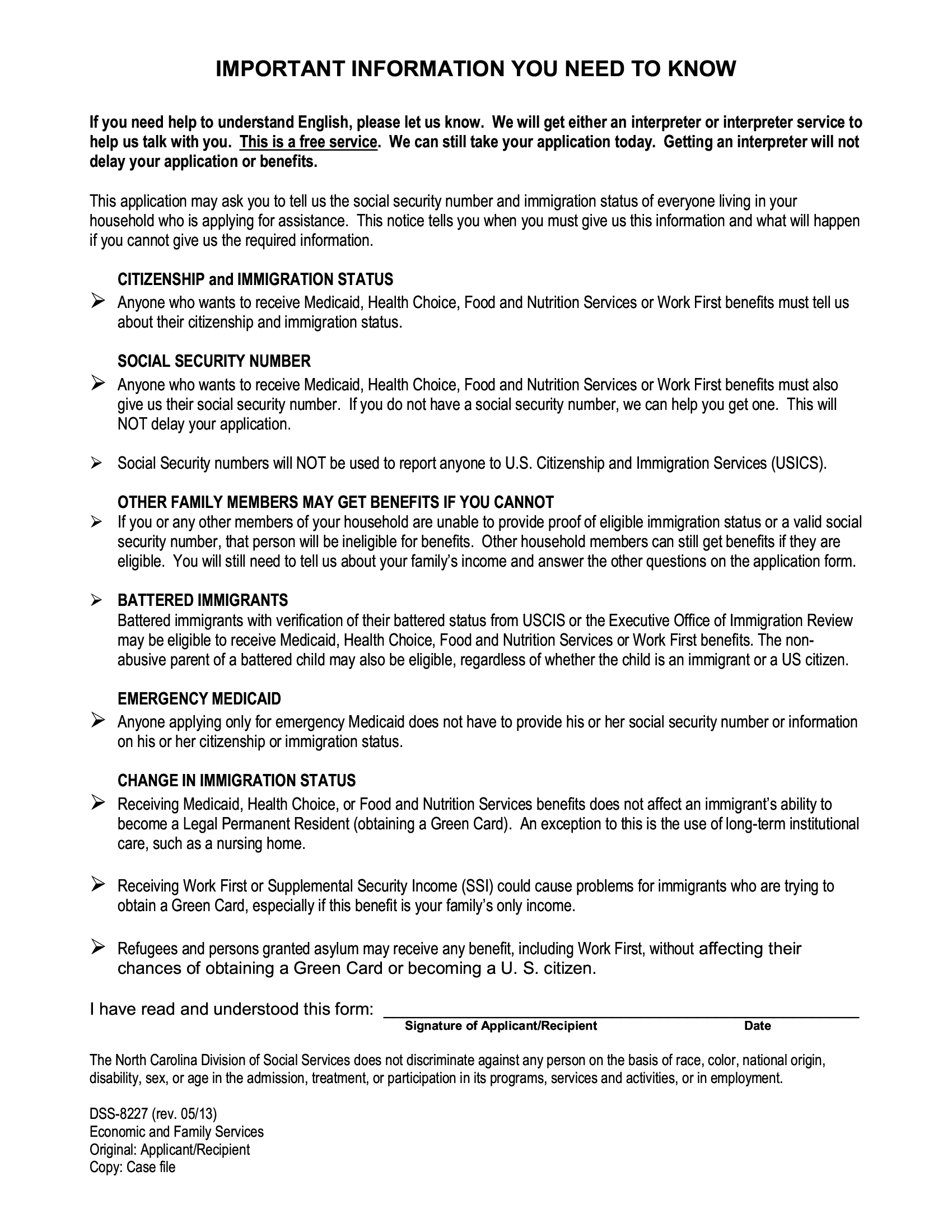
Form DSS-8227, used by the North Carolina Division of Social Services (DSS), explains what applicants need to know about citizenship, immigration status, and Social Security number requirements when applying for public assistance programs. Although it looks simple at first glance, it sets out several important legal rules that directly affect eligibility for Medicaid, Health Choice, Food and Nutrition Services, and Work First benefits. Understanding this form before submitting an application helps avoid delays, denials, and misunderstandings about how personal information is used.
Purpose and Function of the Form
The primary role of this document (DSS-8227) is to inform applicants of their rights, obligations, and the federal requirements tied to public benefits. State agencies are required to provide clear notice about when Social Security numbers and immigration information must be collected, how that data is protected, and what happens if a household member cannot provide it.
In practice, caseworkers rely on this form as part of the application packet. Applicants typically sign it to confirm that they have been informed about the rules. The signature does not grant or deny benefits; rather, it ensures that the applicant understands the conditions under which eligibility is determined.
Explanation of Key Sections
Non-Discrimination Notice
This section confirms that DSS programs operate in compliance with federal civil rights laws. It reassures applicants that they cannot be denied services based on characteristics such as race, national origin, or disability. A common misconception is that immigration-related questions are asked for discriminatory reasons; in fact, they are required by federal benefit rules, not used for enforcement.
Language Assistance
Applicants who need help understanding English can request free interpreter services. A frequent error is assuming that waiting for an interpreter will delay the application—this form clarifies that it will not.
Citizenship and Immigration Status
Any household member who wants to receive benefits must disclose their immigration status. This is a federal requirement for programs funded by federal dollars. However, family members who are not applying for benefits do not have to provide this information.
A typical misunderstanding is believing that undocumented family members cannot apply on behalf of eligible children. In reality, parents may apply for eligible children without providing their own immigration details.
Social Security Number Requirements
Applicants must provide a valid Social Security number (SSN). If someone does not have one, DSS assists them in obtaining it, and the lack of an SSN does not hold up the application. Importantly, the SSN is not shared with immigration enforcement agencies.
Eligibility of Other Household Members
If one household member cannot provide immigration proof, they may be ineligible individually; however, other eligible members can still receive benefits. The household must still report income and answer all other application questions. This separation often confuses applicants who assume that one ineligible person blocks the entire case.
Battered Immigrants
Certain immigrants who are survivors of domestic violence may qualify for assistance even if their immigration status is otherwise limited. This includes victims with verification from USCIS or the Executive Office of Immigration Review. The rule also covers non-abusive parents of battered children. Applicants often overlook this exception, so it is important to raise it during screening.
Emergency Medicaid
This section clarifies that people applying only for Emergency Medicaid do not need to provide an SSN or immigration information. Emergency Medicaid covers life-threatening conditions and labor/delivery services regardless of immigration status.
Changes in Immigration Status
The form explains how participation in benefits may affect future immigration processes. Most benefits—including Medicaid and Food and Nutrition Services—do not harm a person’s ability to obtain permanent residency. However, long-term institutional care and reliance on certain cash assistance programs, such as Work First, may be considered in immigration decisions. This section ensures applicants understand the possible long-term implications.
Practical Recommendations for Completing the Form
- Review the sections carefully before signing; your signature confirms that you understand the policies.
- If household members have mixed immigration statuses, list each person accurately and only provide immigration documents for those applying for benefits.
- If someone lacks an SSN, notify the caseworker immediately—DSS can assist with the process.
- Do not guess or estimate immigration categories; provide documents such as I-94, employment authorization, or approval notices when available.
- If domestic violence is involved, discreetly inform the caseworker to ensure the battered immigrant provisions are considered.
Examples of Real-Life Situations
-
Example 1: A parent without lawful immigration status applies for Medicaid for their U.S.-born child. Only the child’s citizenship information is required, and the parent’s lack of status does not prevent the child from qualifying.
-
Example 2: A lawful permanent resident applying for Food and Nutrition Services worries that the benefits may affect their green card. The form clarifies that FNS benefits do not affect permanent residency applications.
-
Example 3: A woman fleeing domestic violence has pending immigration paperwork. With proper verification, she may still receive Medicaid or Food and Nutrition Services despite her incomplete status.
-
Example 4: A patient needs Emergency Medicaid during a medical crisis. Since the application is only for emergency care, no immigration or Social Security information is required.
Documents Commonly Required
- Proof of identity (driver’s license or other government ID)
- Proof of citizenship or immigration status for those applying for benefits
- Social Security numbers or proof of application for an SSN
- Income documentation (pay stubs, tax forms, employer statements)
- Domestic violence verification (if applying under battered immigrant provisions)
FAQ
Do I have to provide immigration information for every household member?
No. You only have to provide immigration details for individuals who are applying for benefits.
Will my Social Security number be shared with immigration enforcement?
No. The form makes clear that SSNs are not used to report anyone to immigration authorities.
Can an ineligible household member prevent the rest of the family from receiving benefits?
No. Other members may still qualify even if one person is ineligible.
Does applying for Medicaid affect getting a Green Card?
Generally, no. Most Medicaid benefits do not impact future immigration applications.
What if I don’t have a Social Security number yet?
DSS will help you apply for one, and your case will not be delayed because of it.
Do I need an SSN for Emergency Medicaid?
No. Emergency Medicaid applicants do not need to provide SSN or immigration status.
Who needs to sign this form?
The applicant or recipient must sign to confirm they have been informed of their rights and responsibilities.
Micro-FAQ
- Purpose? To explain eligibility rules for SSNs, citizenship, and immigration status.
- Who files? Any applicant for Medicaid, Health Choice, FNS, or Work First.
- Required? Yes, applicants must review and acknowledge the information.
- Deadline? Submitted with the application packet.
- Attachments? Immigration documents, SSN proof, income verification.
- Submitted to? North Carolina Division of Social Services.
- Interpreter available? Yes, free language assistance is offered.
- Immigration risks? Generally none for Medicaid/FNS, with limited exceptions.
- Emergency Medicaid? No SSN or immigration information required.
- Mixed-status families? Eligible members may still receive benefits.
Navigation
- Related forms
- Other forms
- Legal guides and instructions
Form Details
Form Name: Important Information You Need to Know
Form Number: DSS-8227
Region: North Carolina, Division of Social Services
Revision Date: 05/2013