
Form DL 62. Report of Vision Examination
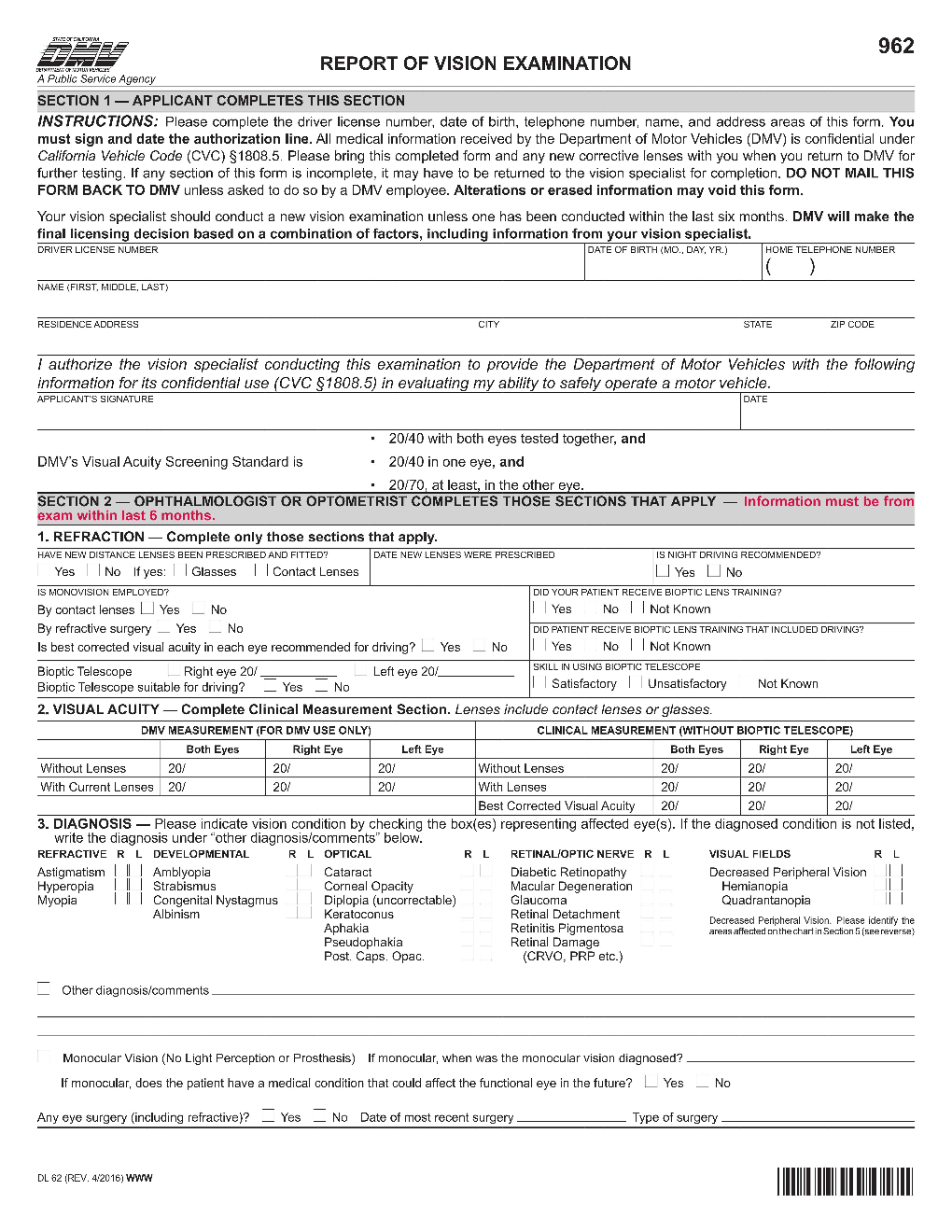
Form DL 62 is a confidential medical document used by the California Department of Motor Vehicles (DMV) to evaluate whether a driver’s vision meets the minimum standards required for safe vehicle operation. This form is typically requested when DMV needs updated information about a driver’s eyesight, usually after a vision screening, a medical review, or when the applicant reports changes to their vision.
The form must be completed jointly by the applicant and a licensed ophthalmologist or optometrist. DMV ultimately makes the licensing decision, but the specialist’s findings play a major role in determining whether a driver may continue driving without restrictions, with limitations, or not at all.
Purpose of the Form
DMV requires Form DL 62 when there is uncertainty about the applicant’s ability to see well enough to operate a motor vehicle safely. Under the California Vehicle Code, DMV must ensure that all licensed drivers meet basic vision requirements. This document provides:
- Clinical measurements of visual acuity
- Information about corrective lenses, refraction, and visual conditions
- Assessment of bioptic telescope usage, if applicable
- A specialist’s diagnosis and recommendations
When You Must Submit Form DL 62
- After failing a DMV vision screening
- When renewing a license with known vision issues
- When DMV initiates a Medical Review Program case
- After reporting new corrective lenses or vision surgery
- When instructed by a DMV employee during an office visit
You generally do not need this form if you only updated your glasses prescription and passed your in-office DMV test without concern.
Who May Complete the Vision Examination
Only the following professionals may complete Section 2 of Form DL 62:
- Licensed ophthalmologists
- Licensed optometrists
General practitioners, nurses, and technicians are not permitted to sign the form.
Detailed Breakdown of Each Section
Section 1 — Applicant Information
The applicant provides basic personal information: driver license number, date of birth, name, contact information, and residential address. The signature line authorizes the specialist to release confidential vision information to DMV under CVC §1808.5.
Typical mistakes:
- Leaving the signature line blank (DMV cannot accept unsigned forms)
- Using an old address that does not match DMV records
- Returning the form by mail without being instructed to do so
Section 2 — To Be Completed by the Ophthalmologist or Optometrist
1. Refraction
The specialist indicates whether new lenses were prescribed, whether night driving is recommended, and whether monovision is used (via contact lenses or refractive surgery). DMV pays particular attention to monovision, as it can affect depth perception.
Important for applicants: If new glasses were prescribed, DMV may request you return wearing them for re-testing.
2. Visual Acuity
This section includes clinical measurements with and without lenses. DMV’s minimum standards are:
- 20/40 in both eyes together
- 20/40 in one eye AND at least 20/70 in the other
If the specialist provides “best corrected” acuity worse than required, DMV may impose restrictions such as daylight-only driving or may require further testing.
3. Diagnosis
The specialist checks relevant diagnoses, such as cataracts, amblyopia, glaucoma, keratoconus, or other conditions affecting vision. DMV uses this information to assess long-term stability and potential future risk.
Why this matters: Some diagnoses (e.g., progressive cataracts or diplopia) may trigger periodic re-examination requirements.
4. Bioptic Telescope Evaluation (If Applicable)
California allows bioptic driving under strict conditions. The specialist must document telescope strength, usage skill, and whether driving with a telescope is recommended.
DMV may request additional driving tests if bioptics are involved.
Practical Recommendations
- Bring any new glasses or contact lenses to the DMV office when returning the form.
- Ensure the specialist completes every required field; incomplete forms are returned and delay processing.
- Ask for a printed copy for your records before leaving the clinic.
- Submit the form promptly; DMV may place a hold on your license if deadlines are missed.
Examples of Real-World Situations
- A driver fails the DMV vision screening during a license renewal and receives Form DL 62 to confirm whether updated lenses can correct the issue.
- An older adult with cataracts undergoes surgery and needs the specialist to update DMV on improved vision.
- A driver with keratoconus uses rigid contacts and must verify that corrected acuity meets the 20/40 requirement.
- A bioptic telescope user applying for restricted driving privileges must document telescope measurements and training.
Documents Commonly Needed
- Current prescription eyewear
- Recent refraction results (within 6 months)
- Bioptic training records, if applicable
- Medical records for diagnosed vision conditions
FAQ
- Do I need to mail this form to DMV? No, unless a DMV employee specifically instructs you to do so.
- What if my doctor says my vision is below 20/40? DMV may impose driving restrictions or require further evaluation.
- Can a general doctor complete the form? No. Only an ophthalmologist or optometrist can complete Section 2.
- How recent must the exam be? The exam must be from within the last six months.
- What happens if my form is incomplete? DMV will return it to you or request clarification, delaying your licensing decision.
- Can I still drive while DMV is reviewing my form? Usually yes, unless DMV has suspended or restricted your license.
- Does DMV accept digital signatures? No. Signatures must be handwritten.
Micro-FAQ (Short Answers)
- Purpose? Confirms vision meets California driving standards.
- Who completes it? Applicant and licensed eye specialist.
- Deadline? Typically within the timeframe DMV provides.
- Attachments? Prescription info, clinical measurements, diagnoses.
- Submit to? Return to DMV office unless instructed otherwise.
- Accepted exam age? Must be within 6 months.
- Required for renewal? Only if DMV identifies a vision concern.
- Is bioptic driving allowed? Yes, with strict documentation.
- Need to bring new glasses? Yes, always bring current corrective lenses.
- Confidential? Yes, protected under CVC §1808.5.
Related Forms
- DL 207 — Medical Examination Report
- DL 546 — Driver Medical Evaluation
- DL 44 — Driver License or Identification Card Application
- DL 937 — Bioptic Driving Affidavit
Form Details
- Form Name: Report of Vision Examination
- Form Number: DL 62
- Agency: California Department of Motor Vehicles
- Region: State of California
- Revision: April 2016