
TX HHS Form H3035. Medical Information Release and Disability Determination
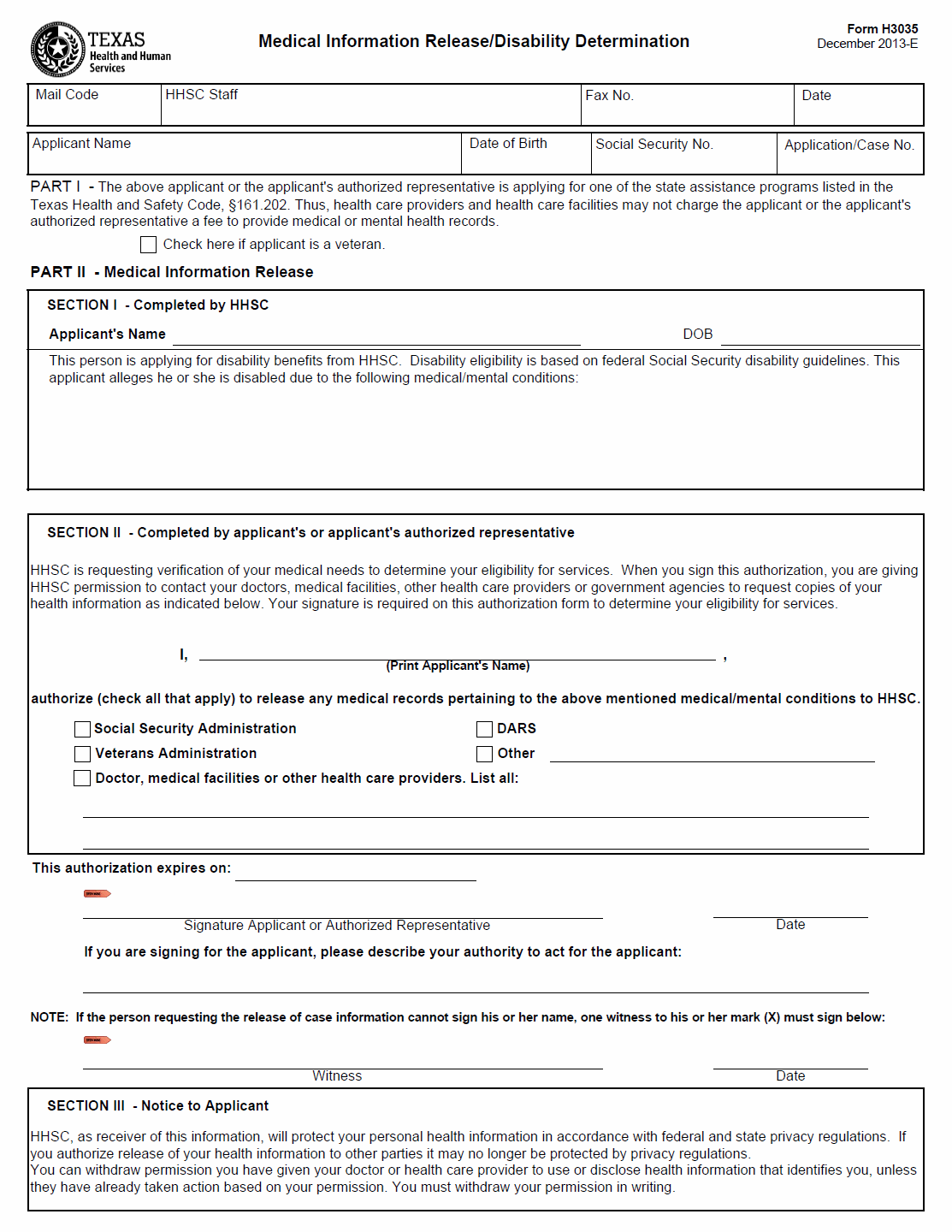
This form is used when a person applies for disability-related assistance through the Texas Health and Human Services Commission (HHSC). It authorizes HHSC to request medical records from healthcare providers in order to evaluate disability status under federal Social Security guidelines. Although the form may look simple, it carries important legal implications and must be completed with care.
Purpose of Form H3035
Form H3035 allows HHSC to legally access the applicant’s medical and mental health records without charging fees, as required under Texas Health and Safety Code §161.202. This information is essential for determining whether the applicant meets the medical criteria to qualify for disability-based state assistance programs.
The form also ensures that HHSC can communicate directly with doctors, hospitals, mental health facilities, the Social Security Administration, the Department of Assistive and Rehabilitative Services (DARS), the Veterans Administration, or any other relevant agency involved in the applicant’s care.
Key Sections of the Form
Section I – Completed by HHSC Staff
This section is filled out before the applicant receives the form. It identifies the applicant, the case number, and whether the individual is applying for a program covered under Texas Health and Safety Code §161.202. If the applicant is a veteran, staff will mark the appropriate checkbox. This information helps providers know that record-copying fees cannot be charged.
Section II – Medical Information Release (Completed by the Applicant)
Here, the applicant authorizes specific institutions to release their medical records to HHSC. The applicant must:
- Print their full legal name
- Specify which entities may release medical information (SSA, VA, providers, etc.)
- Indicate the medical or mental conditions being claimed as disabling
- Provide a signature and the date
- Specify an expiration date for the authorization
If someone signs on behalf of the applicant, their authority must be described (for example: legal guardian, medical power of attorney, or authorized representative). Applicants who cannot sign must provide a witnessed “X” mark.
Section III – Notice to Applicant
This section outlines privacy protections and the applicant’s rights under state and federal law. It explains:
- HHSC will protect personal health information under HIPAA and state regulations.
- The applicant may revoke authorization at any time, as long as HHSC has not already acted on the released information.
- Revocation must be done in writing.
This notice ensures the applicant understands the legal boundaries of the release and the importance of providing accurate medical information.
Common Mistakes Applicants Make
- Forgetting to list all treating providers, which delays disability determination.
- Leaving the authorization expiration date blank.
- Failing to describe the medical conditions claimed as disabling.
- Having an authorized representative sign without explaining their authority.
- Not providing a witness when the applicant signs with an “X.”
When You Do and Do Not Need to Submit This Form
- You must submit Form H3035 whenever HHSC needs medical documentation to determine disability eligibility.
- You do not need this form if you are applying for non-disability assistance programs that do not require medical verification.
- If Social Security disability has already been approved, HHSC may still request this form if state programs require separate validation.
Who Is Allowed to Sign the Form
- The applicant themselves.
- A legally authorized representative (parent of a minor, guardian, person with power of attorney).
- A witness, only when the applicant signs with a mark instead of a signature.
Supporting Documents You May Need
- Government-issued ID
- Existing medical records, discharge summaries, or treatment notes
- Proof of guardianship or legal authority (if signing for the applicant)
- Social Security documentation, if applicable
- Veteran status documents (if the applicant is a veteran)
Examples of Real Situations Where This Form Is Required
- Example 1: A person with severe diabetes complications applies for state disability assistance. HHSC needs access to their endocrinologist’s records to verify medical severity.
- Example 2: An individual recovering from a traumatic injury claims they cannot work. Their surgeon and physical therapist must release updated treatment notes for evaluation.
- Example 3: A veteran with PTSD seeks benefits. HHSC uses this form to request records from both the VA and private clinics.
- Example 4: A parent is applying for disability benefits on behalf of their adult child with developmental disabilities and must authorize multiple specialists to release medical information.
Practical Tips for Filling Out the Form
- List every provider who treats your condition—missing even one may delay your case.
- Be specific when describing medical conditions; avoid vague statements such as “health problems.”
- Use the same full legal name that appears on government identification.
- Set a reasonable expiration date (often one year) so HHSC can access records during determination.
- If you revoke authorization, send a written notice and keep a copy for your records.
FAQ
- Why does HHSC need this form?
HHSC requires medical records to evaluate disability using federal Social Security disability guidelines. - Does this authorization allow HHSC to contact any doctor?
Only the providers you list may release information, so include all relevant names. - Will my information stay confidential?
Yes. HHSC protects personal health data under HIPAA and state privacy rules. - Can I withdraw authorization?
Yes. Submit a written request, unless HHSC has already used the information. - Who can sign for me?
A guardian, parent, agent under power of attorney, or other authorized representative. - Does being a veteran change the process?
Veterans' providers cannot charge fees for releasing records, which can speed up verification. - How long does disability verification take?
It varies, but delays often occur when providers are missing or medical conditions are not clearly listed.
Micro-FAQ (Short Answers)
- Purpose: Authorizes HHSC to obtain medical records for disability determination.
- Who files: Applicants for disability-related assistance or their representatives.
- Attached documents: ID, medical records, authority documentation.
- Submitted to: Texas Health and Human Services Commission.
- Expiration: Applicant must specify; typically valid for several months to a year.
- Revocation: Allowed anytime in writing.
- Veterans: Eligible for fee-free release of medical records.
- Conditions listed: Must describe all medical and mental health impairments claimed.
- Witness needed: Only if signing with an “X.”
- Legal impact: Allows HHSC to make a disability eligibility determination.
Related Forms
- Texas Form H3034 — Disability Determination Medical Release
- SSA-827 — Authorization to Disclose Information to SSA
- VA Form 21-4142 — Authorization to Disclose Medical Information
Form Details
- Form Name: Medical Information Release / Disability Determination
- Form Number: H3035
- Region: Texas
- Issued / Updated: December 2013
- Used By: Texas Health and Human Services Commission (HHSC)