
TX HHS Form H1836-B. Medical Release or Physician's Statement
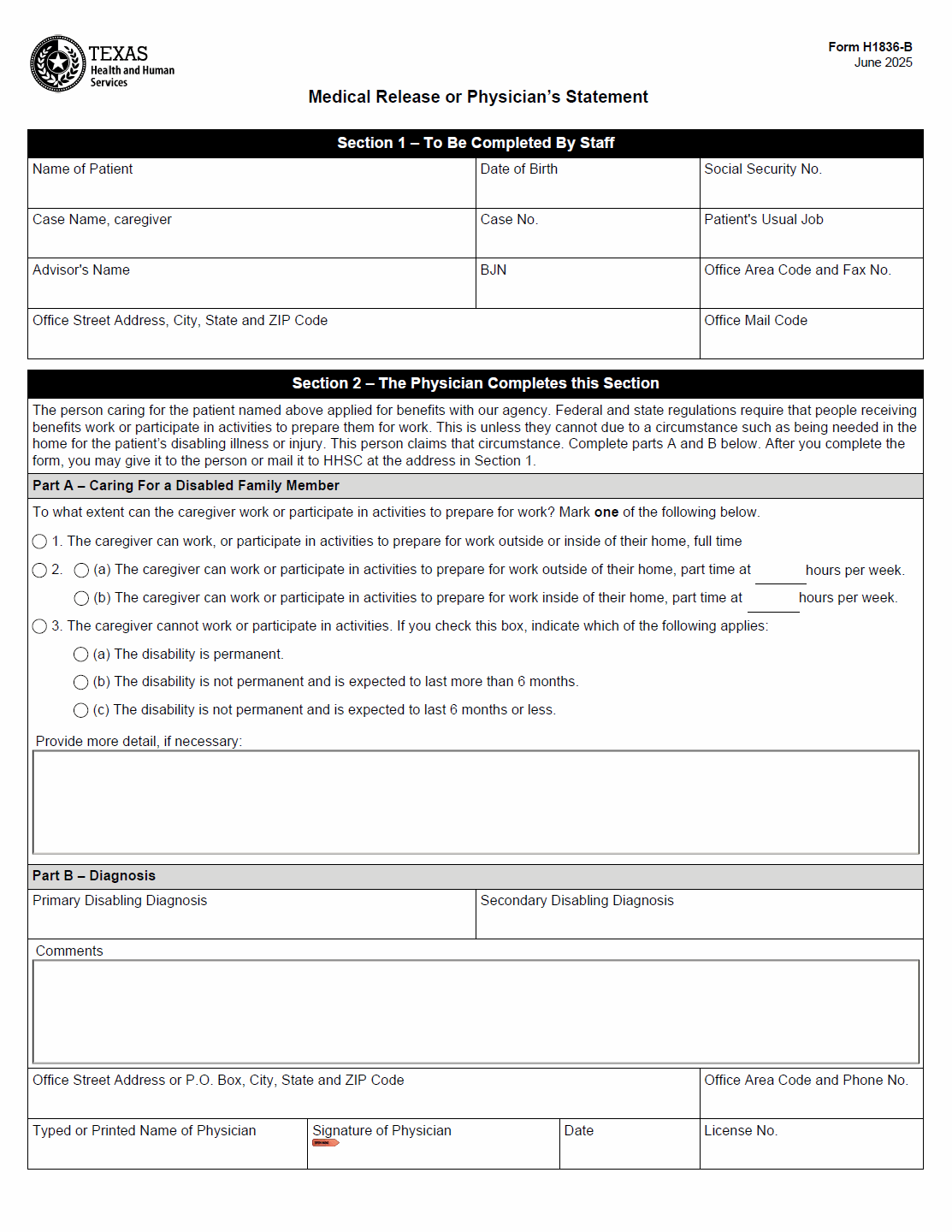
Form H1836-B, Medical Release or Physician’s Statement, is a Texas Health and Human Services Commission (HHSC) document used to verify that a patient has a disabling illness or injury requiring full-time assistance from a caregiver. The form helps the agency determine whether the caregiver may be exempt from participating in work or employment-preparation activities mandated by state and federal benefits programs.
This form plays a crucial administrative role: it connects medical necessity with eligibility requirements, ensuring that caregivers are not penalized when their availability to work is restricted by legitimate medical circumstances at home.
Purpose and When the Form Is Needed
The form is required when a person receiving public benefits claims they cannot meet employment program obligations because they must remain home to care for a disabled family member. HHSC requires medical verification in these situations.
You should complete this form when:
- The caregiver is applying for a work-requirement exemption due to a patient’s medical condition.
- The agency needs medical confirmation about the severity and expected duration of the patient’s condition.
- A physician must document the caregiver’s realistic ability (or inability) to work inside or outside the home.
- The patient authorizes HHSC to contact medical providers for verification.
The form is not typically needed when the caregiver already has another approved exemption category or when the patient’s condition does not require ongoing daily supervision.
Explanation of Key Sections
Section 1 – To Be Completed by Staff
This part identifies the patient, caregiver, and case details. It includes:
- Patient’s name, date of birth, and Social Security number
- Case name and number
- Caregiver’s usual job, advisor name, office address, fax number, and mail code
Typical mistakes: misspelled names, missing case numbers, or outdated office contact information. These minor errors can delay processing because physicians may not know where to send the completed form.
Section 2 – To Be Completed by the Physician
This is the heart of Form H1836-B. HHSC relies on the provider’s professional judgment to determine whether the caregiver can work or participate in work-related activities.
Part A – Caring for a Disabled Family Member
The physician assesses the caregiver’s ability to work inside or outside the home. The options range from full-time ability to complete inability due to the patient’s needs.
- Option 1: Caregiver can work full-time (inside or outside the home).
- Option 2: Caregiver can work part-time — physician must specify the weekly hours.
- Option 3: Caregiver cannot work at all — physician must indicate whether the disability is permanent or temporary.
Common issues: physicians often forget to specify weekly hours for part-time options or fail to explain the duration of temporary disabilities.
Part B – Diagnosis
The physician lists the primary and secondary disabling diagnoses, along with comments that explain severity, functional limitations, and expected duration.
A complete diagnosis section helps HHSC determine the caregiver’s work exemption eligibility and ensures that medical documentation aligns with regulatory expectations.
Section 3 – Authorization to Release Medical Information
The patient, or their legal representative, must sign this section to authorize the physician and related providers to share medical information with HHSC and the Texas Workforce Commission. Without this authorization, the caregiver cannot qualify for the exemption.
This section includes:
- Patient name
- Permission for providers to release medical information
- Expiration date of the authorization
- Signature of the patient or personal representative
- Witness signatures if the patient signs with a mark
Legal note: expiration dates are critical. If left blank, HHSC may reject the form.
Real-Life Examples of When This Form Is Used
- A single parent caring for a child with severe epilepsy who requires constant supervision.
- A spouse caring for their partner recovering from a major accident with limited mobility.
- An adult child assisting a parent with late-stage cancer treatments, making outside employment impossible.
- A caregiver supporting a family member with advanced dementia who cannot be left unsupervised.
State Regulations and Legal Context
HHSC requires verification of caregiving needs under federal and state public assistance rules. Work participation is mandatory unless the caregiver demonstrates a qualifying exemption.
Form H1836-B is the official method to establish that the caregiver’s absence from employment or training is medically necessary. Physicians' statements must comply with Texas workforce and Medicaid/TANF regulations regarding disability-related exemptions.
Practical Tips for Completing the Form
- Ensure Section 1 is filled out by HHSC staff before giving it to the physician.
- Provide your physician with background on your caregiving responsibilities to ensure accurate assessment.
- Ask the doctor to specify hours clearly if they choose a part-time option — HHSC often returns forms with vague entries.
- Verify that all signatures and dates are included, especially in Section 3.
- Keep a copy of the completed form for your records.
Documents Commonly Attached
- Recent medical reports or visit summaries
- Hospital discharge papers
- Diagnostic test results
- Letters from specialists
- Medication lists
Related Forms
- Texas Form H1836 — Medical Release
- Form H3038 — Disability Determination
- Form H1028 — Verification of Employment
- Other HHSC Work Requirement Exemption Forms
FAQ
- Who completes Form H1836-B? Section 1 is completed by HHSC staff; Sections 2 and 3 are completed by the physician and patient.
- Does the caregiver automatically get an exemption after submitting this form? Not automatically. HHSC reviews medical details and decides based on agency standards.
- Can a nurse practitioner complete the physician section? Typically, only licensed physicians complete the diagnosis portion, but local HHSC guidance may allow equivalents in certain cases.
- Is this form used for long-term disability programs? No, it's specifically for work-participation exemptions for caregivers.
- How long is the authorization valid? Only until the expiration date listed in Section 3.
- What happens if information is missing? The form may be returned or processing delayed.
Micro-FAQ (Short Answers for Instant Results)
- Purpose? Verify that a caregiver is needed at home due to a patient’s disability.
- Who files? The caregiver applies; physician provides medical information.
- Who signs? The patient or authorized representative.
- Attachments? Medical records, summaries, diagnostic results.
- Duration? Valid until the expiration date signed in Section 3.
- Submitted to? HHSC office listed in Section 1.
- When required? When caregiver seeks exemption from work requirements.
- Physician role? Evaluate disability severity and caregiver’s work ability.
- Can be denied? Yes, if details are insufficient or inconsistent.
- Physical presence needed? Not usually — many providers complete via fax.
Form Details
- Form Name: Medical Release or Physician’s Statement
- Form Number: H1836-B
- Jurisdiction: Texas Health and Human Services Commission (HHSC)
- Date of Edition: June 2025