
TX HHS Form 8654. State Supported Living Center (SSLC) Admission Application
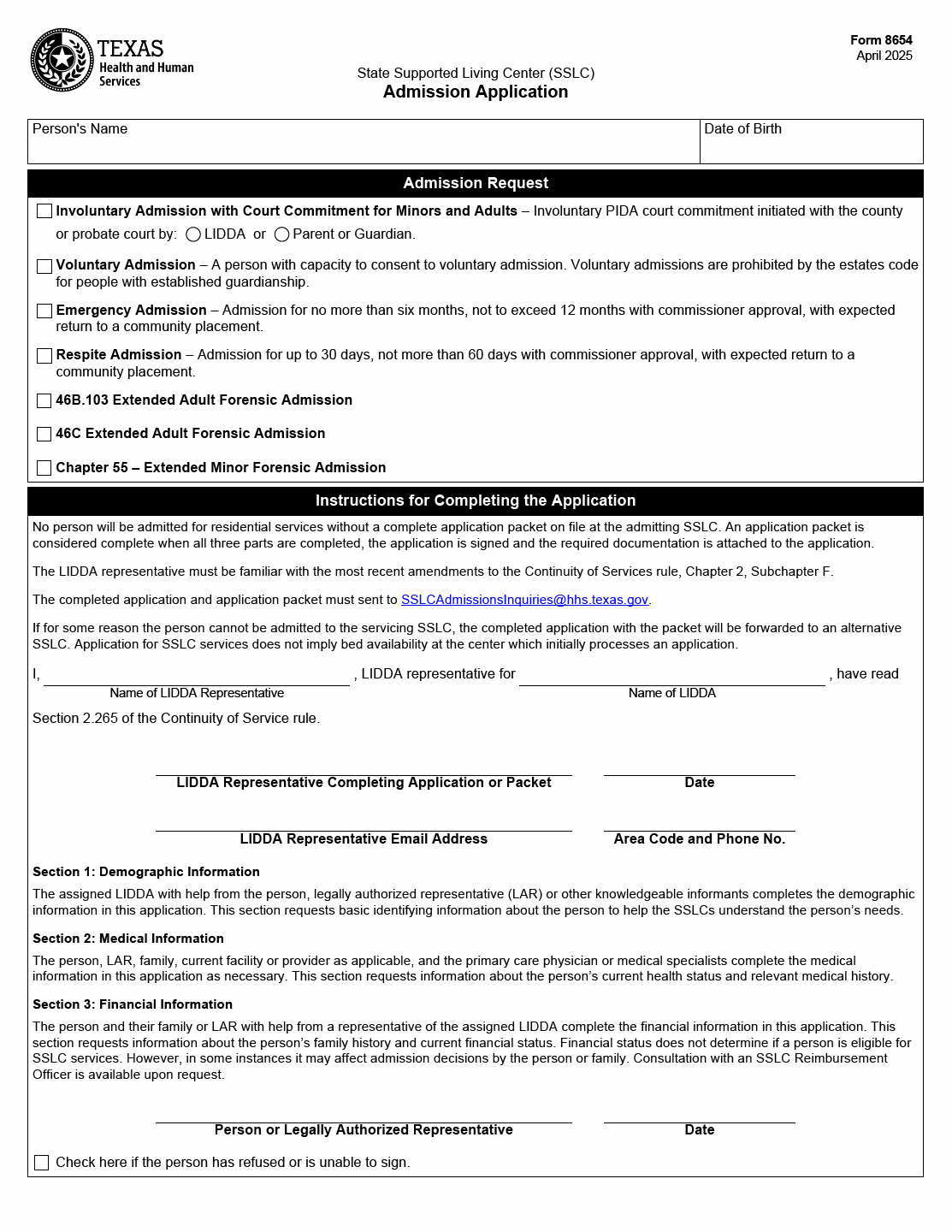
Form 8654 (April 2025) is the official application used to request admission to a Texas State Supported Living Center (SSLC). These centers provide long-term residential services, health care, behavioral support, and habilitation for people with intellectual or developmental disabilities who cannot safely or effectively live in a community setting. The application is detailed for a reason: each SSLC must verify legal authority, medical needs, and eligibility before approving an admission.
This guide explains the purpose of the form, what each section means, who can apply, the documents required, and common mistakes that delay processing. It is written in clear, practical language to help families, LIDDAs, and care providers submit a complete and accurate admission packet.
Purpose of Form 8654
The form is used to formally request one of several admission types to an SSLC. Each admission category has its own legal requirements, documentation standards, and review procedures. In all cases, the State of Texas requires a complete application packet before any person can be considered for residential placement.
- Involuntary admission (PIDA court commitment) — Initiated by a LIDDA or a parent/guardian through county or probate court.
- Voluntary admission — Allowed only for adults who have capacity to consent. Individuals under guardianship cannot be admitted voluntarily.
- Emergency admission — Temporary placement for up to 6 months (12 with approval), usually when community placement has broken down.
- Respite admission — Short-term stay up to 30 days (60 with approval), intended for temporary relief of caregivers.
- Forensic admissions (46B.103, 46C, Chapter 55) — Court-ordered placement for adults or minors involved in legal proceedings.
A complete application does not guarantee bed availability at the requested SSLC. If the original center cannot admit the person, the packet will be forwarded to an alternative location.
Explanation of Each Section of the Form
Section 1: Demographic Information
This section gathers basic identifying details to help the SSLC understand who the applicant is and what supports they may need. A LIDDA representative completes this section together with the person, a legally authorized representative (LAR), or anyone familiar with the person's history.
Information typically includes:
- Name, date of birth, and Social Security Number
- Current address and living situation
- Primary contacts and legal guardianship status
- Communication preferences and primary language
Common mistake: Incomplete or outdated LAR documentation, which can delay the entire application.
Section 2: Medical Information
This portion is completed by the person, LAR, family, health-care providers, and primary-care physicians. SSLCs require a clear picture of current physical and behavioral health needs.
- Current diagnoses, past medical history, and medications
- Special dietary, mobility, or equipment needs
- Vaccination and infection-control information
- Hospitalizations or significant medical events
Why this matters: SSLCs must verify that the facility is equipped to provide the necessary level of care and determine the person’s Level of Need (LON).
Section 3: Financial Information
The applicant, family, or LAR—assisted by the LIDDA—provides details about financial resources. This information does not determine eligibility for residential services but may influence decisions regarding admission timing, insurance coordination, and Medicaid requirements.
- Income sources
- Insurance coverage (Medicaid, Medicare, private plans)
- Assets relevant to the Medicaid Estate Recovery Program (MERP)
Common misconception: Families sometimes avoid completing this section believing it affects eligibility. It does not; the state uses it to coordinate benefits and reimbursements.
Practical Recommendations for Completing Form 8654
- Gather medical, psychological, and behavioral records before starting. Missing documents are the top cause of delays.
- Ensure guardianship documents are current and certified.
- If submitting an involuntary or forensic application, attach the original court order—not a photocopy.
- Coordinate with the LIDDA early; they are responsible for verifying the Continuity of Services rules.
- Use the checklist in the “Required Additional Documentation” section to ensure the packet is complete.
Examples of Real-Life Situations Requiring Form 8654
- Aging caregiver unable to meet complex needs: A 45-year-old adult with an intellectual disability experiences increased behavioral challenges, and the elderly parent cannot safely continue home care.
- Breakdown of community placement: A group home cannot manage medical equipment needs after a hospitalization, requiring emergency SSLC admission.
- Forensic court requirement: An adult is found incompetent to stand trial and is ordered under Code 46C to receive treatment at an SSLC.
- Short-term respite: A family preparing for out-of-state medical treatment needs temporary placement for a dependent adult.
Supporting Documents Often Required
- Certified birth certificate
- Court order of commitment (for involuntary/forensic admissions)
- Determination of Intellectual Disability (DID)
- ICAP booklet and score sheet (within 36 months)
- ID/RC Assessment (from TMHP)
- LIDDA Interdisciplinary Team (IDT) report
- Medical, psychological, and behavioral history
- Guardianship or legal documents, if applicable
- HHS Form 8515 (less restrictive setting evaluation)
FAQ
- Who submits Form 8654? Usually the LIDDA, working with the person, family, or LAR, depending on admission type.
- Is voluntary admission allowed for minors? No. Only adults with capacity and without guardianship may request voluntary admission.
- Does financial status affect eligibility? No. It may affect Medicaid coordination but not whether a person qualifies for SSLC services.
- How long does admission take? Timelines vary depending on documentation, medical review, and bed availability.
- What if the nearest SSLC is full? The packet is forwarded to another center that may have availability.
- Can a person refuse to sign? Yes. The form includes a checkbox for situations where a signature is refused or not possible.
- Are emergency admissions guaranteed? No. They require approval and depend on facility capacity and appropriateness.
Micro-FAQ
- Purpose? To request admission to a Texas State Supported Living Center.
- Who files? LIDDAs, LARs, applicants with capacity, or courts.
- Deadline? No deadline, but complete packets are required before review.
- Attachments? Medical, psychological, legal, and eligibility documents.
- Where submitted? [email protected].
- Is court order required? Only for involuntary or forensic admissions.
- Can guardians file? Yes, but guardians cannot request voluntary admissions.
- Is bed availability guaranteed? No.
- Is medical evaluation required? Yes, for all admission types.
Related Forms
- HHS Form 8515 — Guidelines for Determining Less Restrictive Setting
- ID/RC Assessment (TMHP)
- ICAP Score Sheet and Booklet
- Determination of Intellectual Disability (DID)
Form Details
- Form Name: SSLC Admission Application
- Form Number: 8654
- State: Texas
- Edition: April 2025