
TX HHS Form 8617. Individualized Skills and Socialization Enhanced Staffing Rate
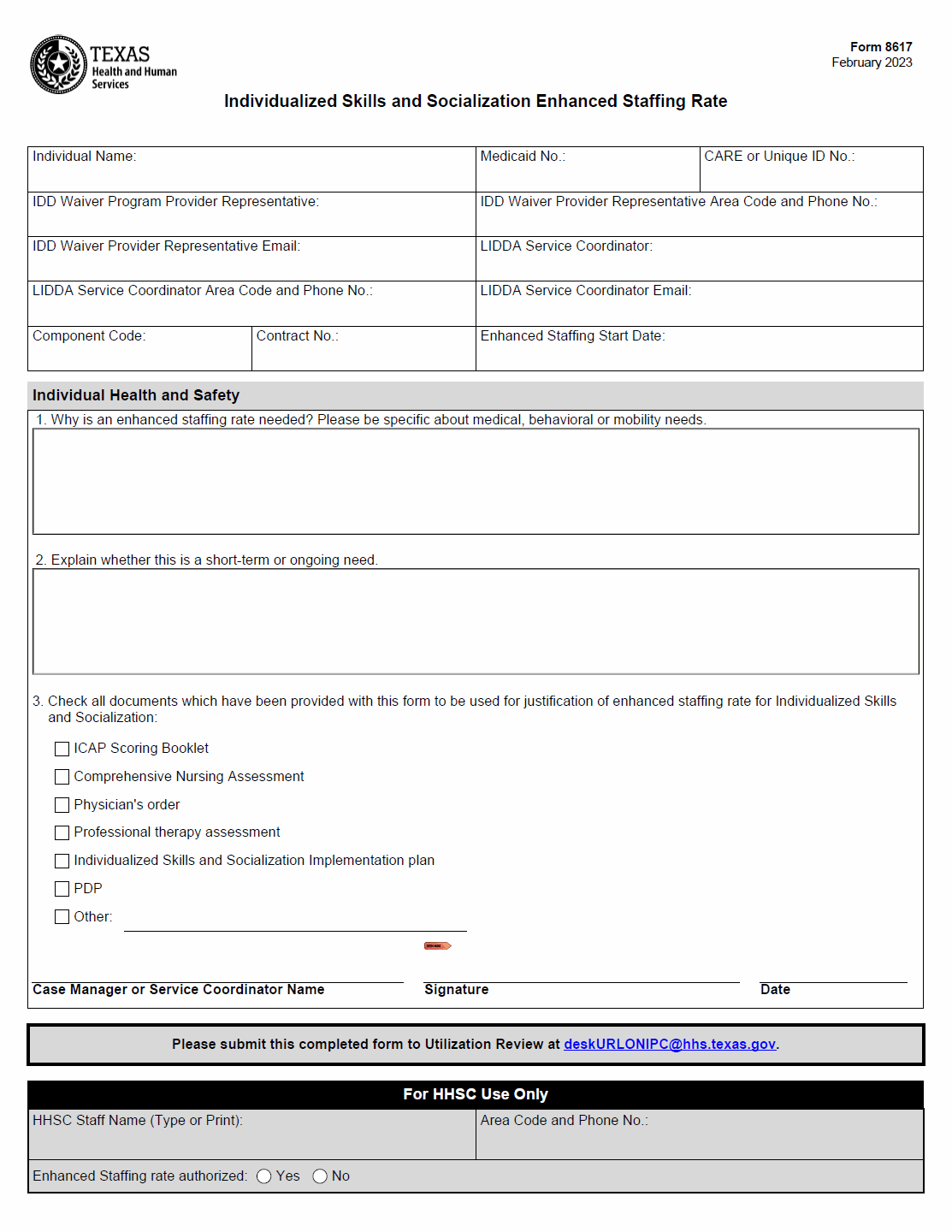
Form 8617 is used within the Texas Intellectual and Developmental Disabilities (IDD) waiver programs to request an Enhanced Staffing Rate for an individual who requires more support than the standard service level provides. This document helps the state justify why additional staffing hours, closer supervision, or specialized assistance are medically or behaviorally necessary. Although the form itself appears short, completing it thoughtfully is crucial — it directly affects safety, funding, and the continuity of services.
Purpose of Form 8617
The primary purpose of Form 8617 is to demonstrate that an individual has unique needs—medical, behavioral, or mobility-related—that require increased staff involvement during Individualized Skills and Socialization (ISS) services. Texas Health and Human Services Commission (HHSC) reviews the form to determine whether the individual qualifies for an enhanced staffing reimbursement rate.
This form is typically completed by an IDD waiver provider representative in coordination with the Local Intellectual and Developmental Disability Authority (LIDDA) Service Coordinator.
When This Form Is Required
- When an individual has medical issues that require constant monitoring or hands-on support.
- When behaviors create risk for self-injury, elopement, or aggression toward others.
- When mobility limitations require a second staff person for transfers or safe navigation.
- When an ISS service provider believes the current staffing ratio cannot safely meet the person's needs.
This form is not required if the individual’s current service plan already accounts for the needed staffing level or if the need is extremely temporary and can be managed internally without state review.
Who Is Allowed to Complete Form 8617
- IDD Waiver Program Provider Representatives
- LIDDA Service Coordinators (supporting documentation side)
- Qualified healthcare professionals who contribute assessments (attachments only)
Family members, caregivers, or the individual themselves typically cannot submit this form, though their observations often guide the provider’s justification.
Explanation of Key Sections
Individual Information
This section captures basic identifiers: name, Medicaid number, CARE or unique ID, and contact details for the provider and service coordinator. Submitting incomplete or mismatched identification data is one of the most common delays in review.
Reason Enhanced Staffing Is Needed
Here the provider must clearly explain the individual’s medical, behavioral, or mobility needs. Avoid generic statements like “needs extra supervision.” Instead, describe what happens, how often, and what risks appear without the extra support.
Short-Term or Ongoing Need
HHSC must determine whether the enhanced rate is temporary—for example, recovery from surgery—or long-term, such as chronic seizure disorders or lifelong behavioral risks.
Documentation Checklist
Providers must attach supporting documents such as:
- ICAP Scoring Booklet — shows functional skill levels
- Comprehensive Nursing Assessment — describes medical needs
- Physician orders — medication, equipment, mobility restrictions
- Therapy assessments — OT, PT, or behavioral therapy insights
- Individualized Skills and Socialization Implementation Plan — details daily supports
- PDP (Person-Directed Plan)
- Any other relevant reports
Missing attachments are the #1 reason Form 8617 gets returned for corrections.
Signature Section
The Case Manager or Service Coordinator certifies that the information provided is correct and that the included documents support the request.
Submission Instructions
Completed forms must be submitted to HHSC Utilization Review at: [email protected].
Legal and Regulatory Context
Form 8617 exists under Texas Administrative Code regulations governing IDD waiver programs. Enhanced staffing rates are only approved when the state confirms the individual’s health and safety cannot be maintained under standard ratios. This ensures accountability in how public Medicaid funds are used and ensures individuals receive the level of support their condition requires.
Typical Applicant Mistakes
- Providing vague clinical descriptions instead of measurable needs.
- Not attaching required medical or behavioral documentation.
- Failing to specify whether staffing needs are temporary or long-term.
- Using outdated or incorrect identifying numbers (CARE ID, Medicaid ID).
- Not updating contact information for coordinators or providers.
Practical Tips for Completing the Form
- Describe the individual’s needs with real examples (frequency, triggers, risks).
- Attach current assessments—not older than 12 months unless still clinically relevant.
- If explaining behavior, include environmental triggers and de-escalation needs.
- Clarify why the standard ISS staffing ratio is insufficient.
- If the need is temporary, specify the expected end date and treatment plan.
Real-Life Situations Where Form 8617 Is Needed
- Post-surgery mobility issues: An individual recovering from hip surgery requires two staff members for safe transfers.
- Behavioral escalation: A person with autism displays unpredictable aggression during community outings, requiring close supervision.
- Seizure disorder: Frequent seizures mandate an additional staff member trained in emergency response.
- Elopement risk: An individual who leaves safe areas without warning requires one-on-one monitoring during ISS activities.
Documents Commonly Attached
- Current medical evaluations
- Behavioral support plans
- Therapist reports
- Person-Directed Plan
- Medication lists and physician orders
- Incident reports (if relevant)
FAQ
- How long does approval take? Reviews typically take several weeks, depending on caseload and documentation quality.
- Can enhanced staffing be denied? Yes, if the justification is insufficient or documentation does not support the request.
- Who decides the final approval? HHSC Utilization Review staff.
- Is a doctor’s order required? Not always, but it strongly strengthens the request when medical need is claimed.
- Does approval last forever? No. Providers may be required to re-submit if needs change.
- Can families request enhanced staffing? They may request evaluation, but the provider must formally submit the form.
Micro-FAQ (Short Answers)
- Purpose: Request enhanced staffing for ISS services.
- Who files: IDD waiver provider representative.
- Regulated by: Texas Administrative Code and HHSC rules.
- Attachments: Medical, behavioral, or mobility assessments.
- Submitted to: HHSC Utilization Review via email.
- Deadline: No strict deadline, but earlier submission prevents service delays.
- Temporary needs covered? Yes.
- Long-term needs covered? Yes.
- Requires justification? Always.
Related Forms
- Form 8578 – ID/RC Assessment
- Form 8593 – ISS Provider Documentation
- Form 2067 – Case Information
- Person-Directed Plan (PDP) templates
Form Details
- Form Name: Individualized Skills and Socialization Enhanced Staffing Rate
- Form Number: 8617
- Region: Texas
- Revision Date: February 2023