
TX HHS Form 3697. Transfer Agreement
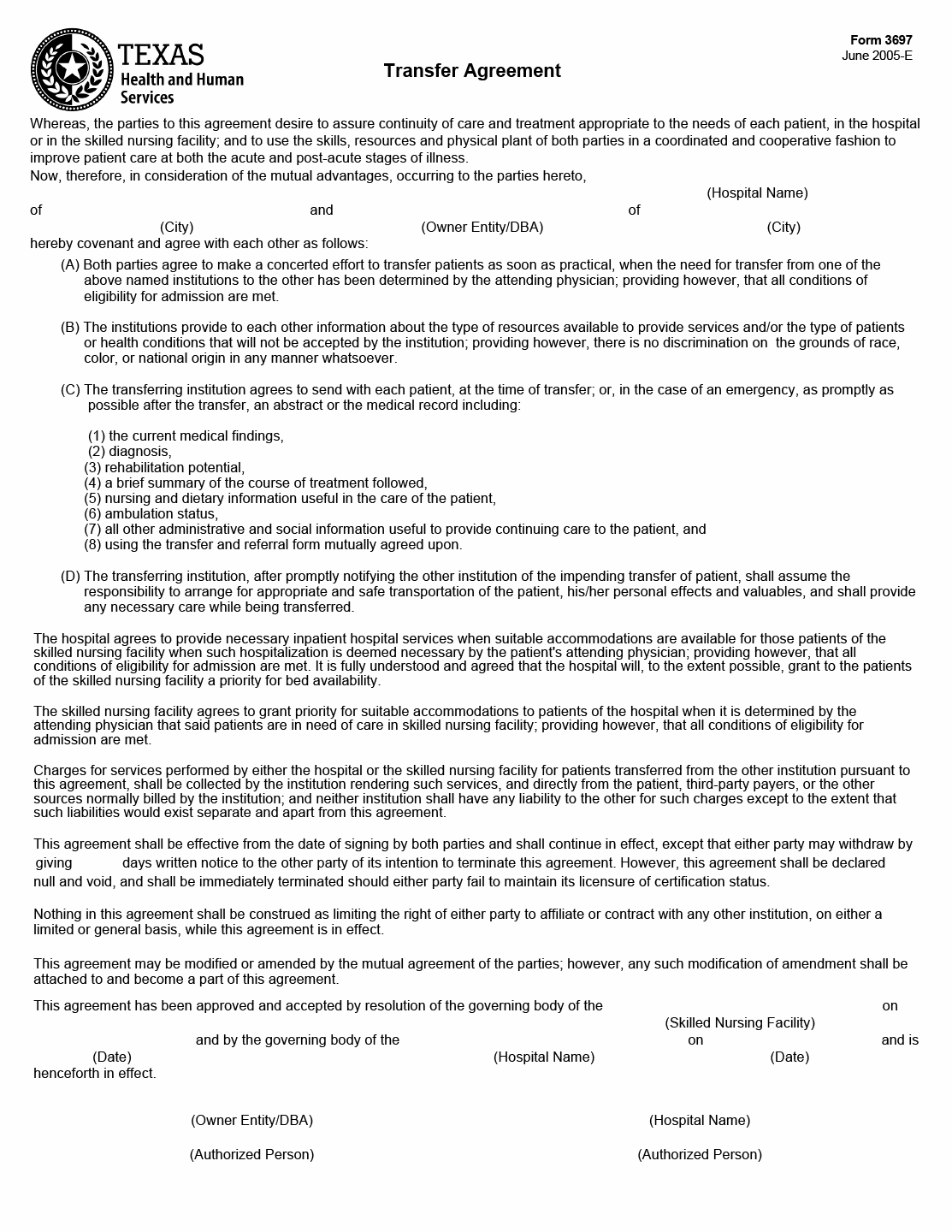
The Transfer Agreement (Form 3697) establishes a formal understanding between hospitals and skilled nursing facilities to ensure the continuity of patient care. It is designed to coordinate resources, information, and responsibilities between institutions, ensuring that patients receive timely and appropriate care across different stages of treatment.
Purpose of the Form
This form serves to:
- Define the procedures for transferring patients between hospitals and skilled nursing facilities.
- Ensure that patient information, medical records, and treatment summaries are accurately communicated.
- Clarify responsibilities for transportation, care during transfer, and allocation of resources.
- Set terms for billing and liability related to transferred patients.
- Ensure compliance with state and federal healthcare regulations and nondiscrimination policies.
Key Sections Explained
Section A – Patient Transfer Agreement
This section establishes that both institutions agree to transfer patients promptly when medically appropriate. The attending physician determines the need for transfer, and all admission eligibility criteria must be met. Common mistake: not verifying patient eligibility before transfer.
Section B – Resource and Acceptance Information
Institutions provide each other with details about available resources and patient types or conditions that may not be accepted. Nondiscrimination based on race, color, or national origin is mandatory. Tip: Always update institutional capabilities and restrictions to avoid delays.
Section C – Medical Records and Documentation
The transferring facility must send an abstract or complete medical record including diagnosis, current medical findings, rehabilitation potential, treatment summary, nursing and dietary information, ambulation status, and other relevant administrative or social information. Emergency transfers require prompt submission. Common mistake: sending incomplete records, which can compromise patient care.
Section D – Transportation and Responsibility
The transferring facility arranges safe transport of the patient and their belongings. Care must be maintained during transfer. The hospital or nursing facility receiving the patient is responsible for providing necessary inpatient services when appropriate. Tip: ensure transport staff are fully briefed on patient needs.
Priority of Accommodations
Hospitals must prioritize beds for skilled nursing facility patients when necessary, and vice versa. This ensures seamless patient flow and reduces wait times. Common mistake: failing to update bed availability or communicate with the other institution.
Billing and Liability
Charges for services rendered to transferred patients are billed directly to patients, third-party payers, or normal sources used by the providing institution. Neither institution is liable for the other's charges outside normal procedures. Tip: maintain clear records of billing agreements to avoid disputes.
Agreement Duration and Termination
The agreement becomes effective upon signing and continues until terminated with written notice by either party. Immediate termination occurs if either party loses licensure or certification. Common mistake: forgetting to provide written notice within required time frames.
Affiliations and Amendments
Institutions retain the right to contract with other organizations. Any amendments must be mutually agreed upon and attached to the original agreement.
Practical Recommendations
- Verify patient eligibility before initiating transfer.
- Keep all medical records complete and updated.
- Communicate bed availability and patient priorities clearly.
- Confirm transportation arrangements, including patient safety and personal belongings.
- Document billing responsibilities to prevent disputes.
Real-Life Examples
- A hospital patient recovering from surgery requires skilled nursing care; the hospital sends the patient with complete medical records to the nursing facility to continue rehabilitation.
- A nursing facility patient experiences a medical complication requiring hospitalization; the facility arranges safe transport and transfers medical records promptly.
- An emergency transfer is needed during off-hours; the hospital and nursing facility coordinate transport and care using the agreed transfer form.
Required Attachments
- Patient medical records and treatment summaries
- Authorized transfer and referral forms
- Any relevant administrative or social documentation
- Proof of institutional licensure or certification
Frequently Asked Questions
Who can initiate a transfer?
Only the attending physician or authorized facility staff can determine the need for transfer.
What documents must accompany a patient?
Medical records, diagnosis, treatment summaries, nursing and dietary information, and any other relevant patient details.
Is transportation included?
The transferring facility is responsible for arranging safe transport, including patient care during transfer.
Can this agreement be terminated?
Yes, either party may terminate with written notice; immediate termination occurs if licensure is lost.
Are there legal consequences for incomplete records?
Yes, failing to provide complete patient information may result in delays, liability issues, or non-compliance with regulations.
Micro-FAQ (Quick Answers)
- Purpose: Coordinate patient transfers between hospitals and nursing facilities.
- Who files: Hospital or skilled nursing facility staff, under attending physician guidance.
- Deadline: Effective immediately upon signing; transfers occur as needed.
- Attachments: Complete medical records, treatment summaries, transfer forms.
- Submitted to: Receiving hospital or skilled nursing facility.
Related Forms
- Admission Agreement Form
- Patient Consent Form
- Medical Records Release Form
- Skilled Nursing Facility Care Plan Form
Form Details
Form Name: Transfer Agreement
Form Number: 3697
Region: Texas
Revision Date: June 2024