
TX HHS Form 3223. Licensed Chemical Dependency Counselor. Counselor Intern and Council on Sex Offender Treatment Complaint
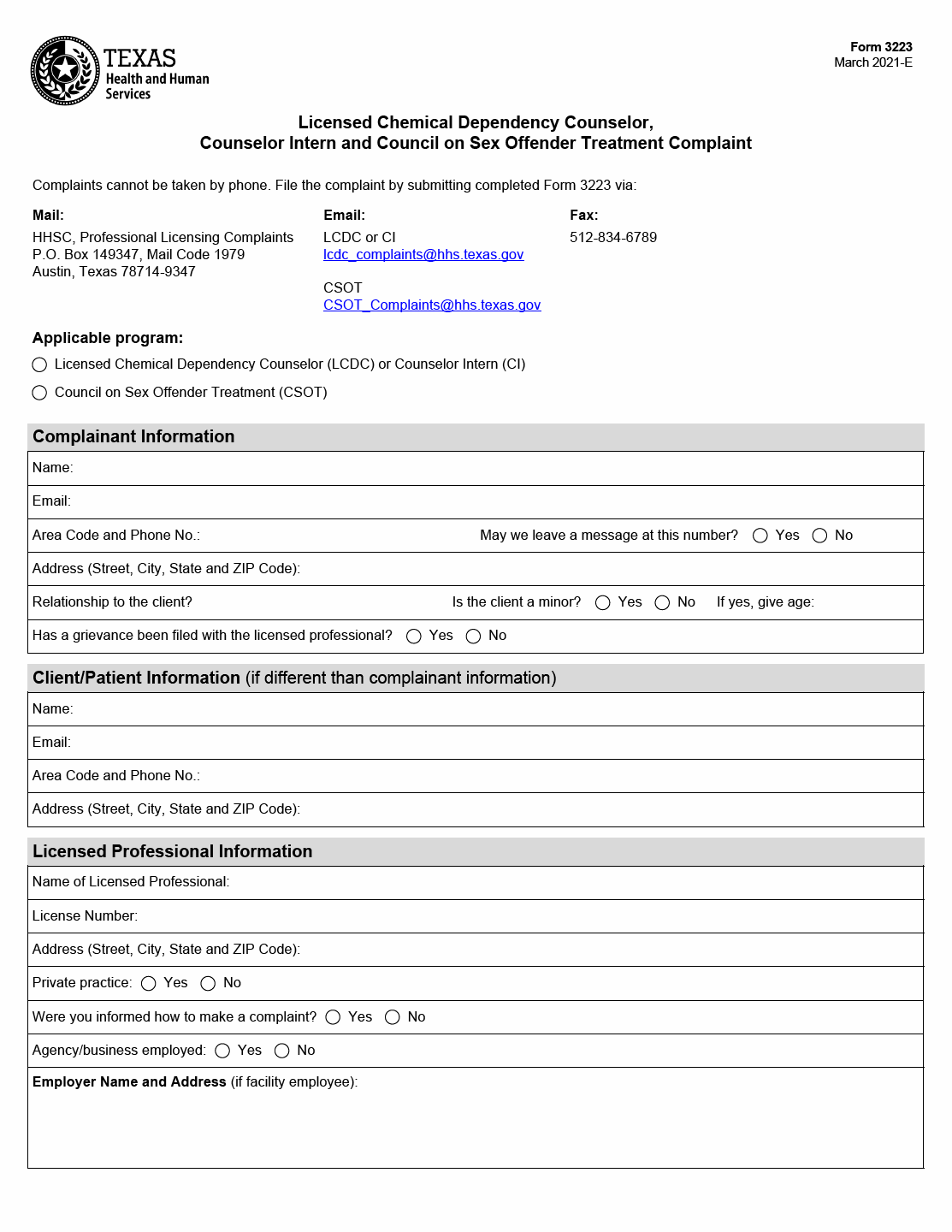
Form 3223 is the official complaint form used in Texas to report concerns about the professional conduct of a Licensed Chemical Dependency Counselor (LCDC), Counselor Intern (CI), or a professional regulated by the Council on Sex Offender Treatment (CSOT). The form allows clients, family members, employers, or other involved parties to submit a written complaint for review by the Texas Health and Human Services Commission (HHSC).
This document creates a formal record of alleged misconduct, ethical violations, or professional concerns and initiates the state’s complaint review process.
Purpose of Form 3223
The main purpose of Form 3223 is to provide HHSC with clear, documented information about potential violations of professional standards. It ensures that complaints are submitted in a consistent format and include the details needed for proper review and investigation.
This form is required because complaints against licensed counselors and CSOT-regulated professionals cannot be accepted by phone and must be submitted in writing.
When This Form Must Be Used
Form 3223 must be used when someone wants to formally report concerns about:
- Unprofessional or unethical conduct
- Boundary violations or inappropriate behavior
- Failure to meet professional standards
- Possible harm to a client or patient
- Violations of licensing rules or program requirements
The form is not required for informal complaints, general feedback, or situations that fall outside HHSC’s jurisdiction. It is also not a replacement for emergency reporting when immediate safety concerns exist.
Who May File the Complaint
Form 3223 may be completed by a wide range of individuals, including:
- Clients or patients receiving services
- Parents or legal guardians of minor clients
- Family members or concerned parties
- Employers or coworkers
- Other professionals or members of the public
The complainant does not need to be the client, but must provide accurate and truthful information.
Explanation of Each Key Section
Applicable Program
This section identifies whether the complaint involves an LCDC, Counselor Intern, or a CSOT-regulated professional. Selecting the correct program ensures the complaint is routed to the appropriate oversight authority.
Complainant Information
This section collects contact details for the person submitting the complaint. It includes name, address, phone number, email, and relationship to the client. The form also asks whether the client is a minor and whether a grievance was previously filed with the professional.
Client or Patient Information
If the complainant is not the client, this section captures the client’s identifying and contact information. Accurate information helps investigators understand the context of the complaint.
Licensed Professional Information
This section identifies the professional involved, including name, license number, practice setting, and employer information. Providing correct license details is critical for processing the complaint.
Complaint Information
This is the most important part of the form. The complainant must provide specific, detailed information explaining:
- Who was involved
- What happened
- When and where the incident occurred
- How the issue arose
- Why the behavior is concerning
Supporting documents may be attached to strengthen the complaint.
Affirmation and Signature
The complainant must affirm that the information provided is true and correct to the best of their knowledge. This statement underscores the seriousness of the submission.
Practical Tips for Completing Form 3223
- Be factual and specific rather than emotional or vague.
- Include dates, locations, and names whenever possible.
- Attach relevant documents, emails, or records if available.
- Confirm the license number before submitting.
- Keep a copy of the completed form for your records.
Common Mistakes to Avoid
- Submitting incomplete contact information
- Leaving out key dates or details
- Filing a complaint outside HHSC jurisdiction
- Using the form for emergencies instead of proper channels
- Providing unsupported or speculative statements
Legal and Regulatory Context
Form 3223 is governed by Texas regulations overseeing chemical dependency counselors and CSOT professionals. State law requires written complaints to ensure fairness, documentation, and due process. The information provided may be reviewed to determine whether an investigation, disciplinary action, or referral is appropriate.
Submitting false information may have legal consequences, while substantiated complaints can affect a professional’s license status.
Real-Life Situations Where This Form Is Used
- A client reports inappropriate conduct by a counselor during treatment.
- A parent files a complaint regarding services provided to a minor.
- An employer reports concerns about ethical violations.
- A former client submits documentation of repeated professional misconduct.
Documents Commonly Attached to This Form
- Written statements or timelines
- Email or text message correspondence
- Treatment records or summaries
- Facility or employer documentation
Frequently Asked Questions
Can I submit a complaint by phone?
No, complaints must be submitted in writing using Form 3223.
Can I file the complaint by email?
Yes, the completed form may be submitted by email.
Do I need proof to file a complaint?
You may file without documents, but supporting evidence is helpful.
Will I be contacted after submission?
HHSC may contact you if additional information is needed.
Can I file anonymously?
Providing contact information is strongly encouraged for follow-up.
Does filing a complaint guarantee discipline?
No, each complaint is reviewed to determine appropriate action.
Related Forms
- Professional Licensing Inquiry Forms
- Grievance Forms for Health Care Facilities
- Ethics Complaint Documentation
Form Details
- Form Name: LCDC, Counselor Intern and CSOT Complaint Form
- Form Number: 3223
- Regulating Authority: Texas Health and Human Services Commission
- State: Texas
- Revision Date: March 2021