
TX HHS Form 2405. Affidavit for Risk Evaluation by Child Placing Agency
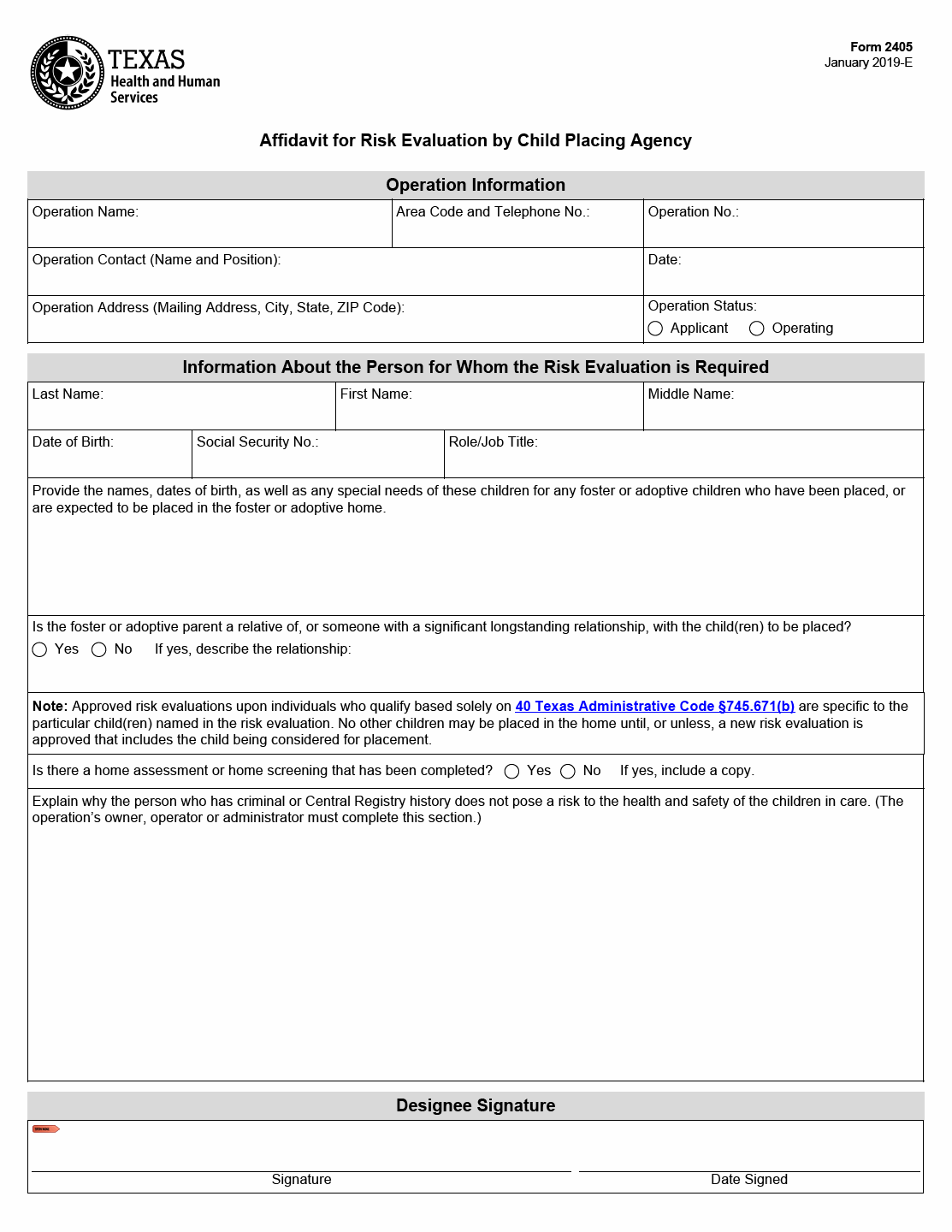
Form 2405 — Affidavit for Risk Evaluation by Child Placing Agency — is a mandatory document used in Texas when a foster or adoptive home includes (or plans to include) a person with a criminal history or a record in the Texas Central Registry. The goal of this affidavit is not to grant automatic approval but to allow a child-placing agency to formally explain why this individual does not pose a danger to children in care.
This form often becomes relevant in emotionally difficult situations: when families are trying to adopt a relative’s child, when a long-standing foster parent has an old conviction, or when a household member’s past unexpectedly surfaces during a routine background check. Because risk evaluations directly impact child safety, the state requires detailed justification and formal documentation.
Purpose of Form 2405
This affidavit is designed to help licensing officials evaluate whether a person with a flagged background can safely remain or be added to a foster or adoptive household. It provides the child-placing agency with space to outline the circumstances, supporting facts, and reasons why this person should be approved despite past history.
Under Texas Administrative Code §745.671, certain individuals may be eligible for a risk evaluation. In these cases, approval applies only to the specific children named in the affidavit. No additional children may be placed until a new risk evaluation is approved.
Breakdown of Key Sections
Operation Information
This section identifies the child-placing agency or operation submitting the affidavit. It includes:
- Operation name and contact information
- Operation number
- Mailing address and status (applicant or operating)
- Name and position of the person completing the form
Common mistake: Agencies sometimes list physical instead of mailing addresses or omit the operation number, which delays processing.
Information About the Person Requiring the Risk Evaluation
This section captures the identity of the individual whose background triggered the review:
- Full legal name
- Date of birth
- Social Security number
- Role or job title within the home or operation
Accurate identification is essential because state systems verify each detail. Even minor errors (e.g., incorrect date of birth) may invalidate the evaluation.
Information About the Children in Placement
The agency must list all foster or adoptive children currently in the home or expected to be placed there. Information must include:
- Names
- Dates of birth
- Special needs (if any)
The form also asks whether the caregiver is a relative or has a long-standing relationship with the children — a factor that can influence the evaluation under §745.671(b).
Home Assessment or Screening
If a home study has already been completed, a copy should be attached. This helps the state understand the household environment, supervision plan, and readiness to care for children.
Risk Explanation Section
This is the most critical part of the affidavit. The operation’s owner, operator, or administrator must explain why the person with a flagged background does not pose a risk. Strong explanations usually include:
- Context of the past criminal or registry history
- Evidence of rehabilitation (employment, counseling, stable living environment)
- Factors indicating low likelihood of repeat behavior
- Protective measures currently in place
Important: Generic statements like “He is a good person now” are insufficient. The state expects factual, concrete reasoning.
Signatures
The designee must sign and date the affidavit. Unsigned forms cannot be reviewed.
Practical Recommendations
- Double-check all identifying information for accuracy.
- Attach the home study if available — it significantly strengthens the evaluation.
- Provide detailed, evidence-based explanations of why the person is safe around children.
- Include supporting documents such as completion of counseling, certificates, or letters from professionals.
- Avoid vague justifications; clarity and specifics speed up approval.
Examples of Real-World Situations
- Relative adoption: A grandmother seeks to adopt her grandchild, but her adult son living in the home has an old non-violent offense. The agency files Form 2405 explaining why he does not pose a risk.
- Long-time foster parent: A foster parent’s background check reveals an outdated record from decades ago. The agency submits the affidavit so she can continue fostering.
- Household member with past substance-related charge: The agency outlines rehabilitation steps and current stability to justify approval.
- Unexpected registry flag: During a placement expansion, an adult sibling in the home shows up in the registry. The agency completes Form 2405 before new children can be placed.
Documents Commonly Attached
- Home assessment or screening report
- Letters of reference from counselors or community leaders
- Proof of completion of courses or rehabilitation programs
- Court records explaining the original incident
- Safety plans or supervision agreements
FAQ
What is Form 2405 used for?
It documents why a person with a criminal or Central Registry history does not pose a threat to children in a foster or adoptive home.
Who completes this affidavit?
The operation’s owner, operator, or administrator — not the individual with the history.
Is approval guaranteed?
No. State officials evaluate the explanation and determine whether risk is acceptable.
Do I always need a home study?
No, but including one strengthens the evaluation and speeds up review.
Can this approval apply to all future placements?
No. Under §745.671(b), approval typically applies only to the specific children named.
What happens if information is incorrect?
Processing may be delayed or the evaluation may be denied.
How long does review take?
Timelines vary, but complete and well-supported affidavits move faster.
Micro-FAQ
- Purpose? To justify why a flagged individual is safe for child placement.
- Who files? The child-placing agency or operation.
- When required? Anytime a person in the home has criminal or registry history.
- Attachments? Home study, letters, rehabilitation proof.
- Submitted to? Texas child-care licensing authorities.
- Covers all children? No — only those listed.
- Signed by? Operation owner or administrator.
- Legal effect? Allows state to evaluate potential safety risks.
- Error impact? May delay or deny approval.
- Home study required? Not mandatory, but recommended.
Related Forms
- Form 2972 – Request for Background Check
- Form 2962 – Verification of Foster Family Home
- Form 2404 – Affidavit for Immediate Risk Evaluation
- Texas Adoption and Foster Care Home Screening Forms
Form Details
- Form Name: Affidavit for Risk Evaluation by Child Placing Agency
- Form Number: 2405
- State: Texas
- Edition: January 2019-E
- Issuing Agency: Texas Department of Family and Protective Services