
Form LIC 702. Child's Preadmission Health History - Parent/Authorized Representative Report - California
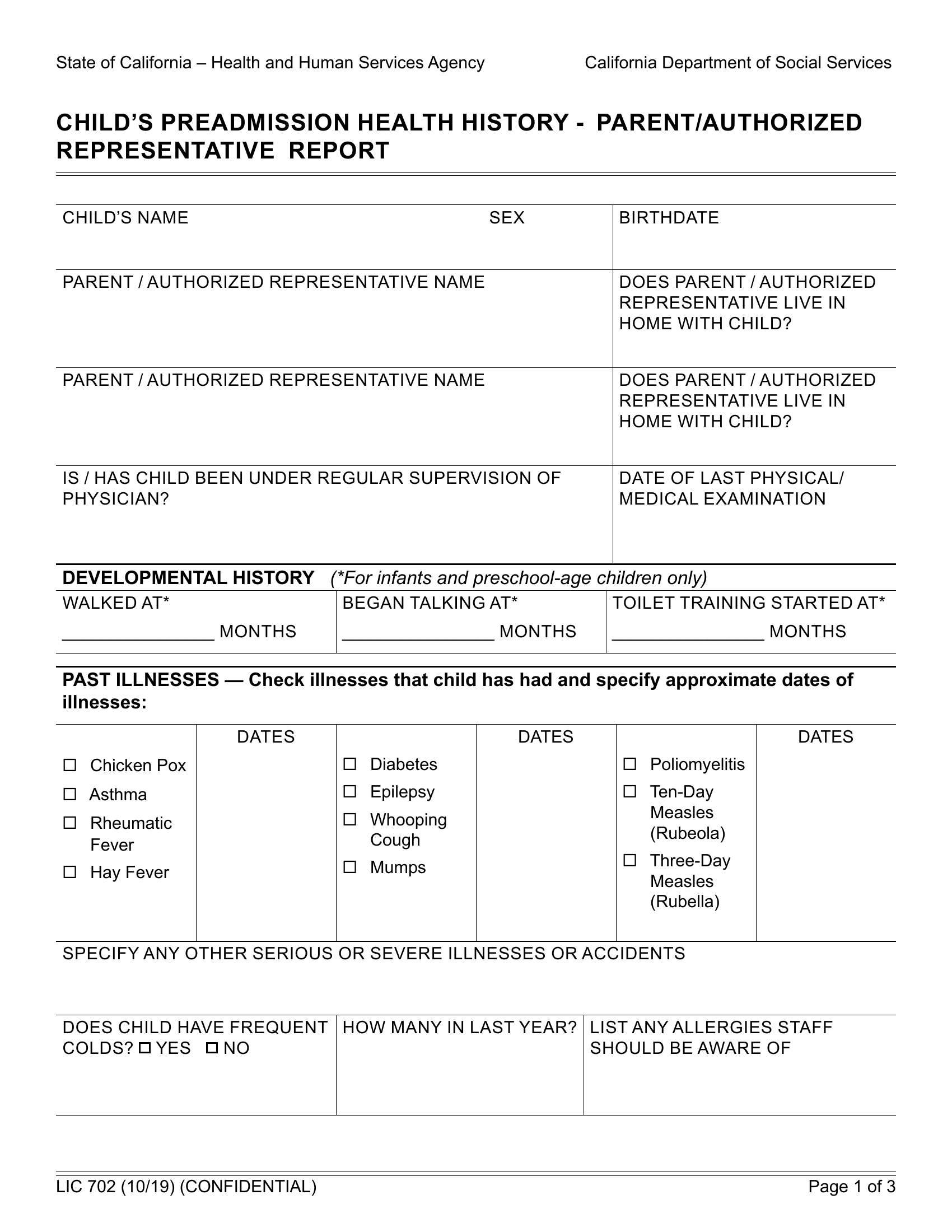
The “Child’s Preadmission Health History – Parent/Authorized Representative Report” (Form LIC 702) is a standard document required by licensed child care centers across California. Before a child is admitted, facilities must review essential health and developmental information to ensure they can provide safe, appropriate care. This form allows parents and authorized representatives to share a child’s routines, medical history, and individual needs in a clear, structured way. Although it may look straightforward, it has important legal implications: the accuracy of the information directly affects the child’s safety and the provider’s ability to meet state regulatory requirements under the California Code of Regulations, Title 22.
Purpose and Legal Background
Form LIC 702 is mandated for all children entering licensed child care programs in California. The California Department of Social Services requires childcare facilities to gather detailed health and behavioral history before admission. The information helps providers identify medical risks, ensure appropriate supervision, and tailor routines for infants and preschool-aged children. Completing the form is not optional: it is part of the facility’s compliance obligations and an important safeguard for the child.
Only a parent or an individual legally authorized to make decisions for the child may complete and sign this form. Providing accurate and complete information is crucial—omissions may delay enrollment or lead to inappropriate care routines that could put the child at risk.
Overview of Key Sections
Child Identification Section
This portion requests the child’s name, sex, and birthdate, along with the names of the parent(s) or authorized representatives. The form also asks whether each listed adult lives in the same home as the child—useful for understanding family context and determining who may be contacted during emergencies.
Medical Supervision and Last Examination
Here, parents state whether the child is under the regular supervision of a physician and the date of the most recent medical exam. Many facilities require the exam to be recent (typically within 12 months), so missing dates can create delays.
Developmental History (Infants and Preschool-Age Children)
This section gives providers insight into key developmental milestones: when the child first walked, talked, or began toilet training. This helps staff understand expectations and identify possible developmental delays or special support needs.
Past Illnesses and Allergies
Parents check off any prior illnesses, such as chickenpox, asthma, mumps, or measles, and provide approximate dates. There is also space to describe serious accidents or conditions not listed. Equally important is the allergy section—child care staff rely heavily on this information to prevent adverse reactions, especially to foods or medications.
Daily Routines (Infants and Preschool-Age Children)
This part outlines the child’s sleep schedule, nap patterns, typical diet, eating times, dislikes, and feeding problems. For younger children, predictable routines help maintain stability in a group care environment.
Toilet Habits
Parents indicate whether the child is fully or partially toilet trained, the usual time of bowel movements, and specific vocabulary the child uses. This prevents misunderstandings and helps caregivers maintain consistent bathroom routines.
Health Evaluation and Medical Needs
Parents report whether the child is under medical care, takes prescribed medication, or uses special devices such as inhalers or orthotic supports. Child care staff must know this information to prepare appropriately and respond in emergencies.
Personality, Social Behavior, and Special Needs
This narrative section describes how the child interacts with family members and peers, whether they have experience in group settings, and any fears, emotional needs, or behavioral concerns. Providers rely on this portion to plan transitions and support emotional wellbeing.
Illness Care Plan and Reason for Daycare
Finally, parents explain what arrangements are typically made when the child becomes ill and briefly describe the reason for requesting daycare placement. These details offer valuable context for caregivers and administrators.
Practical Tips for Completing the Form
- Provide approximate dates for illnesses even if exact dates are unknown—staff mainly need general timelines.
- Be specific about allergies and reactions (e.g., “rash from strawberries,” “hives after amoxicillin”).
- If medications are involved, list both name and purpose to help staff understand urgency and side effects.
- Use the personality section to flag important details: separation anxiety, difficulty napping, sensitivity to noise, etc.
- Double-check that the signature and date are included—many facilities cannot accept the form without them.
Examples of Real-World Use
- Infant starting full-time care: A parent notes the baby’s nap schedule and formula brand so caregivers can replicate home routines.
- Preschooler with asthma: Parents specify triggers and list the child’s inhaler under “special devices,” ensuring staff are prepared.
- Child with food allergies: A family documents dairy and nut allergies, helping the center adjust meal plans.
- Toddler transitioning to toilet training: Parents explain that the child uses a certain word for “bathroom,” preventing confusion during the day.
Documents Commonly Required Alongside This Form
- Recent medical examination record or physician’s report
- Immunization record (e.g., California “Blue Card”)
- Medication administration authorization, if applicable
- Allergy or emergency action plans for conditions like asthma or diabetes
FAQ
Who must complete Form LIC 702?
Only a parent or an authorized representative with legal permission to make decisions for the child may fill out and sign the form.
Is this form mandatory for all child care centers?
Yes. Licensed childcare facilities must collect this form before admission to comply with California Title 22 regulations.
What if I do not know exact dates of past illnesses?
Approximate dates are acceptable. Staff simply need a general understanding of medical history.
Do I need to update the form annually?
Some centers request annual updates, especially if there are new medical conditions, medications, or routine changes.
Can I mention over-the-counter medications?
Yes. If they are taken regularly or may affect care, they should be listed.
What happens if I forget to disclose allergies?
This may create significant health risks. Allergies should always be disclosed, including mild ones.
Is a doctor's signature required?
No. The form is filled out and signed by the parent or authorized representative only.
Micro-FAQ (Quick Answers)
- Purpose: To provide a child’s medical and developmental history before daycare admission.
- Who completes: Parent or authorized representative.
- Deadline: Before the child’s first day of attendance.
- Attachments: Immunization record, medical exam report, medication plans.
- Submitted to: Licensed child care center or preschool.
- Is it confidential? Yes, the form is kept in the facility’s confidential child file.
- Age range: Required for infants, toddlers, and preschoolers; often used for older children as well.
- Legal basis: California Code of Regulations, Title 22.
Navigation
- Related forms
- Other forms
- Legal guides and instructions
Form Details
- Form name: Child’s Preadmission Health History – Parent/Authorized Representative Report
- Form number: LIC 702
- Region: State of California
- Agency: California Department of Social Services
- Revision date: 10/2019