
Form LIC 9158. Telecommunications Device Notification
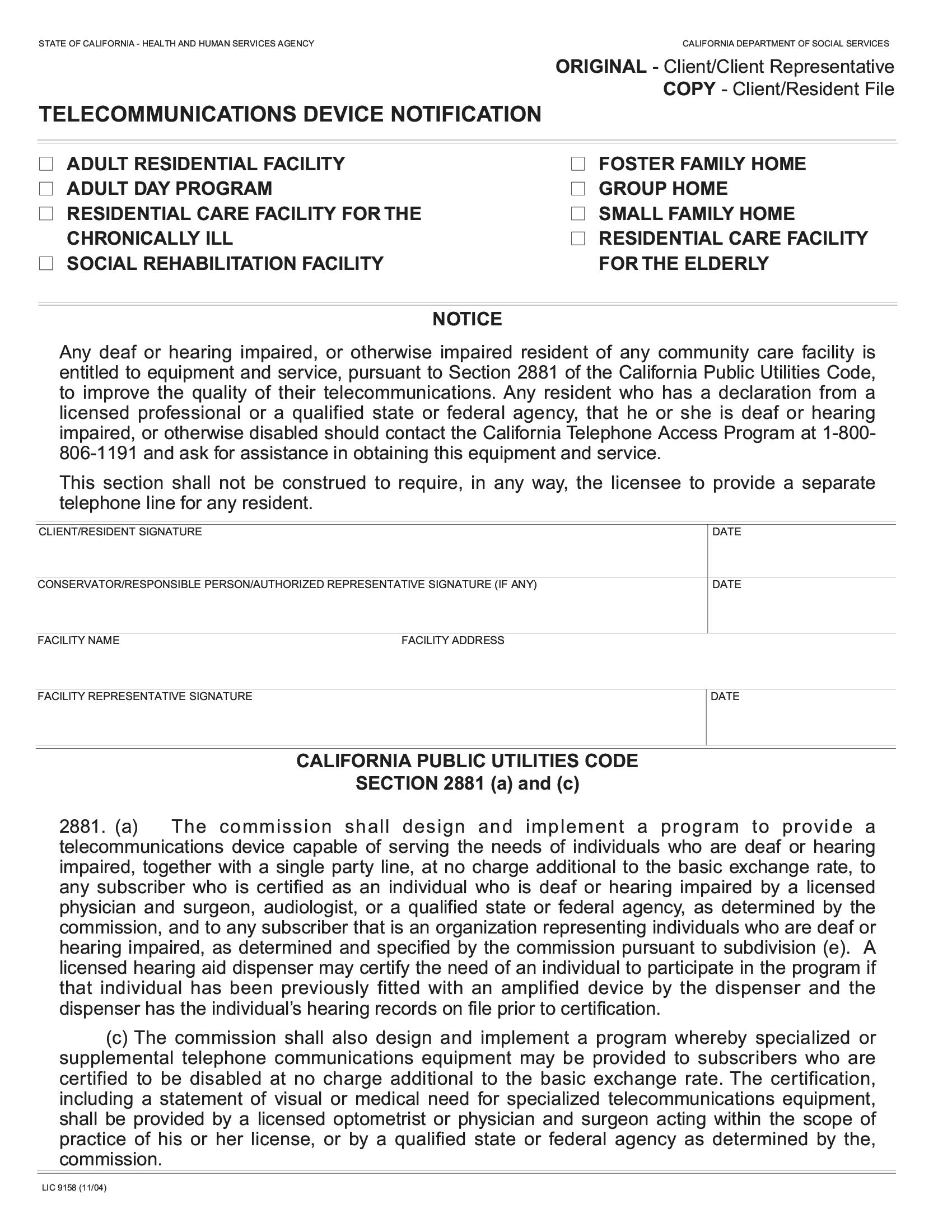
The “Telecommunications Device Notification” form is a short but legally significant document used in California community care facilities. Its purpose is to ensure that residents who are deaf, hard of hearing, or otherwise medically impaired are properly informed about their right to receive specialized telecommunications equipment through the California Telephone Access Program (CTAP). Although the form looks simple, it serves as a compliance tool for facilities and a point of protection for residents. Below you will find a practical, expert-level explanation of how and why this document is used.
Purpose of the Form
This form exists to document that a resident—or their authorized representative—has been informed about available telecommunications assistance under Section 2881 of the California Public Utilities Code. Community care facilities are legally required to notify eligible residents about this program, but they are not required to provide the equipment themselves. The form creates a written record that the resident received this information, which protects both the resident’s rights and the facility’s regulatory compliance.
The notice applies to many types of licensed facilities: Adult Residential Facilities, Group Homes, Foster Family Homes, Residential Care Facilities for the Elderly, Social Rehabilitation Facilities, Small Family Homes, Adult Day Programs, and facilities serving residents with chronic illnesses.
Explanation of Key Sections
1. Notification Statement
This paragraph explains the resident’s legal right to receive telecommunications equipment—such as TTY devices, amplified phones, or other assistive devices—at no additional charge beyond the basic phone rate. The eligibility must be confirmed by a licensed professional (physician, audiologist, optometrist, etc.) or a qualified state or federal agency.
A common misunderstanding is that the facility must install or fund equipment. The notice clarifies that this obligation does not extend to providing separate telephone lines or infrastructure.
2. Client/Resident Signature Section
The resident signs here to confirm they received and understood the notification. If the resident is unable to sign or has a legal representative, the conservator or authorized person may sign instead. Staff should make sure the signer understands what they are acknowledging.
3. Facility Information and Representative Signature
The facility lists its name and address and provides a staff signature. This establishes proof that the required notice was delivered. Facilities often keep a copy in the resident’s file to show auditors or licensing inspectors.
4. Legal Excerpt (California Public Utilities Code §2881)
The form includes the legal foundation for the program. Subsection (a) describes the provision of telecommunications devices for individuals who are deaf or hearing impaired, and subsection (c) explains the availability of specialized equipment for other disabilities. Including the statutory language ensures transparency and shows that the rights described are grounded in state law.
Practical Guidance for Completing the Form
- Explain the purpose clearly to the resident. Many residents may not be familiar with CTAP or assistive telecommunications devices.
- Confirm that the signer understands their rights. Avoid rushing through this; it may be reviewed later during inspections.
- Double-check facility information. Incomplete facility data is a common mistake and can cause compliance issues.
- Keep copies organized. One copy goes to the resident; the facility keeps another in the resident’s file.
- Attach relevant declarations if available. Although not required at signing, any medical certifications supporting the resident’s eligibility can be filed with the form.
When Filing Is Required
The form must be completed for any resident who may qualify for telecommunications assistance. Facilities typically present it during intake or shortly afterward. If a resident’s hearing or disability status changes later, the facility may reissue the notification.
Residents who do not have impairments do not need the equipment, but the facility may still present the notice as part of its standard admission packet to ensure consistent compliance.
Common Errors to Avoid
- Leaving the date fields blank.
- Allowing a resident to sign who does not understand the document.
- Misleading residents into thinking the facility must purchase equipment.
- Failing to provide a copy to the resident or representative.
Real-World Situations Where the Form Is Needed
- A new resident with documented hearing loss moves into a Residential Care Facility for the Elderly. Staff must provide the notification and ensure the resident knows how to contact CTAP.
- A conservator enrolls an adult with disabilities into a Group Home. The conservator signs the form on the resident’s behalf after reviewing the CTAP program.
- A foster parent caring for a hearing-impaired child in a Foster Family Home. The form is used to confirm the family has been advised of available equipment.
- An Adult Residential Facility admits a resident who later obtains a medical certification of impairment. The facility issues the notice again and updates the file.
Documents That May Be Needed
- Medical certification of hearing impairment or disability.
- Professional assessment from a physician, audiologist, optometrist, or licensed hearing aid dispenser.
- Agency determination (state or federal) confirming eligibility.
- Resident admission documents (internal facility paperwork).
FAQ
Who needs to sign this form?
The resident signs if able; otherwise an authorized representative or conservator may sign.
Does this form obligate the facility to install special phone lines?
No. The law explicitly states that facilities are not required to provide separate lines or equipment.
Is medical certification required before signing?
No. Certification is required for obtaining equipment, not for acknowledging the notification.
Where does the resident request the equipment?
Residents contact the California Telephone Access Program (CTAP) directly at the phone number provided on the form.
Is the form mandatory for all residents?
It is required for residents who may qualify but is often given to all new residents to maintain consistent compliance practices.
How long should the facility keep copies?
Facilities generally keep copies in the resident file for the duration of residency and any required retention period after discharge.
What happens if the form is not completed?
Facilities may face compliance issues during licensing reviews, and residents may miss out on important services.
Micro-FAQ
- Purpose: To confirm residents were informed of their right to telecommunications assistance.
- Who signs: Resident or authorized representative.
- When filed: During admission or when impairment is identified.
- Attachments: Optional medical certification for equipment eligibility.
- Submitted to: Kept in facility records; equipment requests go to CTAP.
- Legal basis: California Public Utilities Code §2881.
- Scope: Applies to many licensed care facility types.
- Cost: Equipment is provided at no extra charge beyond basic service.
- Effect: Ensures residents are informed of their telecommunications rights.
Record Details
Form Name: Telecommunications Device Notification
Form Number: LIC 9158
Jurisdiction: State of California, Department of Social Services
Latest Revision: 11/04
Navigation
- Related forms
- Other forms
- Legal guides and instructions